
Ancient craft, modern hobby: Moses Lake woman spins and colors her own wool
CHARLES H. FEATHERSTONE | Hagadone News Network | UPDATED 5 years, 5 months AGO
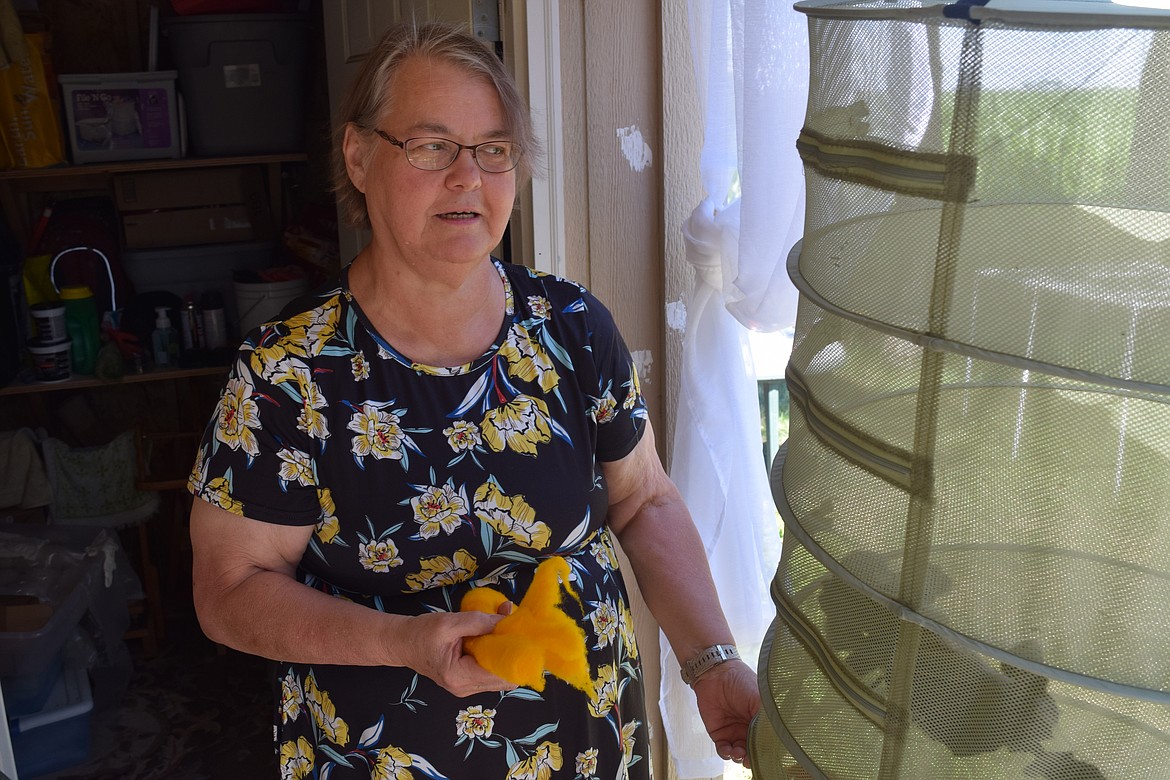
Loveta Boyce stands out back of her home south of Moses Lake, where she cards, dyes and spins wool.
Charles H. Featherstone/Columbia Basin Herald
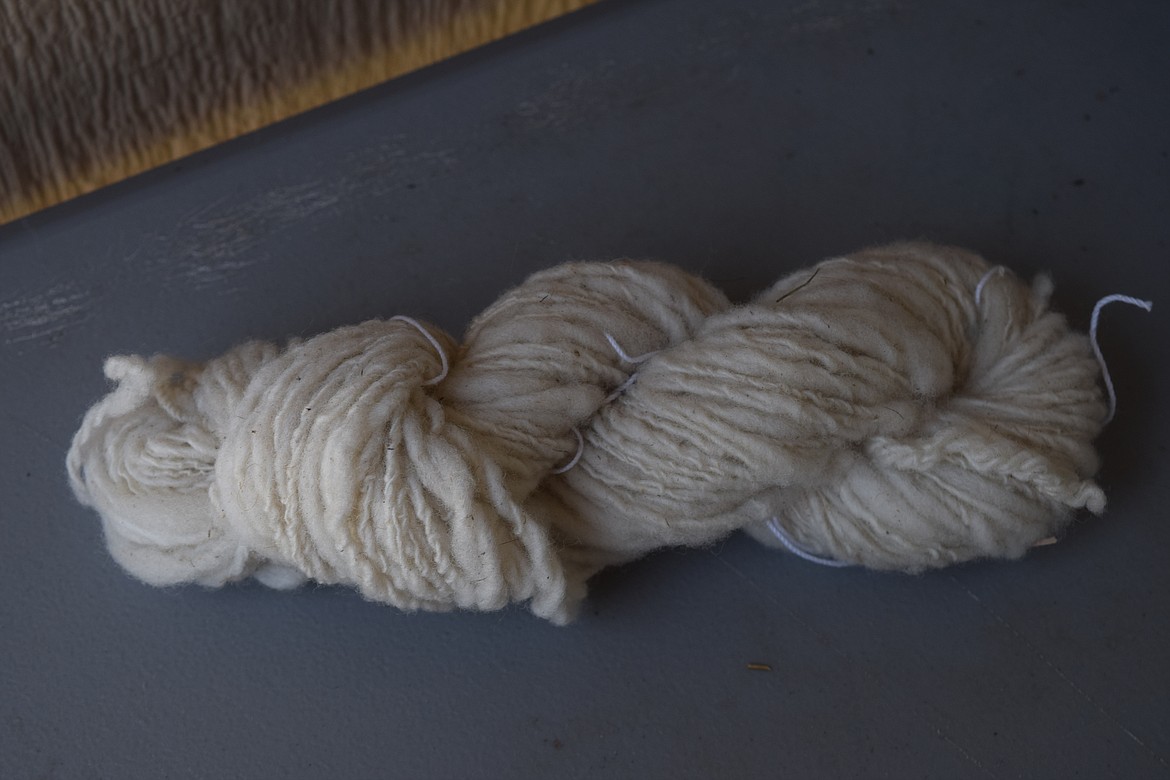
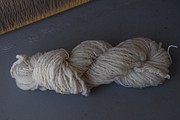
A skein of coarsely spun wool yard.
Charles H. Featherstone/Columbia Basin Herald
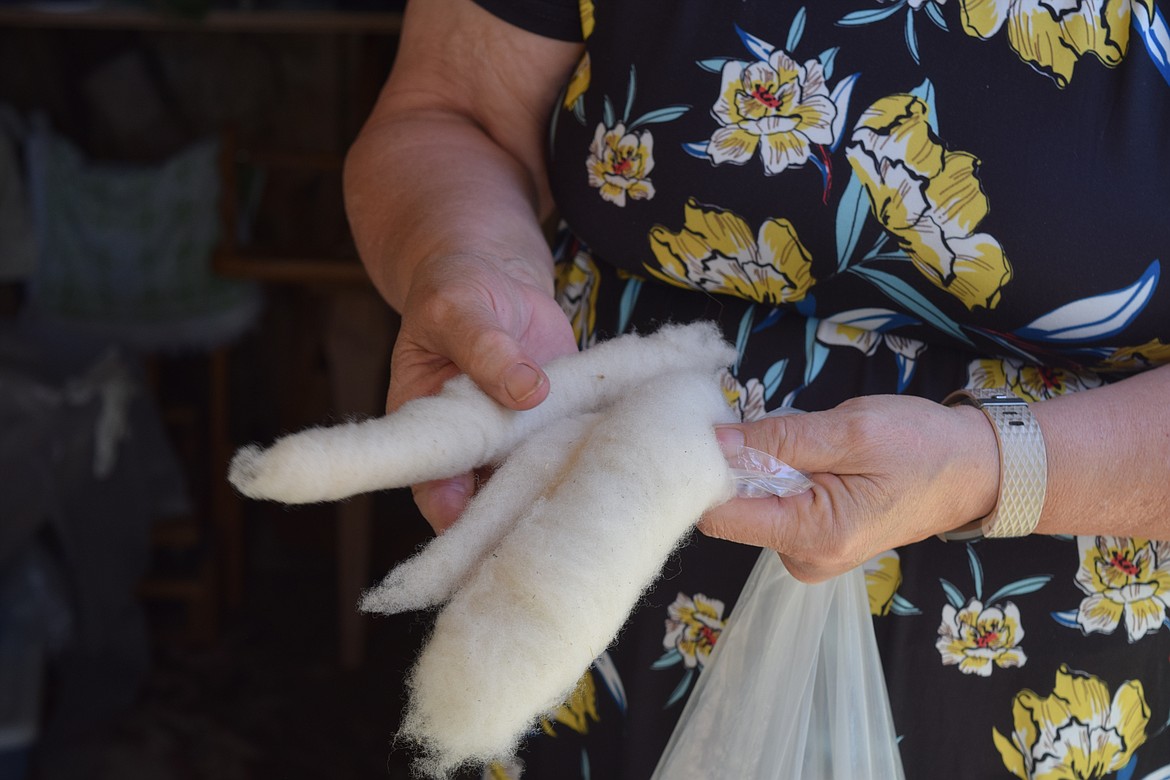
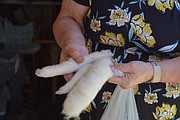
Loveta Boyce holds up several “rolags” of carded wool.
Charles H. Featherstone/Columbia Basin Herald
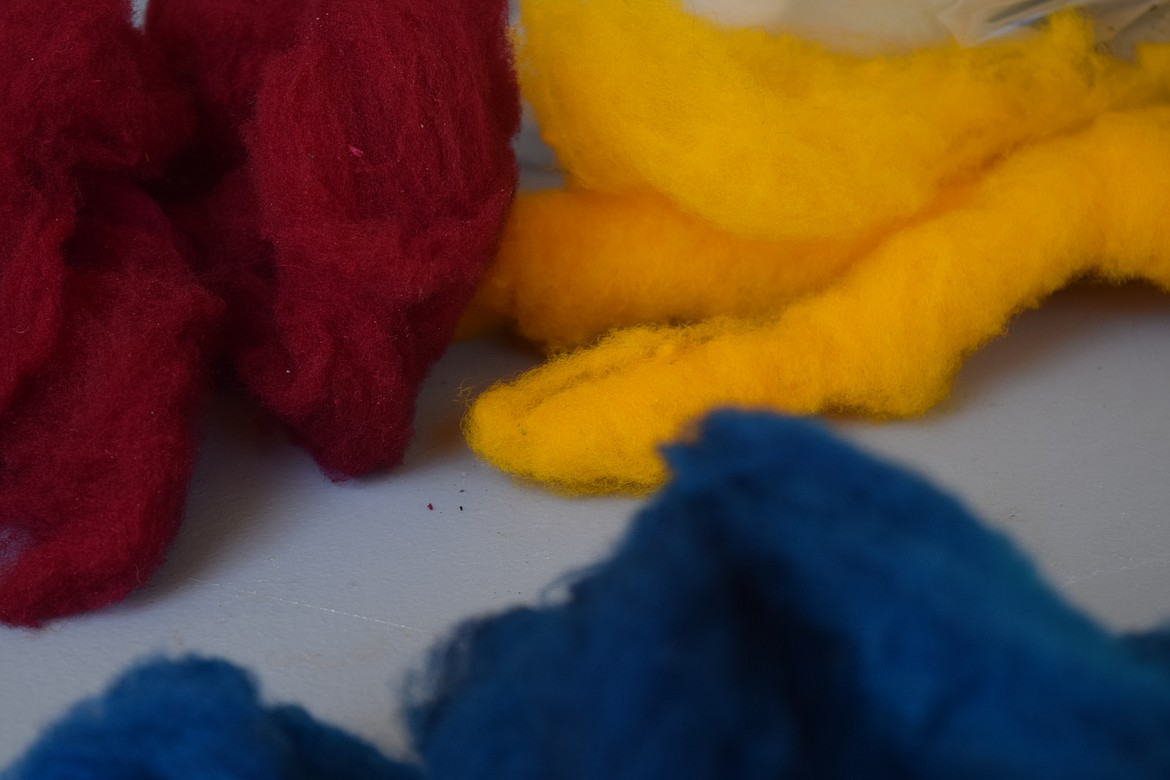
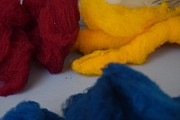
Dyed wool.
Charles H. Featherstone/Columbia Basin Herald
MOSES LAKE — You can weave a basket out of wool that you can boil water in.
Not by setting the basket on a fire, of course. But people have used woven pots to cook, boiling water by adding slowly heated stones to woolen, tree bark or plant-fiber baskets woven tightly enough to make them waterproof.
Loveta Boyce doesn’t make those kinds of baskets. But knowing that people have been weaving for thousands of years is one reason she cards and dyes wool, as well as spinning it into string and even weaving it.
“No culture ever went on to make a pottery pot that didn’t start out making string,” Boyce said. “You can weave a basket to boil water in it, and people did that before they made a clay pot.”
Born in Montana, Boyce said she grew up on a ranch midway between Othello and Moses Lake, and was always surrounded by livestock. So much so, she said, that while other farmers “had dirt in their veins,” her father “had manure.”
Describing herself only as “retired,” Boyce said she has taught school and worked in finance and medical billing, but since retiring five years ago has devoted herself to working with wool as a way of keeping herself busy.
“I always loved fiber,” she said. “It keeps me out of everyone’s hair. If I don’t have something to do I pester people.”
Boyce, who said she’s currently working with wool from a niece’s 4-H project, said that carding disentangles and lines up wool fibers — each one a hair on a sheep’s body when it is sheared.
Carded wool is formed into “rolags,” or small rolls, that can then be spun into string or yarn or matted together into felt.
“Wool has scales on the fiber and so as you spin those together, the scales catch on each other, and that’s what helps hold it together,” she said. “It sticks on itself.”
On this bright Sunday afternoon, however, Boyce isn’t spinning. She’s got her dyeing equipment set up outside. It’s messy work, dyeing wool, and she prefers to do it outside so she doesn’t make a mess in her kitchen. Dyeing involves heating water and basically cooking rolags at just below boiling in a mixture of dye and an acidic substance — citric acid or vinegar — to fix the color.
Boyce then said she will let the wool cool overnight, pull it out and dry it.
While she usually uses professional acid dyes, Boyce said a recent project with her nieces and nephews had them dyeing wool with unsweetened Kool-Aid.
“The colors that we use in food to dye things are pretty highly regulated, and they are the same as acid dyes and already has citric acid in it,” she said.
Once they’re dyed, Boyce lets the woolen rolags dry outside in the sun for a few days, and then will eventually spin them into yarn. The secret to spinning is making yarn or string a consistent width, Boyce said, something she tried to do this year during the “Tour de Fleece,” an event the world’s spinners undertake during the Tour de France bicycle race.
Boyce held up a small skein of undyed, unevenly-spun yarn, some portions thicker than others. She spun it herself, and is not quite sure what she will do with it. It might make a good sweater, she said.
“I’ve always loved to weave. I’ve got a big loom and several smaller looms,” she said. “Tapestry weaving, that’s where most of this will go.”
In the end, it’s not so much about the final product as it is about simply being involved in something people started doing long ago.
“It’s kind of satisfying,” Boyce said. “We take thread for granted in our culture. To think that’s where our technology started.”
Charles H. Featherstone can be reached at [email protected].
ARTICLES BY CHARLES H. FEATHERSTONE
Potato prices up, sales down for first quarter 2023
DENVER — The value of grocery store potato sales rose 16% during the first three months of 2023 as the total volume of sales fell by 4.4%, according to a press release from PotatoesUSA, the national marketing board representing U.S. potato growers. The dollar value of all categories of U.S. potato products for the first quarter of 2023 was $4.2 billion, up from $3.6 billion for the first three months of 2022. However, the total volume of potato sales fell to 1.77 billion pounds in the first quarter of 2023 compared with 1.85 billion pounds during the same period of 2022, the press release noted. However, total grocery store potato sales for the first quarter of 2023 are still above the 1.74 billion pounds sold during the first three months of 2019 – a year before the outbreak of the COVID-19 pandemic, the press release said.

WSU Lind Dryland Research Station welcomes new director
LIND — Washington State University soil scientist and wheat breeder Mike Pumphrey was a bit dejected as he stood in front of some thin test squares of stunted, somewhat scraggly spring wheat at the university’s Lind Dryland Research Station. “As you can see, the spring wheat is having a pretty tough go of it this year,” he said. “It’s a little discouraging to stand in front of plots that are going to yield maybe about seven bushels per acre. Or something like that.” Barely two inches of rain have fallen at the station since the beginning of March, according to station records. Pumphrey, speaking to a crowd of wheat farmers, researchers, seed company representatives and students during the Lind Dryland Research Station’s annual field day on Thursday, June 15, said years like 2023 are a reminder that dryland farming is a gamble.

Wilson Creek hosts bluegrass gathering
WILSON CREEK — Bluegrass in the Park is set to start today at Wilson Creek City Park. The inaugural event is set to bring music and visitors to one of Grant County’s smallest towns. “I've been listening to bluegrass my whole life,” said the event’s organizer Shirley Billings, whose family band plays on their porch every year for the crowd at the Little Big Show. “My whole family plays bluegrass. And I just wanted to kind of get something for the community going. So I just invited all the people that I know and they’ll come and camp and jam.” ...