
Warden pioneer Edna Watkins celebrates 100th birthday
CHERYL SCHWEIZER | Hagadone News Network | UPDATED 6 years AGO
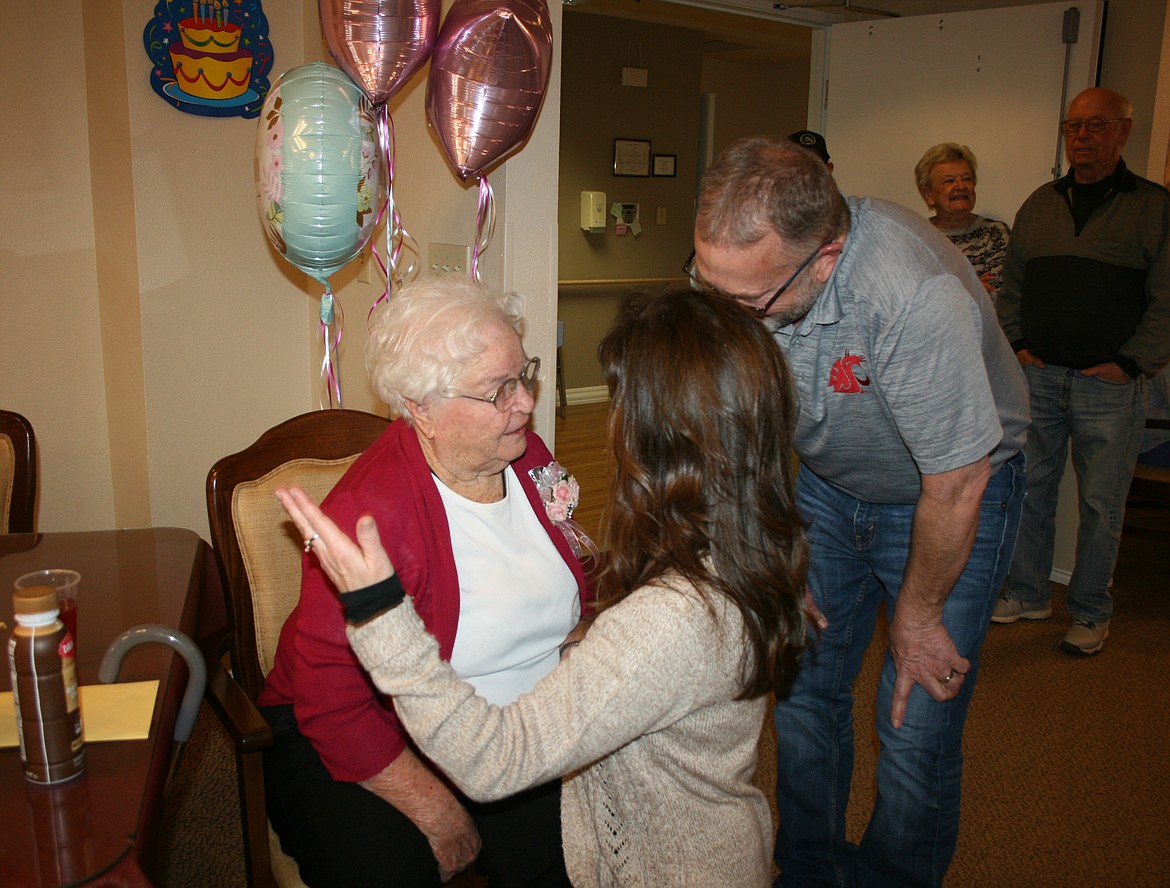
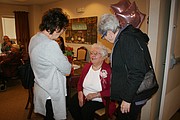
Edna Watkins (seated) talks with visitors at her 100th birthday party Sunday.
Cheryl Schweizer/Columbia Basin Herald
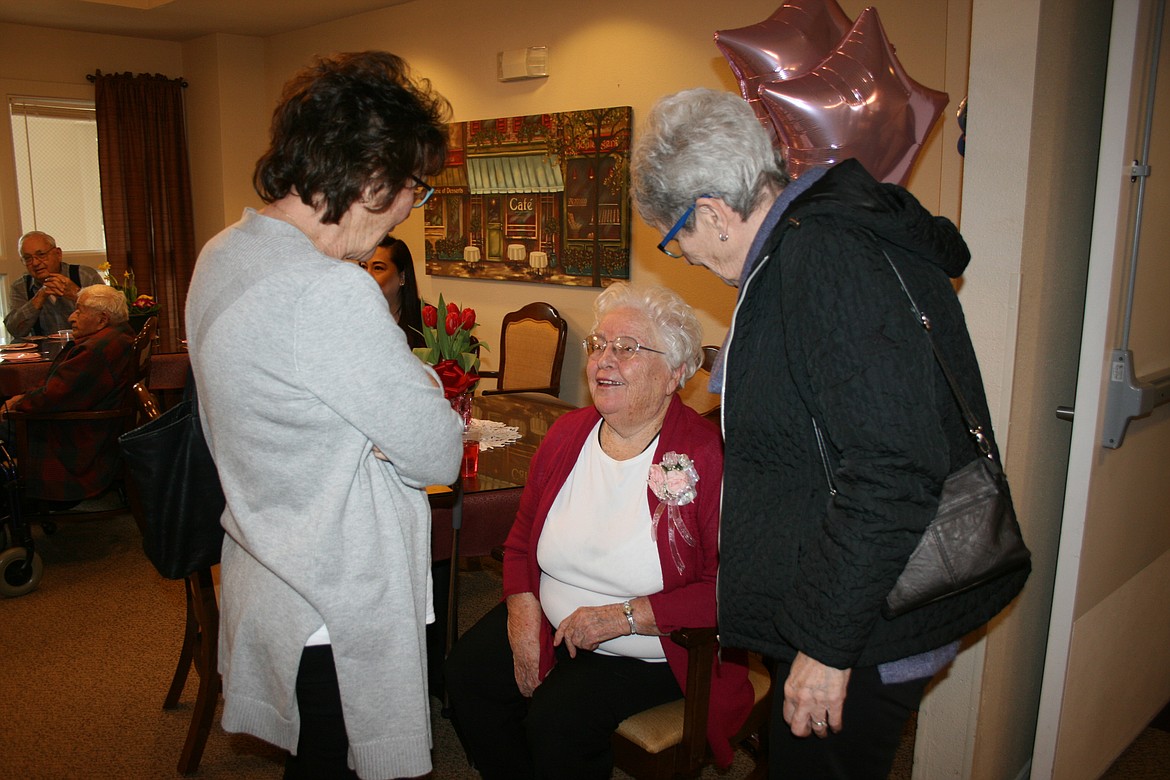
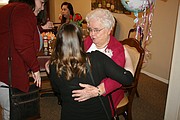
Edna Watkins (center) talks with visitors during her 100th birthday party Sunday at Monroe House in Moses Lake.
Cheryl Schweizer/Columbia Basin Herald
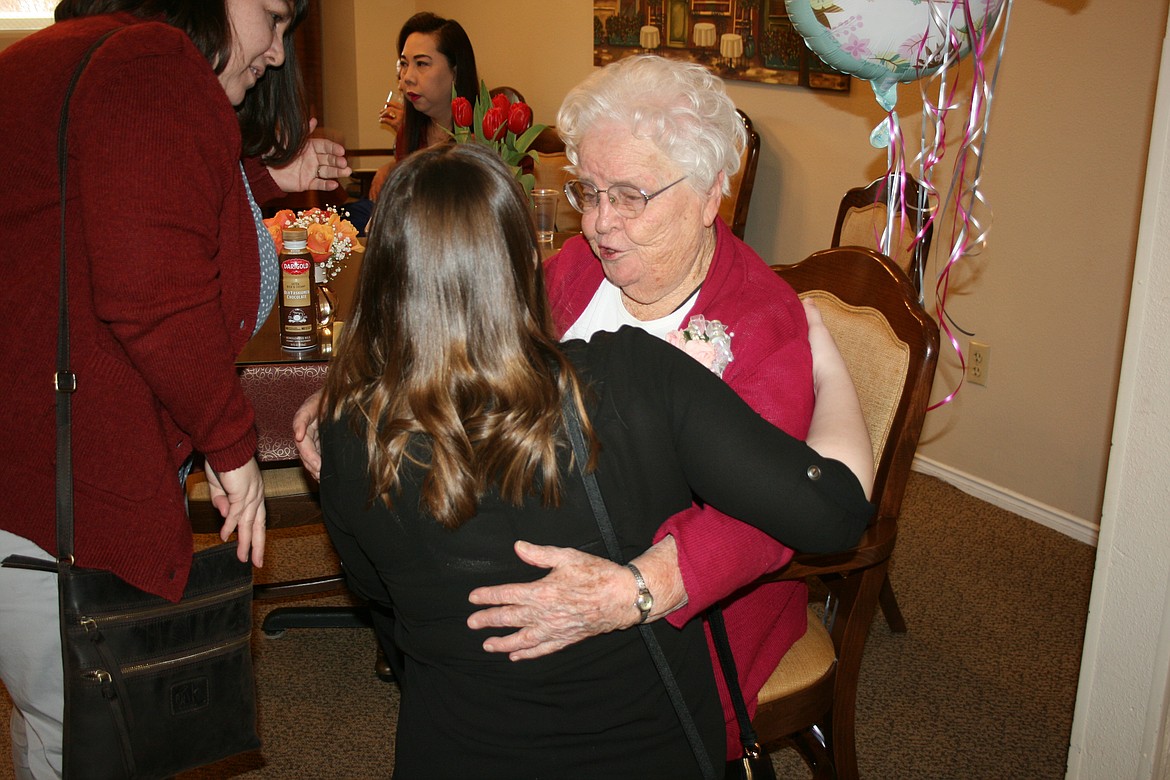
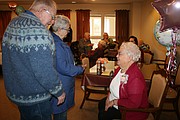
Edna Watkins (seated) talks with a visitor during her 100th birthday party Sunday.
Cheryl Schweizer/Columbia Basin Herald
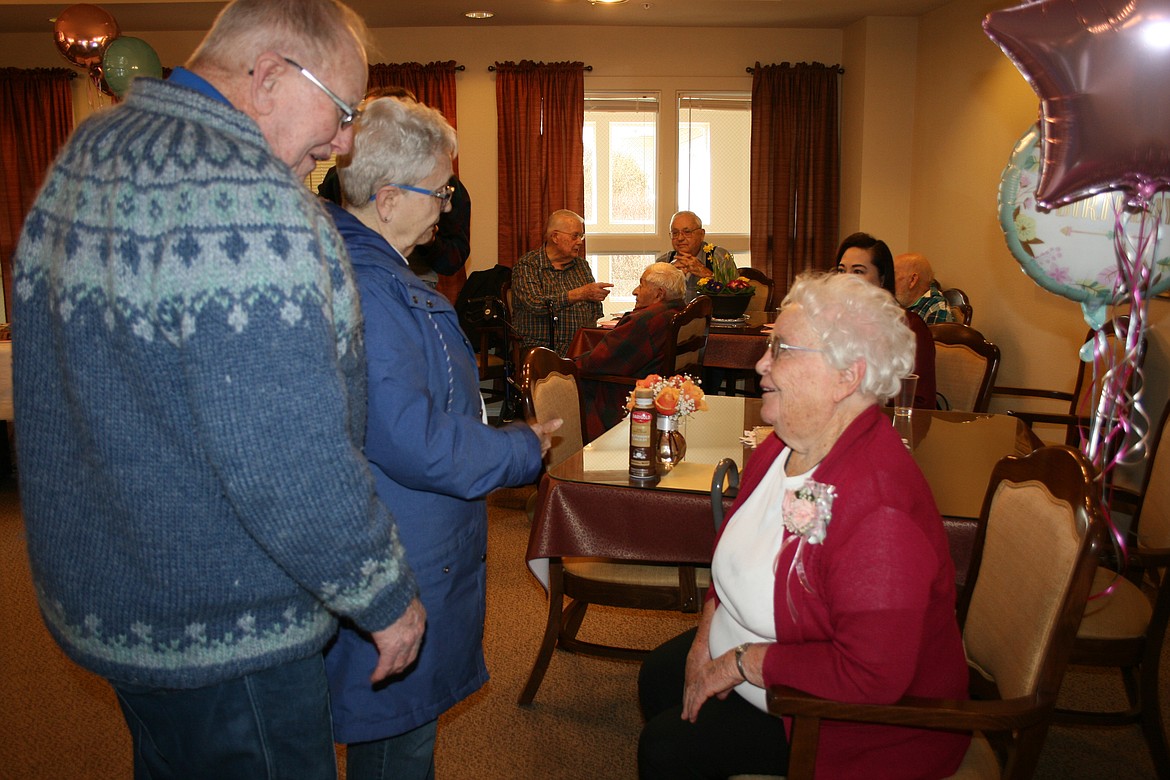
Edna Watkins (right) talks with visitors at her 100th birthday party Sunday at Monroe House.
Cheryl Schweizer/Columbia Basin Herald
Senior Reporter Cheryl Schweizer is a journalist with more than 30 years of experience serving small communities in the Pacific Northwest. She began her post-high-school education at Treasure Valley Community College and enerned her journalism degree at Oregon State University. After working for multiple publications, she has settled down at the Columbia Basin Herald and has been a staple of the newsroom for more than a decade. Schweizer’s dedication to her communities and profession has earned her the nickname “The Baroness of Bylines.” She covers a variety of beats including health, business and various municipalities. | March 5, 2020 11:44 PM
She lived almost 90 years on the family farm
WARDEN — Edna Watkins is a Warden girl through and through.
Watkins was born on the family homestead on March 3, 1920, and lived there for all but 18 months of her next 90 years. Edna and her twin sister, Irene Byers, reached their 100th birthdays Tuesday, although the fact that they live on opposite sides of the state, and the challenges of travel, meant they couldn’t spend the day together.
Edna was the guest of honor at a 100th birthday Sunday at Monroe House in Moses Lake.
“She’s a true Warden pioneer,” said Edna’s daughter Roylene Scoggin. Roylene participated in an interview with Edna at Monroe House on Edna’s birthday.
“I really am,” Edna said.
Edna’s paternal and maternal grandparents immigrated to the United States in 1901, she said, arriving about six months apart. “Actually they came from Russia,” she said, the descendants of Germans who had settled in the Volga River valley in the late 18th century.
The Columbia Basin was genuine pioneer country in 1901, with just the beginnings of towns and farms. Previous groups of Volga Germans had already settled in what became Adams and Lincoln counties. Edna’s grandparents knew people here, she said, and previous settlers acted as sponsors for new groups.
Settlers came to “Odessa, Lind, Ritzville, and they branched out to Warden,” she said. Watkins’ family settled on a homestead three miles south of what became Warden.
“Born and raised on a farm,” she said. She was the firstborn of the twins — and the arrival of her sister, about six hours after Edna was born, came as a surprise to their mother, Edna said.
By 1920, the town of Warden had started to grow, including the Warden Community Church, where her grandparents were charter members. The farm had a well, meaning it was no longer necessary to haul water. Hauling water was a trip of about 40 miles, one way, Edna said.
In 1927, her parents built a new house, one with an unheard-of luxury — electricity. “We had our own (electric) plant, (a) 32-volt plant in that house,” Edna said.
But the farm was still a dryland operation, dependent on rain for the yearly wheat crop. Wheat harvest required gangs of laborers, who moved from farm to farm. The farmer provided the meals, and in 1938 her ability as a cook gave Edna her first job. “I started working when I was 18 years old,” she said. During apple harvest she went to the Dryden area to pack apples. “The rest of the time I was cooking,” Edna said.
“She was an excellent cook,” Roylene Scoggin said. “She could make a meal out of anything. And pies — the Watkins family was noted for pies.”
One of her cooking jobs was feeding the harvest crew on a wheat ranch near Lind. The owner’s nephew was working there — and the nephew, Roy Watkins, was pretty cute. “He was a Lind boy,” Edna said. They were married in 1942.
“I had a happy marriage, I’ll tell you,” she said.
Roy and Edna had two children, Roylene and her brother, Roger. Roy Watkins died in 2010.
Like a lot of other young people, they moved away from home to work in industry during World War II. That 18-month period was the only time Edna lived away from the family homestead, she said. Then they got an opportunity to return to Warden and work the family farm.
Roy Watkins was a farmer. “It was a good move,” Roylene said.
Edna and Roy came home and moved into a pair of houses on the homestead that they connected with a walkway. The Columbia Basin project arrived after World War II and brought irrigation water to the Watkins farm, although not the original homestead, Edna said. They lived on the farm, moving into a new house they built in 1957, until Roy’s death.
Edna said she enjoys living at Monroe House. “This is a nice place to live,” she said.
She’s involved in all the activities, including the singalongs. “I still love to sing,” Edna said.
Edna said she loved farming and being a farm wife. “A good place to raise your kids,” she said.
The land is still under cultivation and still in the family.
Edna said she didn’t expect to live to 100 years of age, “Heavens, no.” Of her seven brothers and sisters, six are still alive, she said.
Cheryl Schweizer can be reached via email at [email protected].
ARTICLES BY CHERYL SCHWEIZER

Road closures, roundabout, mean construction season underway
EPHRATA — The grass is starting to turn green, the trees are starting to leaf out, construction crews are starting to build roundabouts – hey, it’s spring. At least one roundabout project is in its final phase, held over from fall 2025. The intersection of State Route 282 and Nat Washington Way will be closed the week of April 6 to allow crews to install permanent lights. “This really is the final (closure),” wrote Grant County Administrator Tom Gaines in a media release. “The roundabout will close at 6 a.m. Monday, and we plan to reopen by Friday, possibly sooner if the work finishes early.”
Ybarra announces run for Washington Senate
QUINCY — State Representative Alex Ybarra, R-Quincy, has announced his candidacy for the Washington Senate. If he’s elected, he would replace Judy Warnick, R-Moses Lake, who announced her retirement in March.
Othello Community Museum to open April 25
OTHELLO — With a couple of new exhibits, a new heating-cooling system, rearranged displays and a thorough cleaning, the Othello Community Museum will open for the summer April 25. The goal, said Molly Popchock, museum board secretary, is to operate for a full season.