
Growing cotton in the Columbia Basin
CHARLES H. FEATHERSTONE | Hagadone News Network | UPDATED 5 years, 2 months AGO
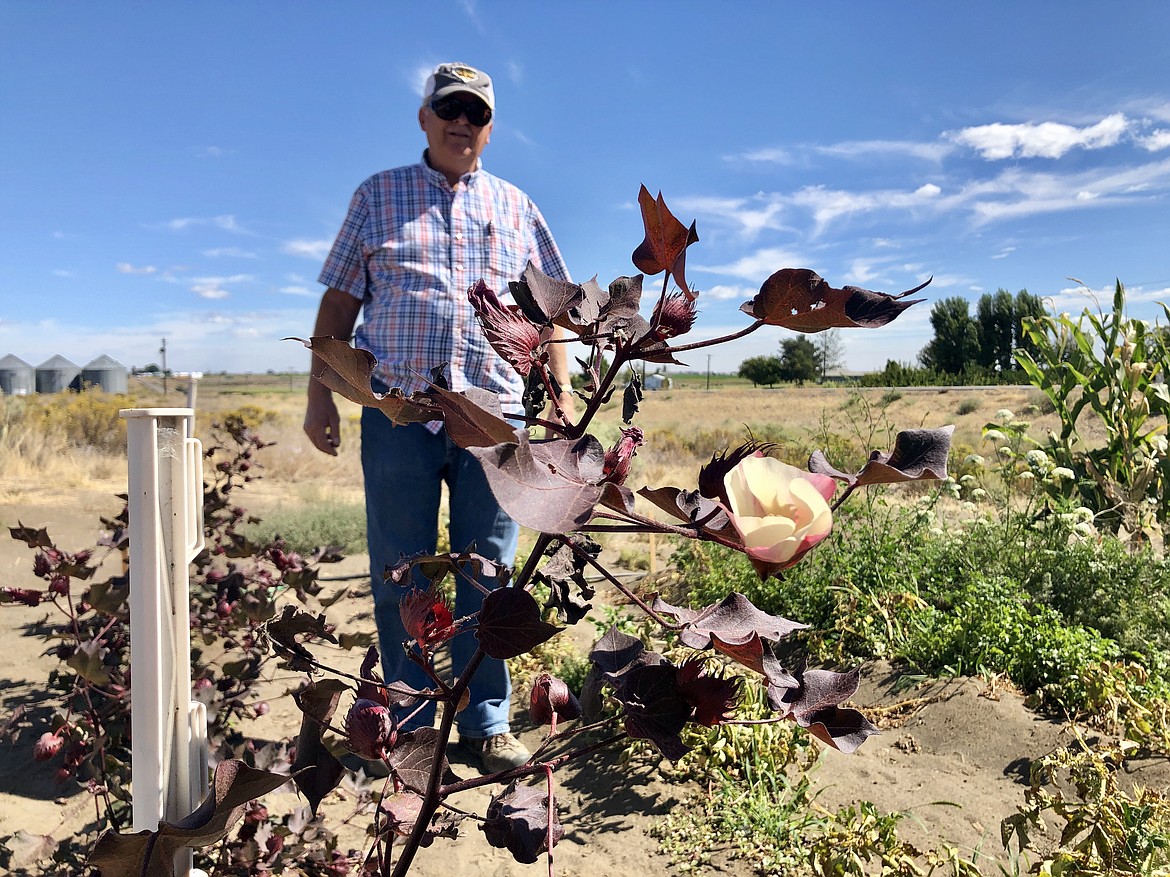
Augie Kooistra of Augie's Ag Sales in his experimental field with his last test crop, red foliated cotton.
Charles H. Featherstone
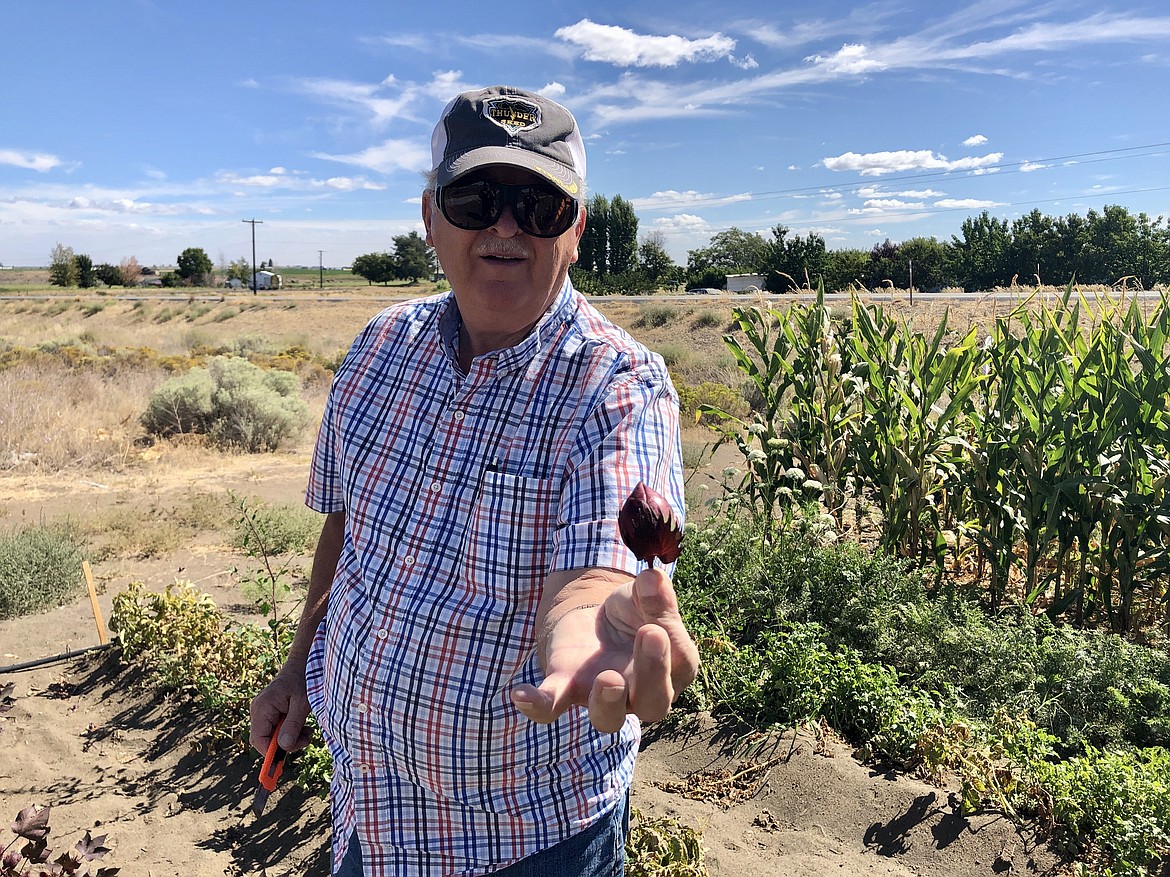
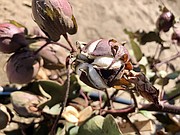
Augie Kooistra holds out a cotton boll, cut from one of the dozen or so cotton plants he's growing in his test field south of Ephrata.
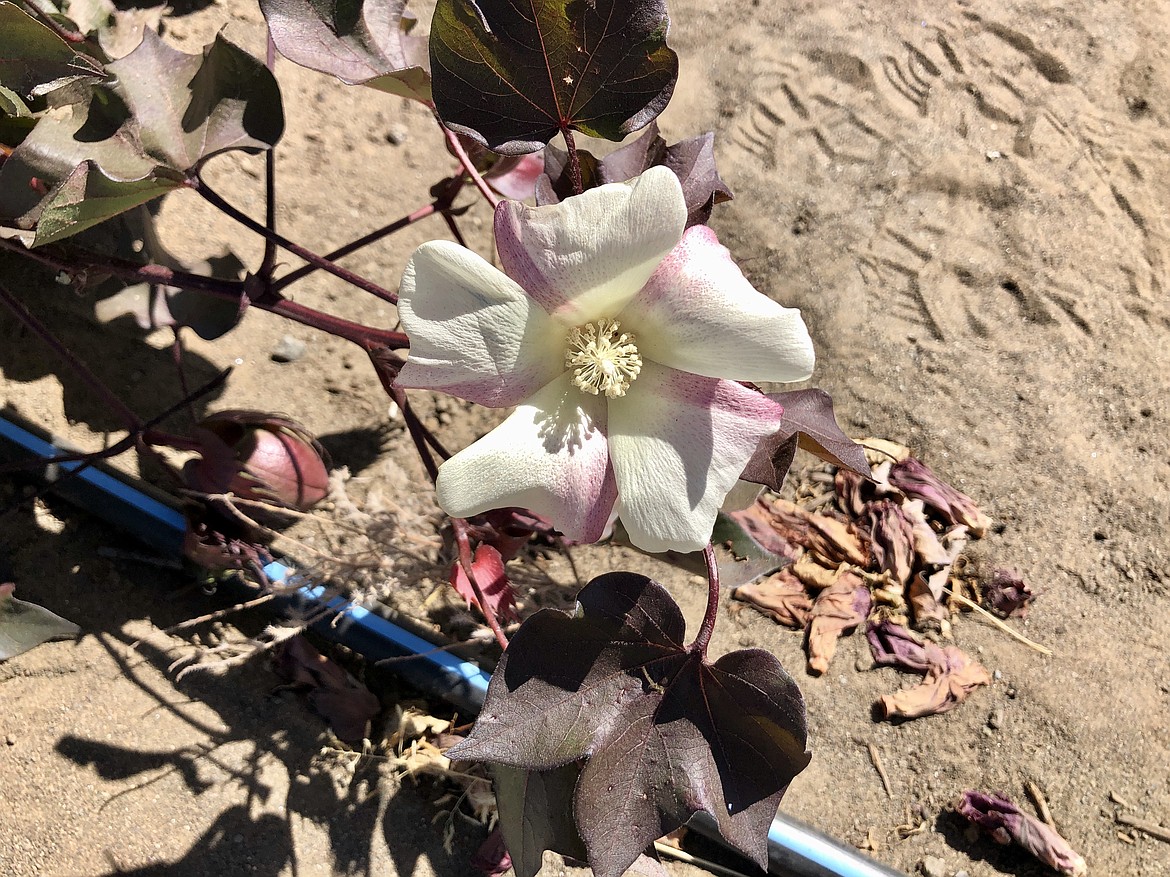
A red foliated cotton flower.
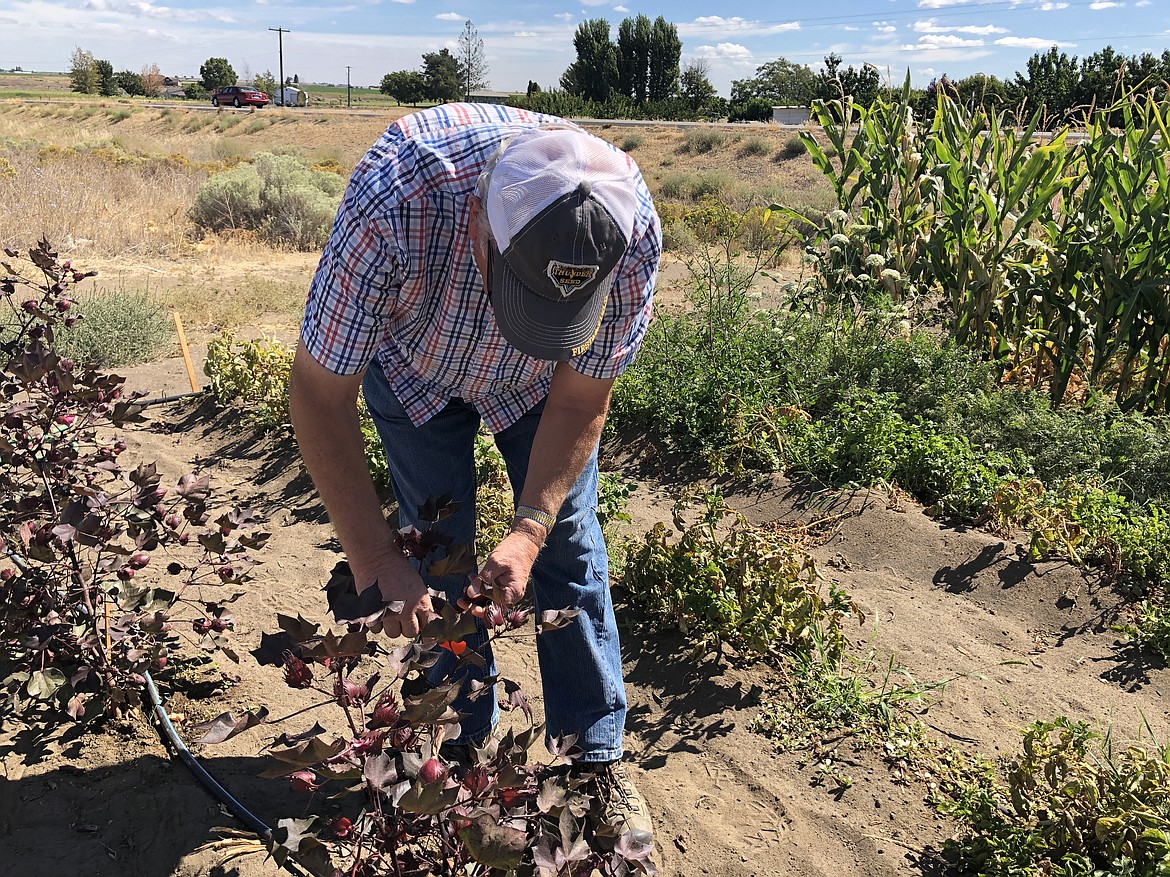
Augie Kooistra of Augie's Ag Sales in his experimental field cutting the boll off one of his cotton plants.
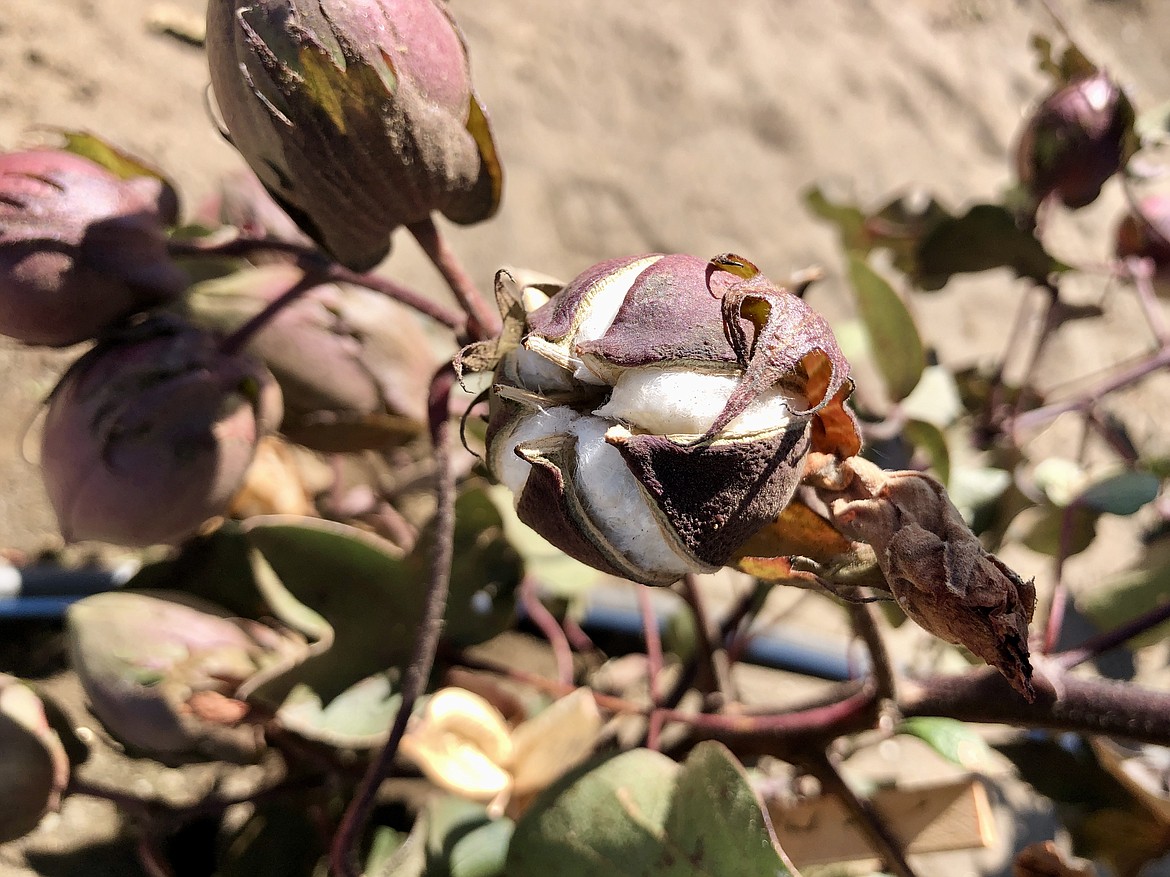
A cotton boll nearly ready to be harvested.
By CHARLES H. FEATHERSTONE
For the Basin Business Journal
QUINCY — Augie Kooistra is not a man who takes “no” for an answer.
“I was on a trip to North Dakota and Texas, and somebody told me about a seed company in Texas I should talk to,” he said as he walks between the rows of plants in his experimental field.
He stands in front of a purple-red plant growing about waist-high with thick red bulbs at the end of some stalks.
There are about a dozen of these purplish plants, taking up half a row in what is otherwise a field full of corn, vegetables and herbs. Kooistra grabs one of the bulbs and cuts it off.
“I called, they wanted me to stop in, and we talked business for a couple of days. I toured their farm, I saw milo, rice, corn and cotton. First time I ever saw cotton in my life,” he said. “I got excited about the possibility of growing cotton here.”
A lot of things are grown in the Columbia Basin, but until Kooistra sowed his dozen or so seeds, red foliated cotton wasn’t one of them. The growing season in the Columbia Basin simply isn’t long enough for most cotton, which needs around 150-180 days to mature — the longest of any regularly planted crop in the United States, according to data from the Cotton Institute.
Because of that, Kooistra said his first attempt to secure cotton seed — from a seed company in Texas — was a bust.
“They said ‘you can’t grow cotton over here, so we’re not interested in doing business with you,’” Kooistra said.
Of course, that just increased his determination to plant some. Kooistra contacted a mail order seed company — Virginia-based Southern Exposure Seed Exchange sells packets of 16-20 red foliated cotton seeds for $4.80 — and bought several packets. Red foliated cotton has a much shorter growing season, 118-120 days, something that can yield a crop in Central Washington.
If you’ve a mind to grow cotton in Central Washington.
“It’s the equivalent of 118-120 day corn, which we can grow for silage here but it will never make dry corn,” he said. “Down in Pasco, it will.”
Cotton is native to the tropics in South Asia, Africa and the Americas, but 90 percent of the world’s cotton is derived from the upland cotton indigenous to Mexico and Central America, of which Kooistra’s red foliated is a variety.
Kooistra and his wife Pam started their cotton indoors, transplanting them into his experimental field in March. Normally, Kooistra said, the field would be full of corn — “50 to 60 different hybrids” — but a disaster with leaf composting left much of the soil with too much nitrogen to grow anything successfully.
“Now I’ve got room for other things,” he said.
As the bolls — the name given to the fertilized flowers that ripen into the “fruit” that is the cotton — ripen, they dry up and pop open. Kooistra said his family has been going down the row of cotton plants harvesting every weekend for the last two weeks.
“There’s a lot of bolls on just one plant, and they are very pretty when they’re flowering,” he said. “They really grow.”
“All of it will yield,” Kooistra added. “It’s really growing good.”
But right now, it’s mostly a novelty. Kooistra said the Columbia Basin simply does not have the infrastructure of gins and warehouses and processors to make a go of cotton.
“Obviously, there’s no commercial infrastructure here for growing cotton, but there was a beginning for all the crops we grow here,” he said.
There is, however, a variety of cotton that grows to maturity in 100 days, Kooistra said — the equivalent of the 100-day corn grown widely across the basin.
“If this’ll grow, obviously 100-day cotton will grow here easy in Ephrata or Grant County,” he said.
He’s planning on planting more next year. A whole row, when he sows his corn next April.
“This proved the point,” Kooistra said. “It will grow.
Charles H. Featherstone can be reached at [email protected].
ARTICLES BY CHARLES H. FEATHERSTONE
Potato prices up, sales down for first quarter 2023
DENVER — The value of grocery store potato sales rose 16% during the first three months of 2023 as the total volume of sales fell by 4.4%, according to a press release from PotatoesUSA, the national marketing board representing U.S. potato growers. The dollar value of all categories of U.S. potato products for the first quarter of 2023 was $4.2 billion, up from $3.6 billion for the first three months of 2022. However, the total volume of potato sales fell to 1.77 billion pounds in the first quarter of 2023 compared with 1.85 billion pounds during the same period of 2022, the press release noted. However, total grocery store potato sales for the first quarter of 2023 are still above the 1.74 billion pounds sold during the first three months of 2019 – a year before the outbreak of the COVID-19 pandemic, the press release said.

WSU Lind Dryland Research Station welcomes new director
LIND — Washington State University soil scientist and wheat breeder Mike Pumphrey was a bit dejected as he stood in front of some thin test squares of stunted, somewhat scraggly spring wheat at the university’s Lind Dryland Research Station. “As you can see, the spring wheat is having a pretty tough go of it this year,” he said. “It’s a little discouraging to stand in front of plots that are going to yield maybe about seven bushels per acre. Or something like that.” Barely two inches of rain have fallen at the station since the beginning of March, according to station records. Pumphrey, speaking to a crowd of wheat farmers, researchers, seed company representatives and students during the Lind Dryland Research Station’s annual field day on Thursday, June 15, said years like 2023 are a reminder that dryland farming is a gamble.

Wilson Creek hosts bluegrass gathering
WILSON CREEK — Bluegrass in the Park is set to start today at Wilson Creek City Park. The inaugural event is set to bring music and visitors to one of Grant County’s smallest towns. “I've been listening to bluegrass my whole life,” said the event’s organizer Shirley Billings, whose family band plays on their porch every year for the crowd at the Little Big Show. “My whole family plays bluegrass. And I just wanted to kind of get something for the community going. So I just invited all the people that I know and they’ll come and camp and jam.” ...