
Apple-picking robots set to revolutionize orchard work
CHARLES H. FEATHERSTONE | Hagadone News Network | UPDATED 4 years, 11 months AGO
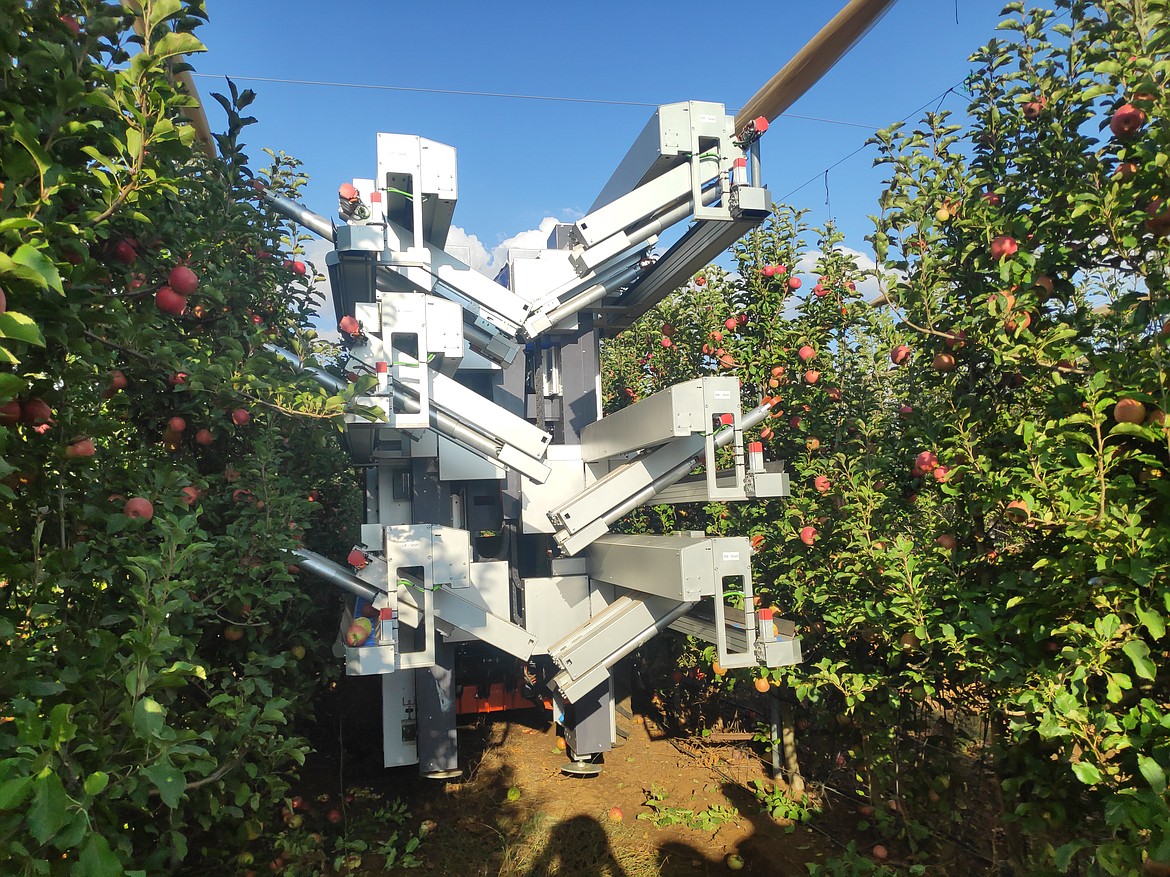
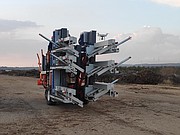
The FFRobotics automated apple picking machine at work in an orchard.
Courtesy Photo FFRobotics
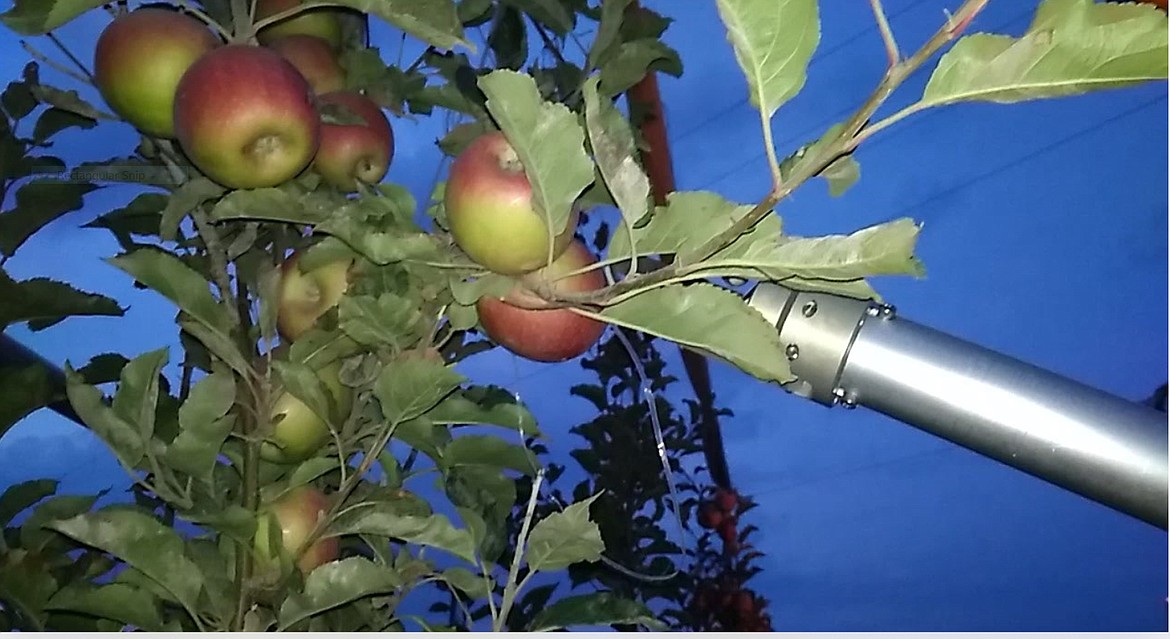
A "hand" on FFRobotics' automated harvesting machine reaches out to pick an apple. FFRobotics is working with the Washington tree Fruit Research Commission to develop a machine that can replace human apple pickers in the hope of having the state's apple harvest 50% automated within 10 years.
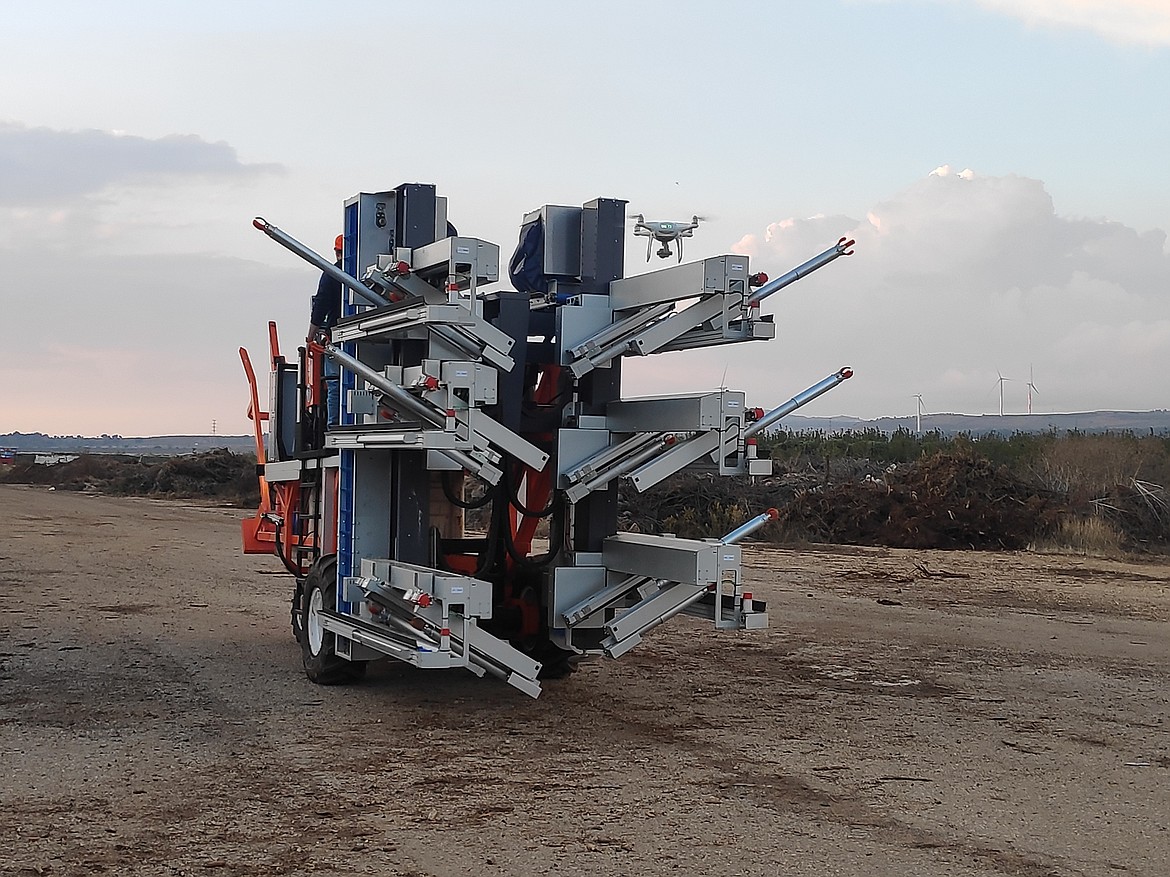
The FFRobotics' automated harvesting machine on its way to work.
WENATCHEE — Every year, during Washington state’s autumn apple harvest, hands reach out to pick apples around 13 billion times.
“That’s a lot of fruit that needs to be picked in a really short time frame of about 80 days,” said Ines Hanrahan, executive director of Washington State Tree Fruit Research Commission.
It means a lot of people need to work those 80 days. They need to be housed, paid and provided for. It’s an expensive undertaking, one that became even costlier in 2020 with the outbreak of COVID-19, which hit apple growing counties especially hard because of some of the crowded conditions migrant workers find themselves living in.
Hanrahan, who grows cherries, pears and apples on an orchard in the Yakima Valley with her husband, said one of the goals of the tree fruit commission since its founding in 1969 is to bring automation and mechanization to the state’s orchards.
Because one of way of helping the state’s apple growers would be to build a machine that could pick apples.
“Right now, the sustainability of our orchard operations would be threatened,” Hanrahan said. “They’re all suffering financially a lot because all of the orchardists are affected by the adverse wage rate and by the notorious difficulty to find enough people to cover peak demand areas for certain activities on the farms.”
It’s a big crisis, Hanrahan added, which is why the Tree Fruit Research Commission has invested heavily in projects like the SmartOrchard — a small, Pasco-area orchard stuffed to the treetops with sensors and patrolled by machines that can scan trees and analyze buds and apples — and even in technology that can pick apples as carefully as people can.
In fact, Hanrahan is hopeful the technology is advancing at such a pace that half of all orchards in the state would be partly or fully automated in 10 years.
“Our hope is to achieve 50% adoption,” she said. “That is a very lofty goal.”
However, right now, speed is the problem. The machines under development simply aren’t as fast as the humans who labor in the orchards.
“While we have now robots that can see the fruit and pick the fruit and put it in a bin, we don’t have robots yet that can do this fast enough and consistently enough so that it would actually help us,” she said.
Avi Kahani, co-founder and CEO of Tel Aviv-based FFRobotics, hopes to change that. His company has designed and built several test models of a robotic apple picker, and a production model is expected to come to the Columbia Basin this fall to show just how well it works.
“I have a background in mechanical engineering and business,” Kahani said during a Zoom interview from Israel. “Back in the 1980s, I used to be an orchard manager, and I spent a lot of time on the ladders to understand that we must find a solution for the harvesting.”
Kahani’s solution is an ungainly-looking device with 12 arms — six on either side — a series of soft rubber conveyor belts, and the ability to hold five bins of apples.
The FFRobotics machine, which can drive itself through an orchard, uses artificial intelligence informed by a battery of cameras to identify apples, and then a robot arm reaches out to pull them off the tree with a three-pronged “hand,” gently deposits the apples on a conveyor belt, where they are lifted up to a stem-cutting table and then deposited in a bin.
Once full, the bins are left in the orchard to be picked up separately, just as they are now, Kahani said.
The goal is to eventually be able to harvest up to 8,000 apples per hour.
“The cameras are on the base of the arm. We look at the tree, identify the fruit, classify the fruit to decide whether we want to pick it based on color and size, and we send the arm to do the picking,” Kahani said.
“It’s exactly like a human being but in a sense it’s more objective. It’s not a personal decision on whether the fruit is red or green, it’s computerized. It’s a more objective criteria,” he said.
Patrick Pinkston, a former vice president of technology for John Deere and the current managing director of The Yield Lab, a St. Louis, Missouri-based company that invests and incubates agriculture-related startups, said Kahani’s company has the potential to do for tree fruit what mechanization and the Global Positioning System (GPS) did for commodity crops like wheat and corn in the 20th century.
“They started off hand harvesting and using horses and by the end (of the 20th century) most of commodity agriculture was fully mechanized,” Pinkston said. “The challenge is that hasn’t occurred yet for most of the produce crops, like apples.”
According to both Pinkston and Hanrahan, most fruit growers have already made most of the changes that would make automated picking and pruning possible. A typical apple orchard is now comprised of fairly short trees secured to trellises in rows about 10 feet apart. And that allows tree fruit growers to focus on fruit quality and quantity, Pinkston said, and also allows for easier and better management of orchards.
“But that also provides a significant opportunity then to go in and automate the harvesting operation and other operations like thinning and pruning,” Pinkston said. “It’s made all of that possible by machine.”
In fact, Kahani and Pinkston said the data gathered by the machine as it picks — and later prunes — will also help them understand their orchards better, get new insights and grow better apples.
“They can see the tree throughout the season, and demonstrate where fruit is being produced,” Pinkston said. “Quality is a big part of this.”
FFRobotics’ machine is only one attempt to automate tree fruit harvesting. Another model uses a large vacuum hose to suck the apples right off trees. Hanrahan said there are lots of different startup companies with technologies vying to become the wave of the apple harvesting future.
“There are some really good vacuum systems out there,” she said. “A problem with a vacuum system is always deceleration, because you move the fruit and you have some sort of speed and then you have to slow it back down, and that can be a problem.”
“People are looking at different ways of doing it,” Hanrahan added.
Both Kahani and Pinkston said their machine will be coming back to Washington this fall to show just how well it works. A similar trial will also take place this fall in France, Kahani said.
“We are ready to demonstrate the machine and the amazing progress we have made despite the COVID and being stuck in Israel,” he said.
“We believe this machine sets a new standard for both production and picking rate as well as quality,” Pinkston said.
If it works, the FFRobotics machine could be the future — or part of the future — for fruit tree agriculture across the world.
“We’re really excited about the work ahead of us,” Hanrahan said. “We think we’re getting somewhere.”
Charles H. Featherstone can be reached at [email protected].
ARTICLES BY CHARLES H. FEATHERSTONE
Potato prices up, sales down for first quarter 2023
DENVER — The value of grocery store potato sales rose 16% during the first three months of 2023 as the total volume of sales fell by 4.4%, according to a press release from PotatoesUSA, the national marketing board representing U.S. potato growers. The dollar value of all categories of U.S. potato products for the first quarter of 2023 was $4.2 billion, up from $3.6 billion for the first three months of 2022. However, the total volume of potato sales fell to 1.77 billion pounds in the first quarter of 2023 compared with 1.85 billion pounds during the same period of 2022, the press release noted. However, total grocery store potato sales for the first quarter of 2023 are still above the 1.74 billion pounds sold during the first three months of 2019 – a year before the outbreak of the COVID-19 pandemic, the press release said.
WSU Lind Dryland Research Station welcomes new director
LIND — Washington State University soil scientist and wheat breeder Mike Pumphrey was a bit dejected as he stood in front of some thin test squares of stunted, somewhat scraggly spring wheat at the university’s Lind Dryland Research Station. “As you can see, the spring wheat is having a pretty tough go of it this year,” he said. “It’s a little discouraging to stand in front of plots that are going to yield maybe about seven bushels per acre. Or something like that.” Barely two inches of rain have fallen at the station since the beginning of March, according to station records. Pumphrey, speaking to a crowd of wheat farmers, researchers, seed company representatives and students during the Lind Dryland Research Station’s annual field day on Thursday, June 15, said years like 2023 are a reminder that dryland farming is a gamble.

Wilson Creek hosts bluegrass gathering
WILSON CREEK — Bluegrass in the Park is set to start today at Wilson Creek City Park. The inaugural event is set to bring music and visitors to one of Grant County’s smallest towns. “I've been listening to bluegrass my whole life,” said the event’s organizer Shirley Billings, whose family band plays on their porch every year for the crowd at the Little Big Show. “My whole family plays bluegrass. And I just wanted to kind of get something for the community going. So I just invited all the people that I know and they’ll come and camp and jam.” ...