
Wildlife biologist talks turkey
MONTE TURNER | Hagadone News Network | UPDATED 5 years, 5 months AGO
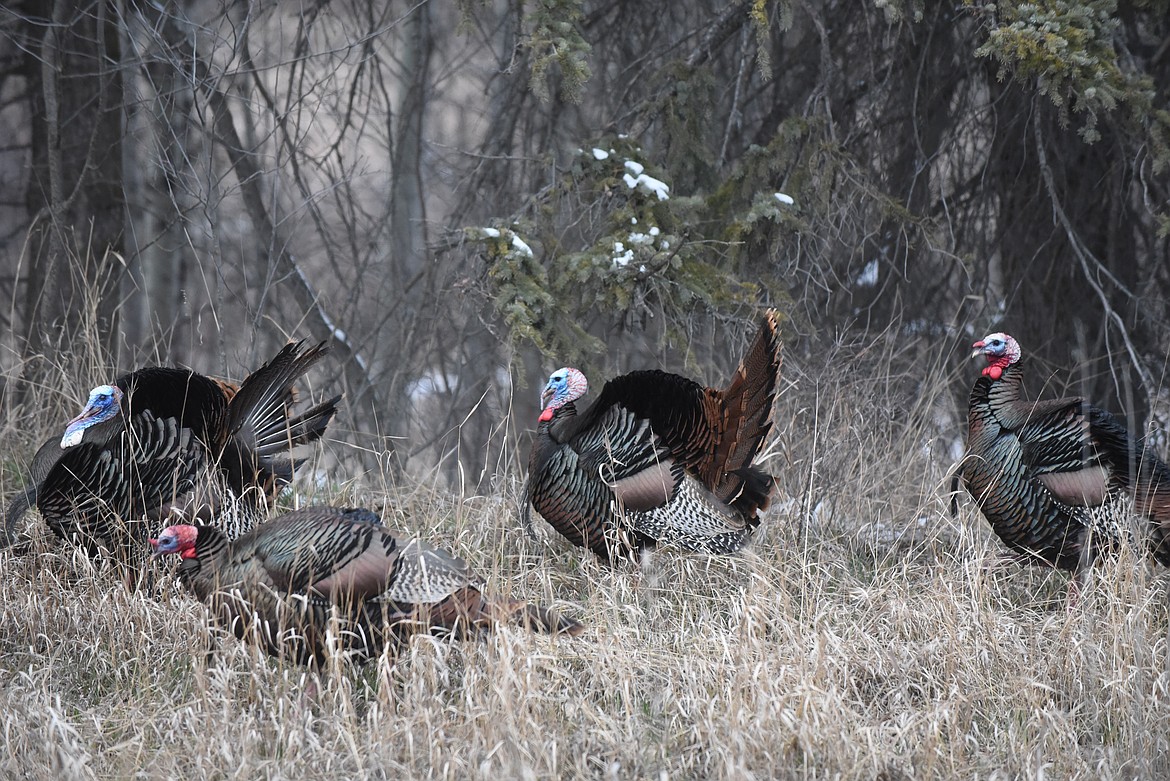
Wild turkey season runs through Sunday, May 16. (Scott Shindledecker/Valley Press0
The spring turkey season for gobblin' toms runs through Sunday, May 16 and both Mineral and Sanders counties has healthy populations.
In the past 10 years, we’ve seen hunters having to draw for a tag to this year where you could actually harvest eight turkeys if you were to travel the different regions and hunting districts.
Liz Bradley, area Wildlife Biologist for the Lower Clark Fork, recruited some help for some questions as she is taking aerial surveys of elk and deer these days.
But Mike Thompson, Regional Wildlife Program Manager Region 2 Headquarters, and Dave Nikonow, Wildlife Biologist, National Wild Turkey Federation/FWP U.S. Forest Service, pitched in to ‘talk-turkey.’
1. When were turkeys introduced to MT, and specifically Mineral County/Sanders County if known? Why were these species chosen (if they are not native to our area?
Although few records are available, attempts were made to establish wild turkeys in Montana during its early settlement. Most of these were very likely of the eastern subspecies and from pen-reared stock.
In 1954, 13 wild trapped Merriam’s turkeys were transplanted into central Montana from Colorado. In 1955, and '57, 44 Merriam’s turkeys wild trapped in Wyoming were released in two areas in southeast Montana. These initial transplants of wild trapped birds provided the base for continued trapping and transplanting throughout the state.
Wild turkeys were comparatively scarce and scattered in FWP Region 2 before 2000, and for many years turkey observations were noteworthy. For example, notes in the files document 11 turkeys on Highway 10, 1 mile east of Milltown, on October 9, 1962, and a hen and six young at the Cyr Ranch near Fish Creek on July 10, 1965. Notes dated 1967-1971 document turkey observations from Four Mile, Keystone, Quartz, Tarkio, Meadow Creek and Nemote Creek.
In response to public interest, FWP renewed its attempts to establish free-ranging populations of wild turkeys in Region 2 in the late 1990s and early 2000s and made a concerted effort to eliminate or reduce
illegally introduced populations of feral domestic turkeys. FWP released wild-trapped turkeys in the Quartz Flat and Fish Creek areas of Mineral County, lower Ninemile in Missoula County, and the Burnt Fork and Sleeping Child areas of Ravalli County between 2000 and 2005.
2. How many eggs in a clutch, and will they have a second clutch if something happens to the first one? How old can a turkey live?
Hens will lay an average clutch of 9-11 eggs and some will renest if the first nest is lost. The lifespan of a turkey will depend on habitat quality and hunting pressure, but 4 years is considered average.
3. Who are their biggest predators?
Foxes, coyotes, birds of prey, mountain lions, and bobcats. Crows, ravens and skunks are also significant nest predators.
4. What do they enjoy dining on?
Turkeys will eat a variety of food items including grass leaves and seeds, berries, forbs, insects, ponderosa pine seeds, and cultivated crops. Kinnikinnick, hawthorne, snowberry, and rose hips are favored plants in Montana.
5. For late season hunters, what you suggest they do to fill their tag?
Head up slope! As the season progresses hens move to initiate and incubate nests. Hens often choose to nest higher in elevation than where you generally see wild turkeys at the beginning of the season. As the hens move up slope, so do the gobblers. Also, as with many game species that are called at, wild turkeys get suspicious of excess calling later in the season. As the weeks go on, less is more in terms of calling wild turkeys.
ARTICLES BY MONTE TURNER
West End Fire to turn up the heat with chili cookoff fundraiser
What better place to enjoy a bowl of full-blown, mega-scorching-hot chili than at a fire station stocked with wildfire equipment, fire extinguishers and a building full of professionally trained firefighters, EMTs and Quick Response personnel?
Senior center cooks up hot dishes with a side social fun
There’s something about a good home-cooked meal that can bring people through the door, and at the Superior Senior Citizens Center, head cook Jessica Williams seems to have figured out the recipe.
Montana-Idaho border reconfigured after survey retraces original state lines
The Bureau of Land Management has completed its official resurvey of the Montana-Idaho boundary near Lookout Pass, going back to the original survey monuments and retracing the line that was established more than 120 years ago.