
Aiming high: Trapshooting is a Shearer family tradition
CHERYL SCHWEIZER | Hagadone News Network | UPDATED 4 years, 7 months AGO
Senior Reporter Cheryl Schweizer is a journalist with more than 30 years of experience serving small communities in the Pacific Northwest. She began her post-high-school education at Treasure Valley Community College and enerned her journalism degree at Oregon State University. After working for multiple publications, she has settled down at the Columbia Basin Herald and has been a staple of the newsroom for more than a decade. Schweizer’s dedication to her communities and profession has earned her the nickname “The Baroness of Bylines.” She covers a variety of beats including health, business and various municipalities. | August 19, 2021 1:00 AM
MOSES LAKE — Travis Shearer saved his best performance for the biggest stage.
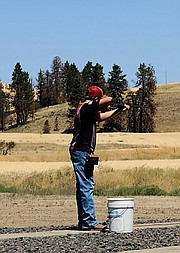
Shearer, 13, of Moses Lake, competed against trapshooters from around the country – actually, from around the world – at the Grand American World Trapshooting Championships last week. Each contestant shot 100 targets, and Shearer hit 95 of his.
It wasn’t enough to place, but it was his best effort.
“The best score he’s ever shot,” said his dad Corey Shearer.
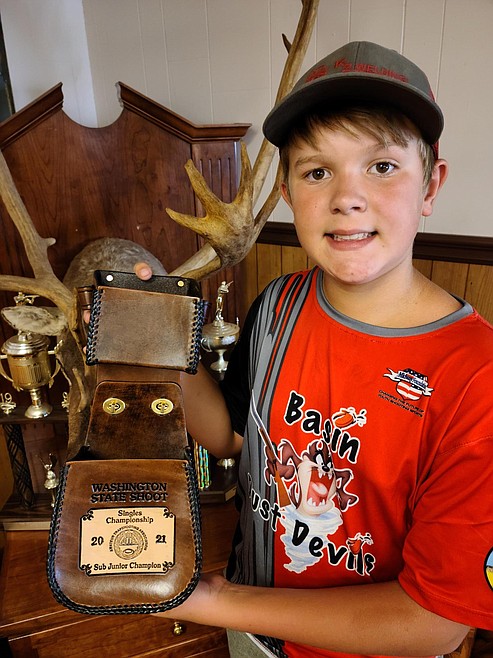
This was the champion of champions event, pitting winners in state, provincial and overseas tournaments against each other. Travis Shearer qualified by winning the singles competition in his age group in the Washington ATA (Amateur Trapshooting Association) state tournament.
“It (the Grand American) was a pretty cool shoot,” Corey Shearer said.
Trapshooting is a family tradition for the Shearers.
“I first started when I was 5 or 6,” Travis Shearer said.
“Pretty regularly when you were 7,” Corey Shearer said. “Same age I was when I started shooting trap. My dad and our family friends were avid trapshooters, so it was kind of in his blood.”
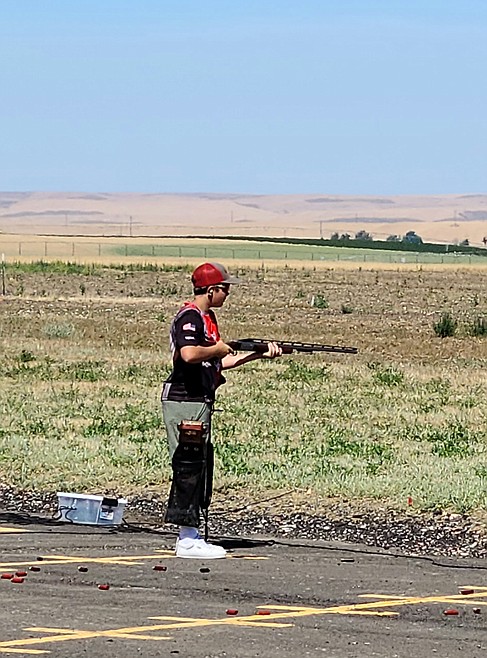
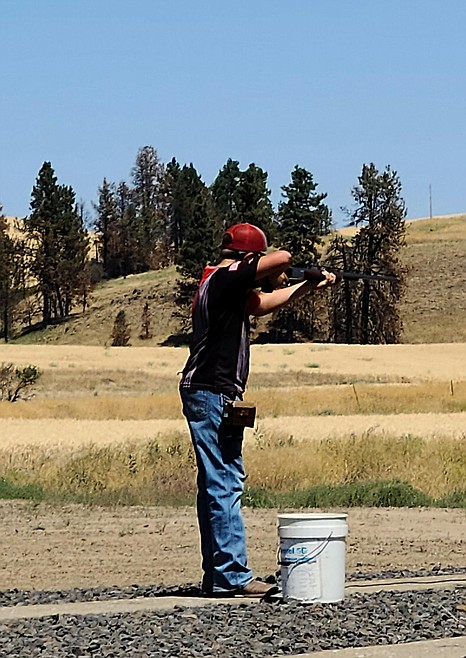
Trapshooting involves a shotgun and a clay target.
“It’s a sport where there’s a clay pigeon, and it (the target) comes out (of the launcher) about 40 miles an hour. And you try to hit the target,” Travis Shearer said.
The pigeon is not shaped like a bird; rather it’s a clay disc. Any hit counts, whether the shooter knocks off a chip or blows the target apart in midair.
“You pretty much have to be in the right spot to hit the target,” Corey Shearer said. “It’s not very forgiving.”
A successful trapshooter follows the target rather than trying to anticipate its flight, Travis Shearer said.
The target guns are designed to assist the shooter, Corey Shearer said, providing as much consistency as possible in sighting.
“They’re designed to shoot high, so you keep your shotgun supposedly under the target, so that you’re able to visualize the target, which aids you in being a more consistent shooter,” Corey Shearer said.
Trapshooters in singles competition shoot from a minimum of 16 yards. Some competitions add distance for more skilled shooters, called handicapping. In handicap competition Travis Shearer shoots from 19 yards.
Success in trapshooting requires practice, of course. But it starts with something else, Travis Shearer said.
“Attitude, I guess,” he said. “Consistency. Focus.”
“You’ve got to do everything the same,” Corey Shearer said.
The shooter has to be consistent because conditions are different every time. Trapshooters practice and compete when it’s windy, when it’s raining, when it’s sunny and hot. Conditions can even change between rounds in a competition.
Cloudy weather is a little easier for shooting, although Travis Shearer said it was tough to determine whether a sunny or cloudy day was more challenging.
“Cloudy is probably better, because the hotness, you get sweaty,” he said.
Shooting for a good score is easier on calm days – wind can be challenging, so can rain.
“Of all those (weather conditions), what I don’t like might be rain. Because I don’t like when it gets on my glasses,” he said.
But a snowy day makes for good trapshooting.
“I like shooting when it’s all snowy. The targets stand out really well, that white (background) and the orange (targets). But it’s cold,” Travis Shearer said.
There is enough interest in the Columbia Basin for a youth trapshooting team, the Basin Dust Devils, of which Travis Shearer is a member. The coaches include Mike Bechtel, Randy Lamb, and Chuck Rey.
Cheryl Schweizer can be reached via email at [email protected].
ARTICLES BY CHERYL SCHWEIZER

Road closures, roundabout, mean construction season underway
EPHRATA — The grass is starting to turn green, the trees are starting to leaf out, construction crews are starting to build roundabouts – hey, it’s spring. At least one roundabout project is in its final phase, held over from fall 2025. The intersection of State Route 282 and Nat Washington Way will be closed the week of April 6 to allow crews to install permanent lights. “This really is the final (closure),” wrote Grant County Administrator Tom Gaines in a media release. “The roundabout will close at 6 a.m. Monday, and we plan to reopen by Friday, possibly sooner if the work finishes early.”

Ybarra announces run for Washington Senate
QUINCY — State Representative Alex Ybarra, R-Quincy, has announced his candidacy for the Washington Senate. If he’s elected, he would replace Judy Warnick, R-Moses Lake, who announced her retirement in March.
Othello Community Museum to open April 25
OTHELLO — With a couple of new exhibits, a new heating-cooling system, rearranged displays and a thorough cleaning, the Othello Community Museum will open for the summer April 25. The goal, said Molly Popchock, museum board secretary, is to operate for a full season.