
MOMENTS, MEMORIES AND MADNESS with Steve Cameron: The day Dale Sr.'s tragic accident saddened an entire sport — and region
Coeur d'Alene Press | UPDATED 5 years, 7 months AGO
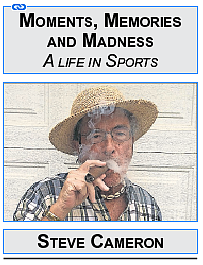
Steve Cameron
Whenever I’m dining in a restaurant with multiple TVs, I try to find a place where I can’t see any of the screens.
At least not clearly.
The idea is to avoid being rude.
See, it’s almost impossible for me to keep from peeking at the action if I can catch just a glimpse of what’s happening on the TV.
So, there I was, in one of those pubs with ferns all around — with just a wee slice of a television visible behind the bar.
It was only place I could sit without staring directly at one of the screens.
I couldn’t help myself.
I’d chat a while with my young lady companion, then take a brief look at the TV, and then look back again.
Until…
I turned away from our shared plate of nachos, stared for just a moment toward the screen, and blurted out: “Oh, my God!”
In that split second, just trying to see the finish of the Daytona 500, I had watched Dale Earnhardt die.
FOR A moment, I hoped the crash I’d just witnessed wasn’t as bad as it looked.
I’d had an odd-angled view, after all.
I remember getting up from the table, taking a few steps to stand with a crowd in front of a large TV, and seeing it again.
And I knew.
You cannot hit a wall at that speed and that angle.
Well, you cannot do it and survive.
Within a minute or two, people in the pub were gasping or crying.
This was a gathering in Charlotte, the very center of the NASCAR world, and every person in the place understood what we’d seen.
That famous black No. 3 car had been bumped gently on the rear bumper — it turned out to be Stirling Marlin, one of Dale’s true friends on the circuit — and spun in a way that caused Earnhardt to hit the wall in Turn 4 at worst possible angle.
Head on.
THE CAR slid down to the infield, along with that of Ken Schrader, who also had been caught up in the crash.
Schrader signaled that he was OK.
Earnhardt did not.
I need to give you some context here.
The date was Feb. 18, 2001 — two decades ago this week — and it was a bit unusual that I was even in a North Carolina restaurant.
I’ve only lived in the South for three years of my life — having made a huge change to become a reporter/columnist for the Sports Business Journal.
I’d been “head-hunted” away from my gig as an opinion columnist in Provo, Utah (both sports and news) during the summer of 2000 — and to borrow a phrase from LeBron James, I’d decided to take my talents to Dixie.
The ironic thing was that, despite traveling to and fro across America as a journalist, I had never even set foot in Charlotte until the visit on which I agreed to cover sports business — as opposed to sports themselves.
As it turned out, I had grisly bad fortune while watching TV in Carolina restaurants — first the Earnhardt crash, then two years later, hearing news of the space shuttle Columbia tragedy while having breakfast with my boss.
BUT THE Earnhardt death hit very, very close to home.
You can’t live anywhere near Charlotte and not know someone connected to NASCAR.
Seeing the crash replayed endlessly on TV was bad enough, but the next morning, well…
I should explain some geography.
My home actually was in South Carolina, about a mile across the border that runs along the southern edge of Charlotte.
I lived in a village called Tega Cay, a delightful little place on Lake Wylie — but it was about a 25-minute commute to our office in uptown Charlotte.
Those three years were the only time I’ve actually ever had a relatively normal, 9-to-5 job that required a drive in rush hour traffic.
The morning after the Earnhardt crash, I still had to make my usual trek up I-77 to the Charlotte city center.
Except…
This particular morning, all the trucks and various other vehicles bearing Earnhardt’s crew and equipment were on the interstate right along with me.
They were en route from Florida, heading home to the suburb of Concord, just north of Charlotte.
On a normal Monday after a race, drivers would have been honking and waving at all the trucks with that huge No. 3 on the side.
But not on this day.
I’M NOT sure I can adequately explain what it was like.
For instance, I stopped at a convenience store for coffee on my way to work, and everyone in the place was either completely silent — or if they absolutely needed to speak, it was in a spooky whisper.
You felt like you should be lighting a candle instead of grabbing a cuppa, as though it was just another Monday morning.
Because it certainly wasn’t any old day.
It felt like the entire city had died.
And in a way, I suppose that was true.
The connection between NASCAR and Charlotte was more like family than a situation where some huge sports industry had happened to land there.
It wasn’t like, say, Disney World and Orlando — where there have been ugly disputes with the county commission and other political battles.
NO, THE Charlotte area loved NASCAR and everything about it unconditionally, and losing Earnhardt (no matter how many other drivers and owners fought with him) was a death in the family.
Everyone in the Charlotte metro region was quiet — in obvious mourning — for several days after the crash.
I’ve never experienced anything like it, before or since.
And bear in mind, I’d only been in town for seven months.
When I saw the crash on TV, I knew immediately that it was a massive loss for NASCAR, and racing in general.
I had no idea, until the following week, what it meant to the community where I’d chosen to live.
If you’ve never had a connection with Charlotte (or the South itself), you might find it hard to believe that the loss of one driver could bring an entire sport — and an entire region — to its knees.
You’ll have to trust me.
Just stopping to get some coffee, and speaking as though you’re in a funeral home…
That was proof enough.
Email: [email protected]
Steve Cameron’s “Cheap Seats” columns appear in The Press on Mondays, Wednesdays and Fridays. “Moments, Memories and Madness,” his reminiscences from several decades as a sports journalist, runs each Sunday.
Steve also writes Zags Tracker, a commentary on Gonzaga basketball which is published each Tuesday.