
Study recommends nine satellite stations to improve fire service around Whitefish
HEIDI DESCH | Hagadone News Network | UPDATED 5 years, 9 months AGO
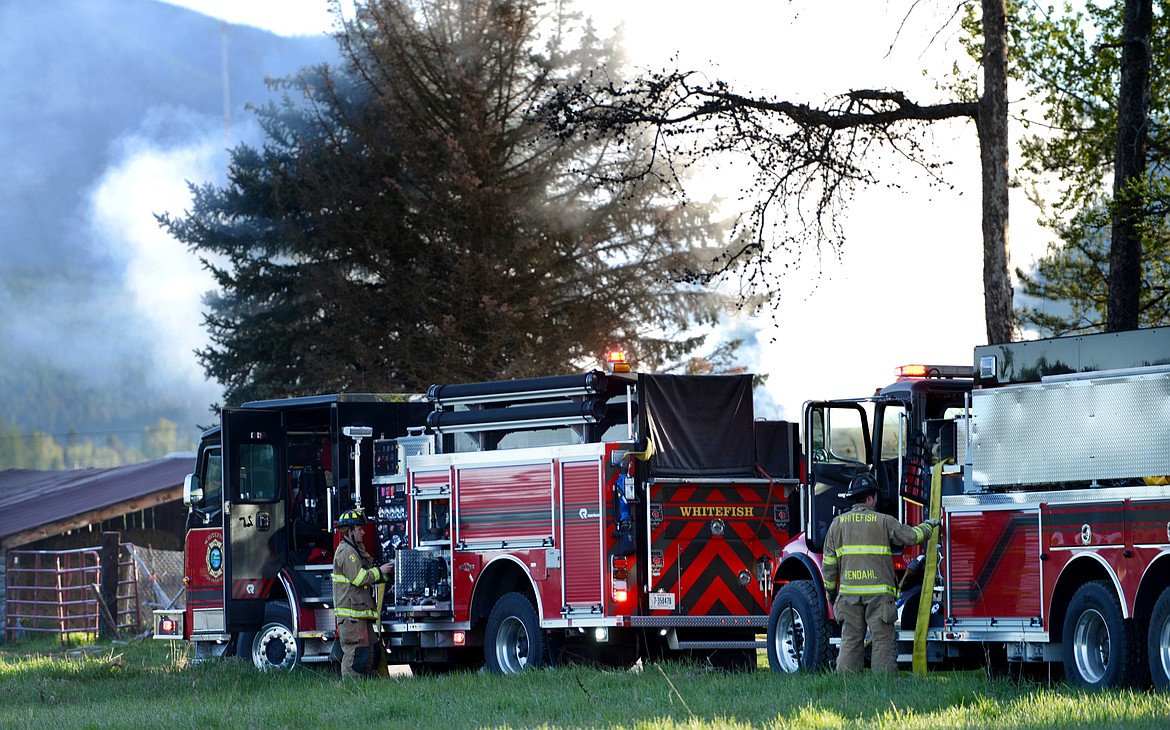
The Whitefish Fire Department responds to a structure fire on JP Road in this file photo.
DEPUTY EDITOR, FEATURES Heidi Desch is the Deputy Editor at the Daily Inter Lake, overseeing coverage of arts, culture, lifestyle, community, and business. Desch leads reporters in developing stories that highlight the people, traditions, and events shaping Northwest Montana, guiding content across print and digital platforms. With more than 20 years of journalism experience, including serving as managing editor of the Whitefish Pilot, Desch is a graduate of the University of Montana School of Journalism. She has received multiple Montana Newspaper Association awards, including part of the team leading the Daily Inter Lake to Best Daily Newspaper in Montana Award and the General Excellence Award in 2024 and 2025. IMPACT: Heidi’s work connects readers with stories that deepen the understanding of the community beyond daily news. | January 6, 2021 1:00 AM
Roughly nine satellite fire stations would need to be constructed in the greater Whitefish area to serve the homes that are currently more than 5 road miles away from the Whitefish Fire Department.
And by constructing those stations it would save homeowners a potential of hundreds of dollars in savings in insurance costs, according to a study recently conducted by Kearney’s Student Lab program at Carnegie Mellon University.
The Whitefish Fire Department this fall began working with the program to provide a data analysis and recommendations for the potential for rural fire stations here.
Whitefish Fire Chief Joe Page said the study will be combined with a long-range plan the fire department is developing for future planning.
“We are looking at what locations make sense and what land is available for the points they picked in the study,” he said. “We will plan to hold community meetings to gage interest and look at funding. We definitely have our work cut out for us.”
In the Whitefish fire service area, about 6,000 structures are located within 5 miles of the station while about 1,400 are located greater than 5 miles from the station. The insurance industry typically uses 5 road miles from a station as the distance when determining adequate fire protection and also being located closer to a station offers better response time in an emergency, notes Page.
The fire department currently serves inside the city limits and the Whitefish Fire Service Area, the rural area immediately outside the city limits, and a portion of the Flathead County Fire Service Area that is not covered by another fire district.
The study found that by constructing nine fire stations it would serve 94% of the current structures in the fire area.
Looking at insurance rates and home values, it found that by constructing new fire stations it would save an average of $884 per structure in insurance costs — or just the cost savings of being within 5 miles of a fire station.
When factoring in the cost of constructing and operating a fire hall in those areas, homeowners could be looking at savings of between $230 and almost $400 depending on the type of fire hall constructed.
Page had speculated from his experience that adding fire stations to rural areas of Whitefish could save homeowners money on their insurance, but the goal of the study was to use data to see if that was true.
“The results of the study were far more favorable than I thought it would be when we started this,” he said of the study’s findings.
The study analyzed the costs for a rural fire station, a larger sized volunteer station, a resident station with living quarters and finally a staffed fire station. The annual operating cost, including the cost for initial construction and vehicles, for a rural station would be about $140,000, a volunteer station about $160,00, a resident station was about $185,000 and a staffed station would be about $785,000.
What the study found was three of the four station options would likely save homeowners money. The rural, volunteer and resident stations offered on average savings of up to $400 from reduced rates in insurance premiums. However, the staffed station would cost about $1,880 more to homeowners.
Funding for the stations could come from two main options, either spreading out the cost for all taxpayers in the city and rural fire areas or spreading the cost out amongst those near the fire halls such as through a special improvement district, the study notes.
The study also analyzed the nine areas individually to investigate whether it would make sense to construct them all at once or individually. It determined that based on population and growth estimates that the optimal path would be to construct six new stations first then add the additional stations in the remaining areas as growth continues.
By constructing more stations at once rather than one at a time, it provides cost savings and also benefits a greater number of homes right away, noted Richie Ibsen, one of the students involved in the project.
“With the whole network, everyone sees improvement and gets the benefit,” he said. “We’d recommend the network approach going forward. With the building nine stations then 94 percent of the community would benefit at once.”
Ibsen noted that constructing the fire stations would take several years so the ideal path would be to begin work sooner to provide the benefit to homeowners faster.
Julia Penkal, one of the students involved in the project, noted that the study selected hypothetical locations for the fire halls based on data and more investigation would be needed to determine if those locations would be an option depending on land availability and topography. It could take at least two to three years to construct the stations, she noted.
Page said he is currently investigating the potential locations for fire halls and working to collaborate with the Whitefish Fire Service Area based upon the results of the study.
As part of the study, a survey was released asking Whitefish homeowners to answer questions regarding their insurance coverage. There were more than 200 responses to the survey.
Of the respondents, the survey found that 17.5% have had their homeowner’s insurance coverage refused in the past and that insurance rates are 20% higher for those who are outside of 5 road miles to the nearest fire station.
The team first identified all the structures and current fire coverage in the area, and then determined the factors affecting insurance premiums and calculated the potential cost implications for adding satellite stations and the optimal locations for those stations.
The Whitefish Fire Department applied to be accepted by the student program, which is conducting the analysis for free.
ARTICLES BY HEIDI DESCH

Whitefish wildfire protection plan up for City Council review
Fourteen areas of concern that are primed for mitigating wildlife risk are at the center of a draft Whitefish Community Wildfire Protection Plan.

Kalispell resident advocates for more women in the trades after being crowned Mrs. America
Standing on the stage in Las Vegas, wearing a white formal gown accented with feathers on one shoulder, Qadra Evans gripped hands with a fellow competitor.

Whitefish mulls updates to community growth plan
Whitefish City Council on Monday will consider updates to its community plan including language that looks to protect the historic character of its downtown amid state requirements allowing buildings up to 60 feet in height in certain zoning districts.