
No bird feeders until March
SAM FLETCHER | Hagadone News Network | UPDATED 5 years, 1 month AGO
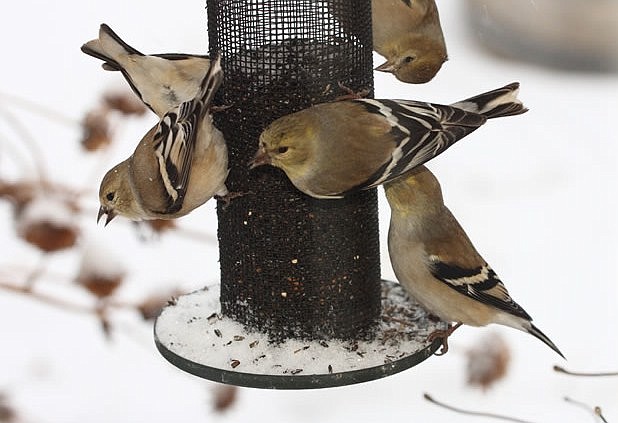
Pine siskins at a feeder, where spreading salmonellosis is common. Photo courtesy of WDFW.
Courtesy WDFW
Recent reports of sick or dead birds at backyard feeders across Washington are prompting the Department of Fish and Wildlife to recommend people temporarily discontinue feeding wild birds or take extra steps to maintain their feeders.
The current die-off of finches and other songbirds is attributed to salmonellosis, caused by the salmonella bacteria, according to WDFW veterinarian Kristin Mansfield.
Salmonellosis is the “disease we get when we have too much salmonella in us and it starts doing naughty things,” said WDFW biologist Chris Anderson.
Birds with eyes only half open who appear puffed up or bloated and lethargic may have salmonellosis, Anderson said.
There are 2,000 types of salmonella bacteria that cause salmonellosis, one of the most common illnesses among birds in the area, he said. It’s particularly difficult to recover from the disease.
So far in 2021, 10 times the statewide reports of salmonellosis have occurred compared to an average year, particularly in pine siskins, he said. However, predators who eat infected prey were reported to get it as well, including other bird species, household pets and farm animals. Exact numbers aren’t available because no means exist to count animals for the disease.
Though it’s rare, it’s possible for humans to get it too, Anderson said.
According to the WDFW, it is a common illness in small birds this year, who congregate on unhygienic feeders and baths.
“They’re over each other, hanging out, looking like they’re having fun, but that’s like a kindergarten, and here’s the sick kid,” Anderson said.
The WDFW’s initial press release, published Jan. 8, urged people to take down their bird attractants until February. However, January has been the worst month yet for the outbreak, so now it’s asked to hold off longer.
“Once we put the release out, our phones and emails blew up,” said Staci Lehman, WDFW communications manager. “Based on that, we know that the outbreak is bigger than we initially thought.”
The extensive calling could be a case of boy-who-called-wolf, said WDFW assistant wildlife biologist Ella Rowan. Based in Ephrata, she works in the north central region, which includes Grant and Adams counties.
“If it’s something like someone thinks they saw a wolf over in Spokane, then all of a sudden people start calling in and reporting that they think they’ve seen wolves,” she said. “There’s this weird phenomenon where explaining to the public that a problem exists suddenly increases the number of reports artificially, so it’s not exactly correlated with the truth.”
Additionally, salmonellosis is pretty common in birds and there hasn’t been an unusual number of reports in the north central region, Rowan said.
However, it’s possible that the fewer number of reports here is because there are simply fewer eyeballs, she said. It doesn’t necessarily mean there isn’t a problem.
“Grant County is a lot of ag circles and shrub-steppe habitat where people aren’t there to notice things,” she said. “Adams County is a lot of really huge ranches, privately owned, so a lot of dead animals can go unseen in these unpopulated areas compared to the west side of the state.”
The department is now extending their statewide recommendation until March, Lehman said. Come spring, the environment will be different and birds will be more spread out in terms of migration. There will also be more food sources, so the birds won’t be so concentrated.
Apart from taking feeders and baths down, Anderson recommends keeping them clean with a 10% bleach solution, as well as soap and water. This should be done regularly, regardless of an outbreak, he said. Also, of course, keep an eye on children and pets.
But it’s preferred people remove attractants.
“We’re building little groceries for these guys,” Anderson said, referring to bird feeders. “We’re asking them to go back to living off the land right now.”
The birds will adjust to the change, Lehman said. It will be better for their health in the long run.
“People are stuck at home, and birdwatching is something that we are all enjoying and so a lot of people are really concerned about ‘are the birds going to survive without the feeders?’ and they will,” she said. “But the other thing is it’s kind of a hit to our mental capacities right now, too. We’re appreciative that people are willing to take things down.”
With everything compounding this winter, this is just another bummer, Anderson said.
“I get it,” he said. “I took my feeders down, too, and my kids are sad and I’m a little sad.”
While the recommendation may be upsetting in the short term, it’s also an opportunity, said Wendy Walker, community engagement manager of the Seattle Audubon Society. People can think about permanent changes to their yard that will attract birds via habitat as opposed to feeders and baths.
“As much as it pains me to not see birds at feeders and get to see how crazy and frantic they are, there’s also something to be said about cleaning stuff, taking time, especially since a lot of us are at home right now, to just learn about how our birds use our spaces naturally,” Anderson said.
To help the WDFW track the salmonellosis outbreak, report sick birds at https://survey123.arcgis.com/share/a384e90f69744f2e846135a9ce80027f.
ARTICLES BY SAM FLETCHER

'It's refreshing': Summer Street on 3rd brings color to downtown Moses Lake
“We’re moving from recovery to (resilience),” said Downtown Moses Lake Association (DMLA) Executive Director Lexi Smith of post-shutdown Moses Lake.

Off to a fair start: Kiwanis Club hosts Cowboy Breakfast
MOSES LAKE — If the music, games and performances didn’t lure people to Sinkiuse Square Friday morning, it must have been the smell of waffles, syrup, sausage, eggs and coffee as the Kiwanis Club of Moses Lake kicked off the Grant County Fair with the Cowboy Breakfast.

Moses Lake to demolish some old structures
This year, the city of Moses Lake is cleaning up some rubble.