
Wildfire smoke risky for the respiratory system
CHERYL SCHWEIZER | Hagadone News Network | UPDATED 4 years, 8 months AGO
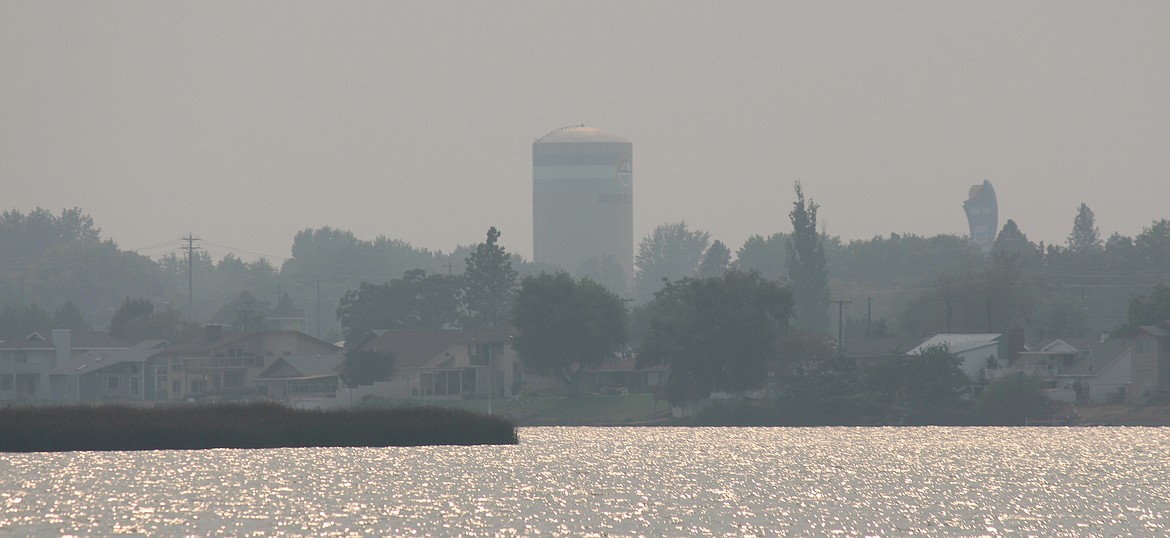
Smoke from wildfires lingers over Moses Lake in 2018. As fire season gets into full swing, it’s important to keep an eye on air quality outdoors.
File photo
Senior Reporter Cheryl Schweizer is a journalist with more than 30 years of experience serving small communities in the Pacific Northwest. She began her post-high-school education at Treasure Valley Community College and enerned her journalism degree at Oregon State University. After working for multiple publications, she has settled down at the Columbia Basin Herald and has been a staple of the newsroom for more than a decade. Schweizer’s dedication to her communities and profession has earned her the nickname “The Baroness of Bylines.” She covers a variety of beats including health, business and various municipalities. | July 27, 2021 1:00 AM
MOSES LAKE — Dry conditions, really dry conditions, and record-breaking heat mean it’s not looking good for the rest of the wildfire season. Wildfire smoke isn’t good for anybody, especially people with respiratory conditions like allergies and asthma or other underlying conditions.
So far, 2021 has been no picnic in the smoke department. About 65,000 acres near Mazama in Okanogan County were burned as of Sunday, as well as multiple fires in southern British Columbia. A fire started Thursday in Northrup Canyon in northern Grant County, which was about 250 acres as of Sunday, and was pumping out smoke.
The smoke will go where the wind blows, and sometimes that’s right over Grant County.
Everyone is affected to some degree or another by wildfire smoke, said Stephanie Shopbell, environmental public health manager for the Grant County Health District.
“Headache, itchy eyes, scratchy throat, coughing, all of that can be attributed to smoke,” Shopbell said.
Wildfire smoke is made up of gases released from the burning trees and grasses — and in some cases buildings — and particles of various sizes, according to the U.S. Environmental Protection Agency. The smallest particles cause the most trouble for everybody.
“The reason those particles are of concern is because they can pass the barrier between your lungs and your bloodstream. So they can not only short term (problems) but they can cause more chronic issues,” Shopbell said.
For most people the effects go away within 24 hours after the smoke goes away, according to researchers from the University of California, San Francisco. The story is different for people with allergies, asthma and other respiratory diseases, Shopbell said.
“It can exacerbate them,” Shopbell said. “People with allergies, people with asthma, it can make those conditions worse.”
Misty Aguilar, public information officer for the GCHD, suffers from allergies.
“For me, it sometimes can make my chest a little tight,” Aguilar said.
Aguilar said smoky conditions will cause her to limit outdoor activity.
“I don’t want to walk my dog if it’s really smoky. But if I’m just quick in and out, from my car into work, into my house, it’s usually okay. But I can start to feel the effects of the smoke,” Aguilar said.
People with heart disease are at increased risk from smoke, according to the U.S. Centers for Disease Control and Prevention. So are pregnant women. Children also can be at risk because their respiratory systems are still developing.
Smoke, of course, makes itself seen, and GCHD has a chart on its website, www.granthealth.org, which gives an estimate of air quality as measured by visibility. If visibility is about five miles, most people don’t have to take precautions. About three miles of visibility means people should limit outdoor activity. If visibility has been reduced to about a mile, everybody should be indoors.
Technology provides tools for people who want more precise information. There is a network of air quality sensors statewide, and multiple online tools to monitor them.
“There are two different scales,” Shopbell said, one established by the federal government, the other by the state of Washington.
The Air Quality Index is used by the federal government on its AirNow app, https://fire.airnow.gov/. Washington state officials use the Washington Air Quality Advisory, https://enviwa.ecology.wa.gov/home/map.
“It (the WAQA standard) is more protective than the AQI,” Shopbell said. “If someone is using AirNow, it may say the air is moderate, but for Washington, it would put (air quality) in ‘unhealthy for sensitive groups.’”
And that was the case at about 4 p.m. Friday afternoon. The AirNow map designated air quality in Moses Lake as moderate. The map maintained by the Washington Department of Ecology designated air quality as unhealthy for sensitive groups.
The GCHD uses the WAQA index when making recommendations on activities that might need to be suspended due to smoke.
Shopbell said the best defense against wildfire smoke is staying inside and keeping doors and windows shut, if possible.
“If you do have to go outside, using an N95 or a KN 95 mask keeps out the smallest particles,” she said.
Cheryl Schweizer can be reached via email at [email protected].
ARTICLES BY CHERYL SCHWEIZER

Road closures, roundabout, mean construction season underway
EPHRATA — The grass is starting to turn green, the trees are starting to leaf out, construction crews are starting to build roundabouts – hey, it’s spring. At least one roundabout project is in its final phase, held over from fall 2025. The intersection of State Route 282 and Nat Washington Way will be closed the week of April 6 to allow crews to install permanent lights. “This really is the final (closure),” wrote Grant County Administrator Tom Gaines in a media release. “The roundabout will close at 6 a.m. Monday, and we plan to reopen by Friday, possibly sooner if the work finishes early.”

Ybarra announces run for Washington Senate
QUINCY — State Representative Alex Ybarra, R-Quincy, has announced his candidacy for the Washington Senate. If he’s elected, he would replace Judy Warnick, R-Moses Lake, who announced her retirement in March.
Othello Community Museum to open April 25
OTHELLO — With a couple of new exhibits, a new heating-cooling system, rearranged displays and a thorough cleaning, the Othello Community Museum will open for the summer April 25. The goal, said Molly Popchock, museum board secretary, is to operate for a full season.