
Tight supply: Questions unanswered as to why airplane fuel is hard to find in eastern Washington, Dent says
CHARLES H. FEATHERSTONE | Hagadone News Network | UPDATED 4 years, 4 months AGO
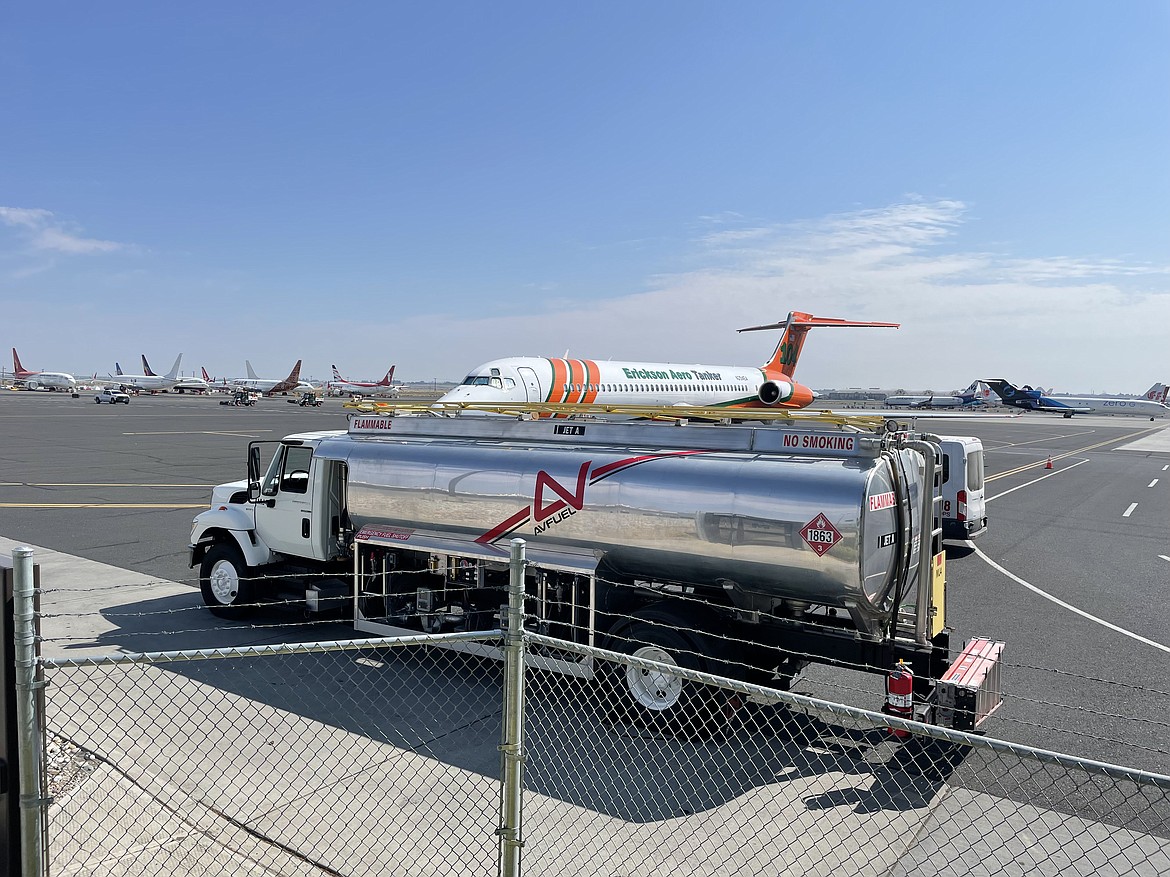
An Avfuel refueling and tanker truck sits in front of the Erickson Aero Tanker MD87 firefighting plane on the ramp at the Grant County International Airport on Wednesday.
Charles H. Featherstone/Columbia Basin Herald
MOSES LAKE — In mid-July, the Grant County International Airport almost ran out of fuel.
“Things got desperate,” said Larry Godden, the general manager of aircraft and pilot services company Million Air at GCIA. “We got down to 1.4 days of supply.”
While Godden said he saw the problem coming earlier this year and started stockpiling fuel, the situation eventually got so desperate Godden requested 100,000 gallons of emergency aircraft fuel from the Washington State Department of Commerce, telling state officials the GCIA’s “general aviation fuel has been depleted” and more fuel was needed to keep the U.S. Forest Service aerial tanker base in Moses Lake operating and fighting wildfires, according to documents Godden submitted to the state and provided to the Columbia Basin Herald.
Godden said Million Air’s storage tanks can hold around 1 million gallons, and he likes to keep around 300,000 gallons on hand just to be safe.
But there is no “typical” day at the GCIA, Godden added.
“I plan on 30,000 gallons per day, when very busy. However, some days we don’t pump any fuel. It’s all a moving target, depending on the wildfires,” he said.
On Wednesday, Godden said he had around 4.8 days of fuel on hand – a little less than 150,000 gallons.
The shortage affecting nearly all of general aviation in eastern Washington, including crop dusters, does not appear to be one of supply – refineries across the Pacific Northwest are producing enough aircraft fuel – but rather a matter of not having enough drivers to deliver the fuel.
“Trucks aren’t available to haul fuel, and there aren’t enough drivers. That’s part of the issue,” said Rep. Tom Dent, R-Moses Lake, who is also a rancher and a pilot who owned a crop dusting operation.
“We can’t identify a supply problem,” he added.
Dent, who said he’s spent the last week trying to solve the problem, also said he believed the situation was related to a misunderstanding of a proclamation issued by Gov. Jay Inslee on July 16, which exempted companies hauling fuel for firefighting aircraft from state laws and regulations regarding hours drivers can work.
But he also said there were a lot of unanswered questions as to why airplane fuel was hard to find in eastern Washington, especially since it was plentiful at rural airports in neighboring states.
“A lot of answers we don’t have,” Dent said. “Fuel is in tight supply.”
Dent has asked the state to temporarily lift weight limits on fuel tanker trucks, allowing them to carry as much as 10% more, as well as for the Washington National Guard to provide fuel tanker drivers.
However, Dent said he also understands fuel is beginning to flow and the supply crunch is beginning to ease.
“We will have adequate fuel,” he said. “We’re on the right track.”
Godden blamed the driver problem on the extended unemployment benefits still being paid by Washington state as part of the response to the COVID-19 pandemic.
“If the state would wake up and cut off their unemployment and have people come back to work, that would greatly help the problem,” he said.
Ann Arbor, Michigan-based Avfuel, which has the contract to supply fuel to the GCIA, did not respond to requests for comment by press time.
According to Guillermo Garza, the commercial drivers license instructor at Big Bend Community College, while there is a shortage of certified tanker drivers, that’s part of a much bigger shortage of truck drivers following the massive expansion of delivery services both for homes and businesses.
“It’s supply and demand, and right now, there’s more demand,” he said.
Garza said in addition to needing a CDL, tanker drivers must be certified to handle hazardous materials – something he teaches as part of BBCC’s five-week CDL program, though not all students opt to take that exam.
“To haul fuel, you have to be careful and trained right,” he said. “It’s not like hauling potatoes or something like that.”
The fuel that has been in short supply is Jet A, which is very similar to stove oil or kerosene, and is used by most turbine-engine propeller and jet-driven aircraft, both Godden and Dent said.
“Turbines are much safer, simpler and easier on pilots,” Dent said.
ARTICLES BY CHARLES H. FEATHERSTONE

Potato prices up, sales down for first quarter 2023
DENVER — The value of grocery store potato sales rose 16% during the first three months of 2023 as the total volume of sales fell by 4.4%, according to a press release from PotatoesUSA, the national marketing board representing U.S. potato growers. The dollar value of all categories of U.S. potato products for the first quarter of 2023 was $4.2 billion, up from $3.6 billion for the first three months of 2022. However, the total volume of potato sales fell to 1.77 billion pounds in the first quarter of 2023 compared with 1.85 billion pounds during the same period of 2022, the press release noted. However, total grocery store potato sales for the first quarter of 2023 are still above the 1.74 billion pounds sold during the first three months of 2019 – a year before the outbreak of the COVID-19 pandemic, the press release said.

WSU Lind Dryland Research Station welcomes new director
LIND — Washington State University soil scientist and wheat breeder Mike Pumphrey was a bit dejected as he stood in front of some thin test squares of stunted, somewhat scraggly spring wheat at the university’s Lind Dryland Research Station. “As you can see, the spring wheat is having a pretty tough go of it this year,” he said. “It’s a little discouraging to stand in front of plots that are going to yield maybe about seven bushels per acre. Or something like that.” Barely two inches of rain have fallen at the station since the beginning of March, according to station records. Pumphrey, speaking to a crowd of wheat farmers, researchers, seed company representatives and students during the Lind Dryland Research Station’s annual field day on Thursday, June 15, said years like 2023 are a reminder that dryland farming is a gamble.

Wilson Creek hosts bluegrass gathering
WILSON CREEK — Bluegrass in the Park is set to start today at Wilson Creek City Park. The inaugural event is set to bring music and visitors to one of Grant County’s smallest towns. “I've been listening to bluegrass my whole life,” said the event’s organizer Shirley Billings, whose family band plays on their porch every year for the crowd at the Little Big Show. “My whole family plays bluegrass. And I just wanted to kind of get something for the community going. So I just invited all the people that I know and they’ll come and camp and jam.” ...