
Smokin’ deal: Fire district uses mechanical savvy in buying ‘new’ ladder truck
CHERYL SCHWEIZER | Hagadone News Network | UPDATED 4 years, 6 months AGO
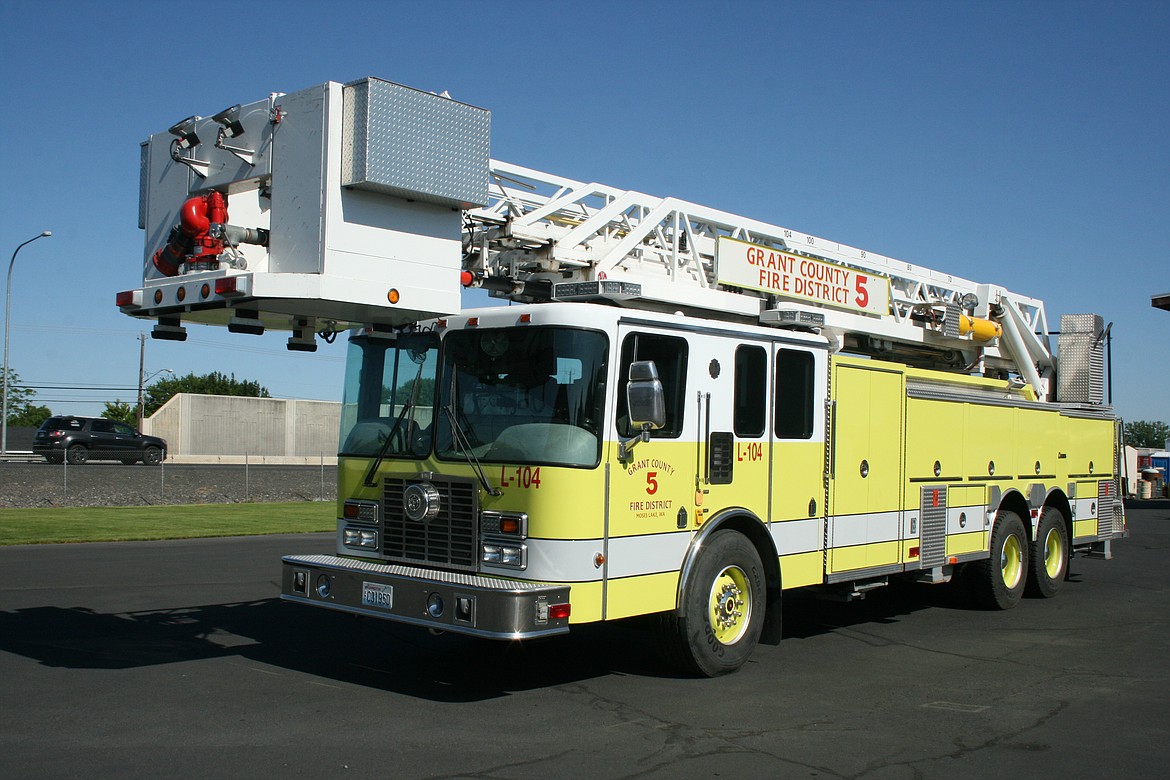
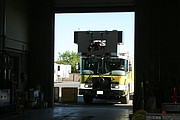
Grant County Fire District 5 took advantage of their expertise in fire truck repair when buying a new ladder truck (pictured).
Cheryl Schweizer/Columbia Basin Herald
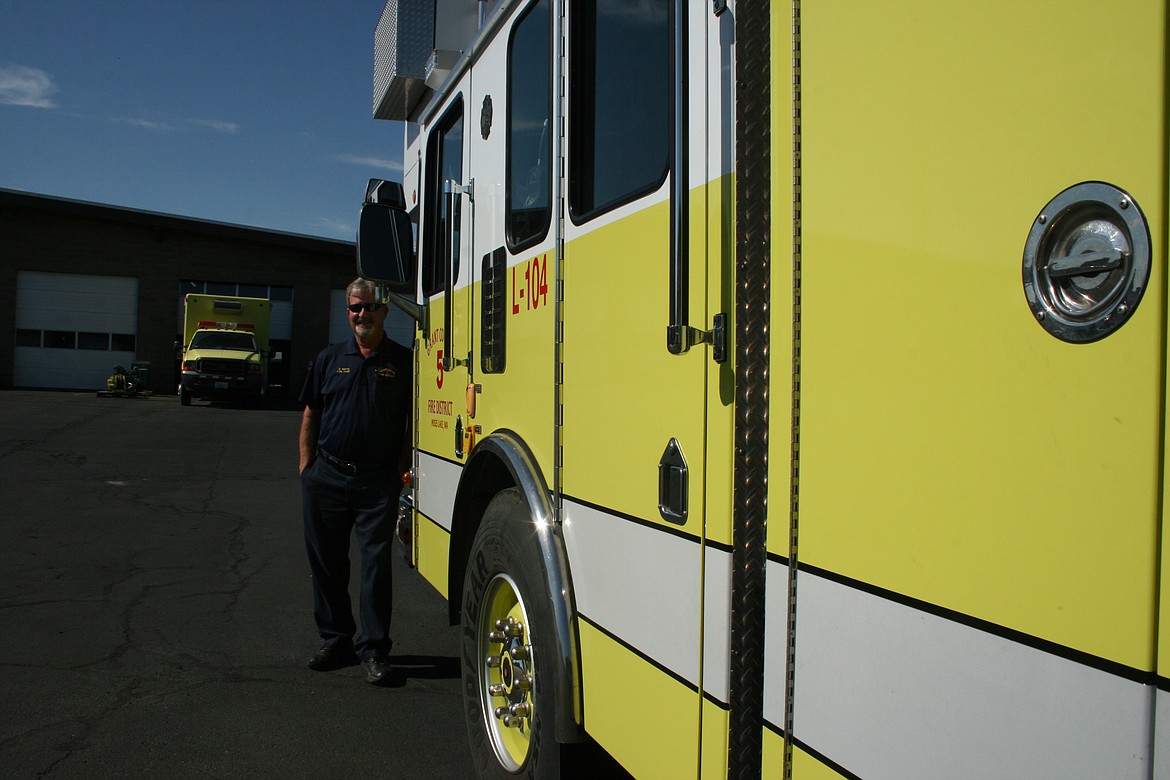
Dan Smith, chief of Grant County Fire District 5, with the district’s new ladder truck.
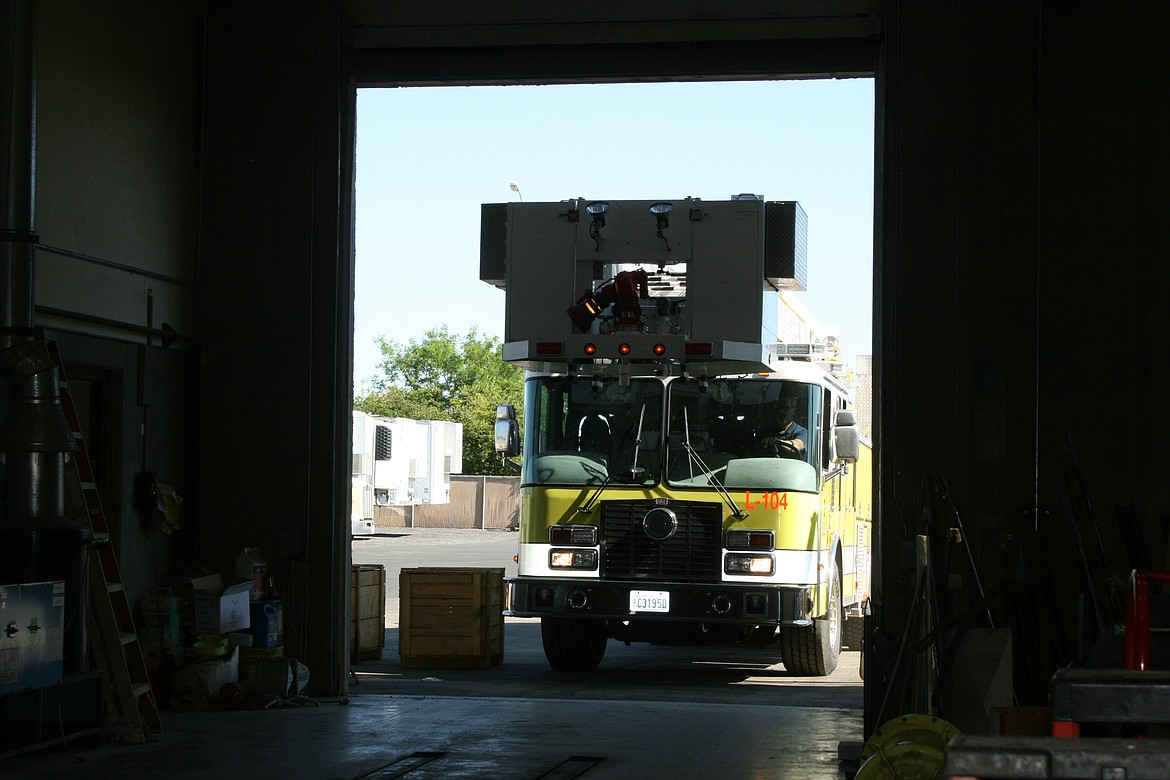
Grant County Fire District 5 Chief Dan Smith drives the district’s new ladder truck into its temporary home.
Senior Reporter Cheryl Schweizer is a journalist with more than 30 years of experience serving small communities in the Pacific Northwest. She began her post-high-school education at Treasure Valley Community College and enerned her journalism degree at Oregon State University. After working for multiple publications, she has settled down at the Columbia Basin Herald and has been a staple of the newsroom for more than a decade. Schweizer’s dedication to her communities and profession has earned her the nickname “The Baroness of Bylines.” She covers a variety of beats including health, business and various municipalities. | June 28, 2021 1:00 AM
MOSES LAKE — Sometimes it pays to know a trained mechanic.
The new-to-the-district ladder truck for Grant County Fire District 5 is 13 feet high, with a ladder that extends a maximum of 104 feet. It has a platform – really a bucket – for firefighters, and GCFD5 Chief Dan Smith said it can pump a lot of water.
Even a used one normally runs six figures, but the fire district got a deal.
“We paid $44,000 for it,” Smith said. “A new one can be over a million (dollars).”
The truck was built in 1999, and was in service in The Dalles, Oregon, until the department there (Mid-Columbia Fire & Rescue) wanted to get rid of it. GCFD5 bought it last fall, worked on it during the winter and publicly showed it last week.
“They were done with it. I think they were having a few problems with it, and they don’t have the means and methods to fix it like we do,” he said.
GCFD5 has a long history of building custom fire trucks, and the personnel who work on its fire trucks have “emergency vehicle technician” certification. A lot of other departments, Mid-Columbia Fire & Rescue among them, don’t have that.
“They would have to pay somebody to come in and do all the repairs on it, where we do them in-house,” Smith said.
Anyone who’s been through a car repair knows a mechanic doesn’t come cheap.
“You can just about double it (labor cost) for a fire truck,” Smith said.
The truck actually was in pretty good repair, nothing the GCFD5 mechanics couldn’t fix.
“Just a lot of TLC,” he said. “It had 20 years of use on it, but only 8,000 miles. It didn’t get used a lot.”
But then, a fire truck isn’t like a car.
“They do get driven hard, because obviously you’re going to be in a hurry to get somewhere,” Smith said. “They sit around a lot, and then get asked to do a job at the drop of a hat with no issues and no problems. We have a pretty elaborate maintenance (schedule) to make sure they are ready to go at all times.”
Maintaining a reliable fleet starts with good equipment, even used equipment.
“We’re pretty picky about the used ones we buy, something that’s well-built to start with,” Smith said.
It’s the district’s fifth ladder truck; Smith said GCFD5 has two with 50-foot ladders, one with a 65-foot ladder and one with a 95-foot ladder.
“As far as fire trucks go, they’re our biggest,” he said.
At 13 feet, the truck won’t fit in the original GCFD5 station on Nelson Road, and is parked in a back building for now.
“You don’t just drive it through a normal door,” Smith said.
Eventually, it will be stationed near the Grant County International Airport. The 95-foot ladder is stationed near the industrial area on Wheeler Road. Newer stations are being built with taller doors to accommodate the biggest trucks.
For a vehicle that big, it’s not that hard to drive, Smith said. He’s driven big vehicles all his life, so it’s pretty familiar for him.
“It’d be comparable to a really big bus,” he said. “It drives really nice.”
But not just anybody can drive it.
“We have a select amount of people that are checked off to drive it,” he said.
Once it’s in service, firefighters will get training in its operation. The main rule, Smith said, is to keep it on the pavement, since it’s very heavy and can’t navigate some off-road surfaces.
Ladder trucks are valuable when it’s a big fire – one that’s already taken out a roof, as an example – and for fires in multi-story buildings.
“It has its purpose,” Smith said.
When the fire has burned through a roof, fighting it from above is easier, he said, and safer than sending firefighters in a structure that’s no longer stable. A ladder truck is valuable when rescuing people from the upper floors of a building.
“They have the ability to move a lot of water. Thousands of gallons a minute through the nozzle,” he said.
The department having ladder trucks helps businesses when it comes to fire insurance. Insurance agencies evaluate fire protection when setting fire insurance rates.
“It’s a valuable tool in the toolbox,” he said.
Cheryl Schweizer can be reached via email at [email protected].
ARTICLES BY CHERYL SCHWEIZER

Outgoing Othello mayor says time in office taught some lessons
OTHELLO — Outgoing Othello Mayor Shawn Logan said his time in office has reinforced some things he already knew and taught him some new lessons, too. “Othello has nice people in it. Really good people. And we really are a family-friendly, youth sports, agriculture, largely Hispanic community,” he said. “I got to know my community better. And the other thing that I was learning is that this town has a lot of kids in it.” Logan was defeated earlier this year in a bid for his fourth term as mayor. He was first elected to the mayor’s job in 2014. Logan said his motivation was to help Othello grow and improve, and that continued to be his focus. The question, he said, was how to do it.
Stevens Pass set to partially reopen
STEVENS PASS — A section of US Highway 2 will reopen Monday for daytime use, with a pilot car, but other sections of the road remain closed. A detour will be available for people trying to access the east section of Highway 2 from Leavenworth.

Winter temperatures to arrive and stay for a while
MOSES LAKE — All those mild days in November and December? All those 50-degree afternoons? Well, as people may have noticed, that late fall weather is going away, at least for the time being. Joey Clevenger, meteorologist with the National Weather Service office in Spokane, said weather patterns are starting to push cold air into Eastern and Central Washington.