
Skeeter patrol: Fighting the bloodsucking pests the job of mosquito control district
CHERYL SCHWEIZER | Hagadone News Network | UPDATED 4 years, 10 months AGO
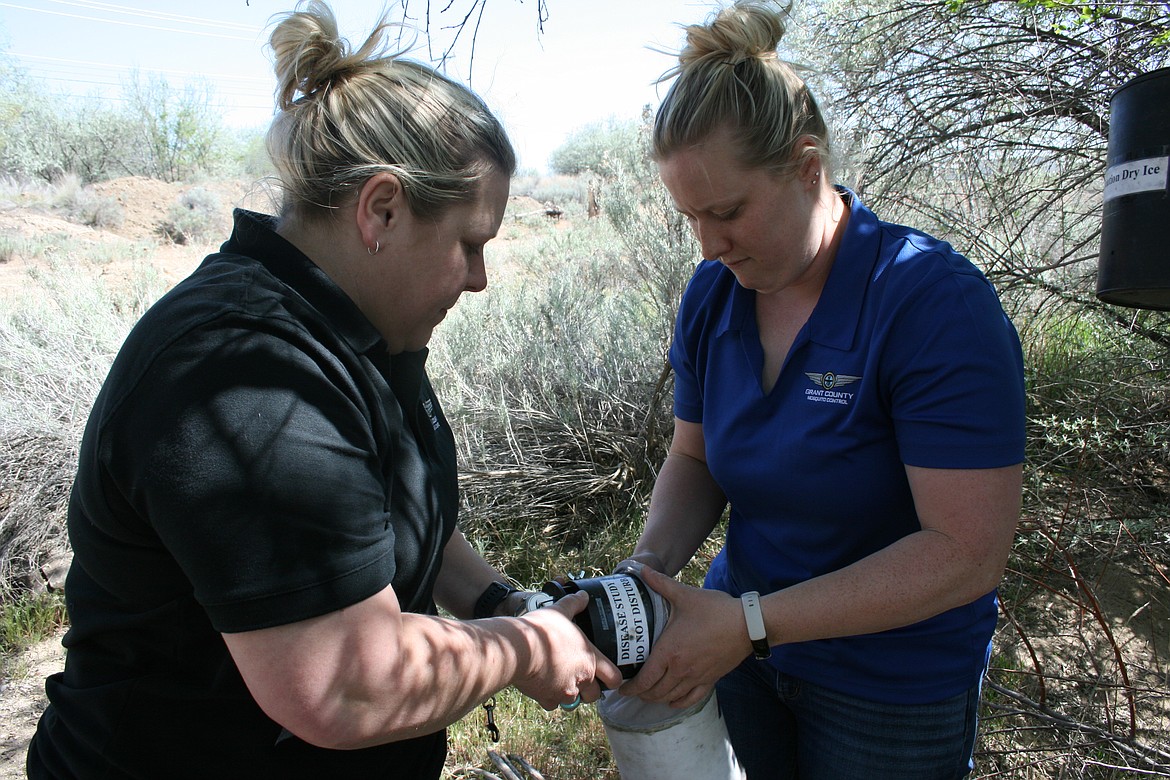
Ann Belchik-Moser, at left, manager of Grant County Mosquito Control District 1, and Carina LeFave, the district’s assistant manager, prepare a mosquito trap Tuesday.
Cheryl Schweizer/Columbia Basin Herald

From the left, Ryan Kuhn, chief pilot for Grant County Mosquito District 1, and manager Ann Belchik-Moser talk to larvicide aircraft pilot Kevin Clare.

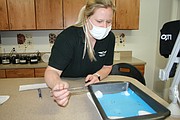
Carina LeFave separates mosquitoes by species.
Senior Reporter Cheryl Schweizer is a journalist with more than 30 years of experience serving small communities in the Pacific Northwest. She began her post-high-school education at Treasure Valley Community College and enerned her journalism degree at Oregon State University. After working for multiple publications, she has settled down at the Columbia Basin Herald and has been a staple of the newsroom for more than a decade. Schweizer’s dedication to her communities and profession has earned her the nickname “The Baroness of Bylines.” She covers a variety of beats including health, business and various municipalities. | May 10, 2021 1:00 AM
MOSES LAKE — It may be counterintuitive, but it’s true, as anybody who’s been outside on a summer evening can testify. The Moses Lake area – yes, that spot out in the middle of the desert – is fertile ground for mosquitoes.
Ann Belchik-Moser, manager of Grant County Mosquito Control District 1, said conditions are just right for mosquitoes. That includes mosquitoes carrying diseases like West Nile Virus.
“We have the most mosquito breeding habitat, I would say, of any other mosquito district in the Pacific Northwest,” she said.
It’s not just the irrigated farmland. There’s an extensive system for getting water to the farmlands, and right now there’s a lot of water going through that system, Belchik-Moser said, much of it destined for O’Sullivan Reservoir.
“While they’re filling that, it increases the water table in the North Potholes Reserve, so that’s where we focus a lot of our larvicide,” she said. “Because that’s where the mosquito larvae are. They’re not necessarily in wide-open water, deep water. They don’t like that.”
Moses Lake is shallow, with lots of shoreline, but that’s not really mosquito habitat.
“The lake isn’t really the problem. It’s all the ponds, and seepage, canal seepage, backyard ponds, anything like that, versus Moses Lake,” she said.
What mosquitoes really like is standing water, especially with vegetation.
“(Locations) that are constantly wet, have a lot of grass or organic matter for the mosquito larvae to eat, they’ll produce and produce and produce all summer long,” Belchik-Moser said.
But while female mosquitoes like stagnant water as a place to lay eggs, they’re not limited to that habitat.
“Eggs can be laid singly on the ground, in preparation for a flood. That’s what’s really fascinating. The egg can be laid on just the soil anywhere. They’ve found some that are 17 years (old),” Belchik-Moser said.
And it turns out winter doesn’t stop them. Some species of mosquitoes hibernate over the winter. And by the time the hibernating mosquitoes emerge, they’re hungry, she said.
Only the females actually bite people, Belchik-Moser said. They’re looking for protein, which they find in blood, to allow them to produce eggs.
“In a person’s normal routine, who’s not in mosquito control, the likelihood of you seeing a male mosquito is rare,” she said.
All male mosquitoes really want is food, shelter, and to find a female, she said.
Some of the bugs that definitely seem to be mosquitoes -- well, some of the bugs out right now -- aren’t mosquitoes at all.
“What that is, is a midge fly. It’s so easy to misidentify them,” she said. “It looks a lot like a mosquito at first glance, but they’re not. They don’t bite, they just hang out.”
Not only are mosquitoes little, nasty, biting nuisances, they carry disease. Humans have been fighting them for centuries. In fact, the reason the mosquito district exists is due to an outbreak of encephalitis in Moses Lake back in the 1950s. Central Washington is home to about eight different species, two of which carry disease.
“The mosquitoes right now are the floodwater mosquitoes that are going to hatch, and they’re very aggressive. But they don’t carry disease,” Belchik-Moser said.
As technology has changed, the methods of fighting mosquitoes have changed. The mosquito control district has had its own pair of airplanes since the 1980s. Aerial application is the most efficient way to apply the materials, Belchik-Moser said.
“Larvicide,” like its name implies, is used to kill mosquito larvae. The stuff used on the adult mosquitoes is self-explanatory as well. It’s called “adulticide.”
Different aircraft are used to apply the larvicide and the adulticide. The adulticide aircraft can cover up to 7,500 acres in the course of a night, while the larvicide plane can cover about 250 acres an hour. Mosquito control is done at night, when mosquitoes are active, but bees and other pollinators have gone home for the night.
Of course, aerial applications don’t work everywhere. The district has trucks for what Belchik-Moser called “ultra low volume” application. Some places require spraying by hand. Modern technology uses nature against the bugs. What looks like -- and is -- chopped-up corn cob is the method of doom for mosquito larvae.
“There’s a bacteria that’s sprayed on this corn. And once this hits the water, the bacteria comes off the corn, and the corn cob just disintegrates. The bacteria just hangs out in the water column, the mosquito comes along, because they filter feed, and they eat it, and life’s over,” Belchik-Moser said.
Grant County Mosquito Control District 1 assistant manager Carina LeFave said most of the effort is aimed at mosquito larvae.
“We really try to kill them before (they emerge) and have wings,” LeFave said.
District employees also trap mosquitoes to test them for disease, a procedure that involves a can that looks like a paint can, netting, and dry ice. The extreme cold of the dry ice puts them to sleep, LeFave said. Then they can be separated by species, and the ones that might carry disease are tested to see if they are carrying disease. It’s important to keep them alive during the process, Belchik-Moser said, since killing them makes it more difficult to determine if they are carrying a virus.
The best way to control mosquitoes is to keep control of the area around a residence or property, checking to see that standing water is removed and the water in a pond, trough or swimming pool is kept moving.
“And if you have mosquitoes, let us know, and wear repellant,” Belchik-Moser said.
Cheryl Schweizer can be reached at [email protected].

ARTICLES BY CHERYL SCHWEIZER

Road closures, roundabout, mean construction season underway
EPHRATA — The grass is starting to turn green, the trees are starting to leaf out, construction crews are starting to build roundabouts – hey, it’s spring. At least one roundabout project is in its final phase, held over from fall 2025. The intersection of State Route 282 and Nat Washington Way will be closed the week of April 6 to allow crews to install permanent lights. “This really is the final (closure),” wrote Grant County Administrator Tom Gaines in a media release. “The roundabout will close at 6 a.m. Monday, and we plan to reopen by Friday, possibly sooner if the work finishes early.”

Ybarra announces run for Washington Senate
QUINCY — State Representative Alex Ybarra, R-Quincy, has announced his candidacy for the Washington Senate. If he’s elected, he would replace Judy Warnick, R-Moses Lake, who announced her retirement in March.
Othello Community Museum to open April 25
OTHELLO — With a couple of new exhibits, a new heating-cooling system, rearranged displays and a thorough cleaning, the Othello Community Museum will open for the summer April 25. The goal, said Molly Popchock, museum board secretary, is to operate for a full season.