
How to maintain your forest
EMILY BONSANT | Hagadone News Network | UPDATED 4 years, 11 months AGO
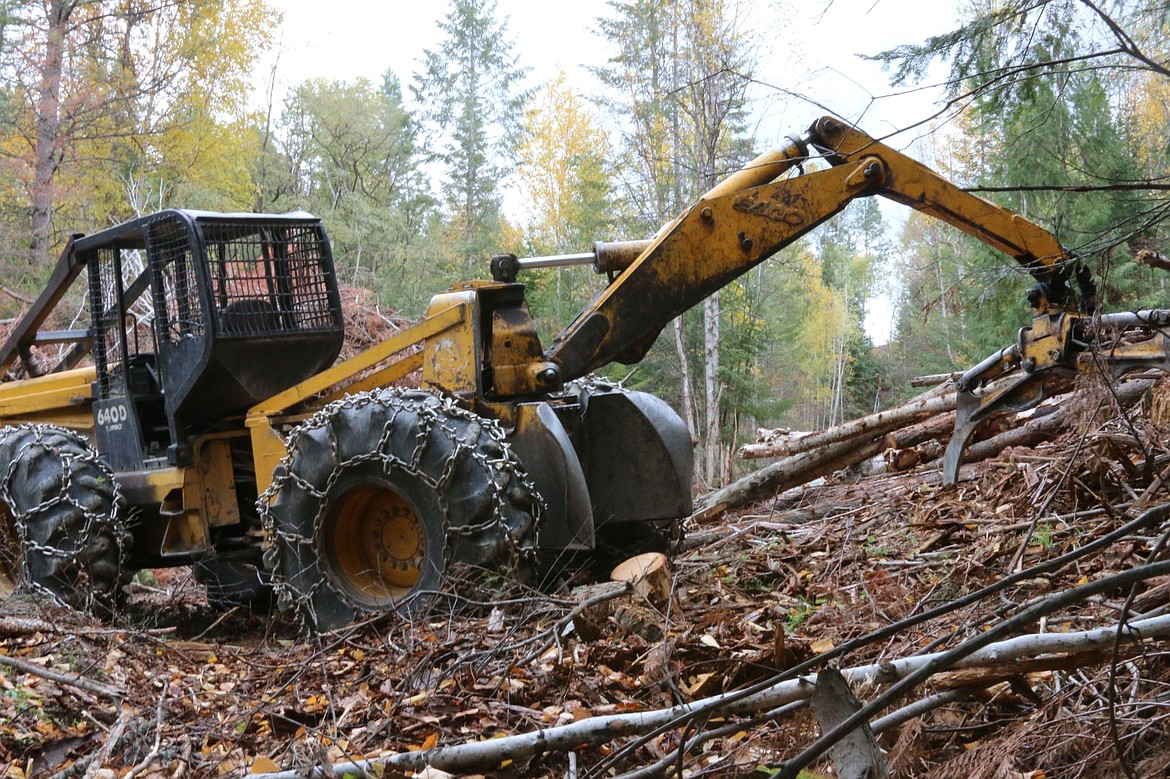
Logging equipment on logging site.
(Photo by EMILY BONSANT)
I have deep North Idaho roots and graduated from Eastern Washington University with an English degree with a creative writing emphasis with a minor in film. I worked at at the Bonner County Daily Bee before coming to work at the Bonners Ferry Herald in August 2021. I enjoy writing for the paper that my great-grandfather read and covering the same small town community that is still alive today. I cover all things Badger sports, local politics and government, community news, business, outdoors and appear on the 7Bee podcast for the Herald's update. When I'm not working I can be found reading a good book and sipping tea, knitting or attempting to sign opera. | October 27, 2021 1:00 AM
BONNERS FERRY — If you’re wondering how you can keep your forest healthy, professional forester Russ Hegedus has the answer.
Mills and loggers are always seeking logs and land to log, Hegedus said. He prepares a forestry management plan for land owners. He then assists landowners to get their property logged. Hegedus’ goal is responsible harvesting of timber.
“Timber is a crop,” said Hegedus. “Loggers and foresters have this mindset.”
Before you call the loggers, Hegedus said it is a good first step to make sure your boundary lines are clearly marked. If there is good timber on the boundary line, the loggers will take every other tree since the ownership of trees on boundary lines is disputed.
Desired species for logging include Douglas Fir, Western Larch, Grand Fir, Western Hemlock, Lodgepole Pine, White Pine, Engelmann Spruce, Sub-Alpine Fir, Ponderosa Pine and Western Red Cedar.
Foresters like Hegedus look for sick, dead and dying trees, whose health is failing in some sort of way. He said that weather changes and drought impact the trees.
“Some forests are overstocked with trees without any regards to the weather,” he said.
When making a forestry management plan Hegedus looks at the number of trees per acre and the size of the trees. The number is not a one-size fits all, said Hegedes, every piece of land is different.
“It all comes down to forest health and how to make the forest more resilient to drought,” he said.
When it comes to taking stock of the trees on someone’s land Hegedus will walk the property with the landowner. He said that people don’t really know what they have on their property when it comes to tree species, tree stock and value.
“It doesn’t matter if it is five, 10 or 150 acres, trees and other vegetation grows and is in a constant state of change,” he said.
When it comes to landowners getting their property logged, Hegedus wants it to be clear to landowners that they have to have enough logs or stock to make the logging job worthwhile to loggers. He said it is hard to move all the equipment necessary for logging on properties, adding there are added expenses of transporting the equipment from job site to job site.
“The biggest limiting factor isn’t land, or landowners; it is staff, loggers, truck drivers and the sawmill workers,” he said.
Hegedus said that when lumber prices went up the price for logs did as well. Last year landowners were in the place of need when it came to logging because of the lack of loggers, said Hegedus.
He said that there were local loggers who are booked out a year and a half for jobs.
Hegedus suggested some things for landowners to look out for when it comes to tree health.
The scolytus beetle, or the Fir Engraver Beetle, mainly attacks firs, but will also target Engelmann Spruce and Mountain Hemlock, said Nevada Division of Forestry. The beetle will enter the tree over the summer and will prevent the passage of nutrients from the top of the tree to the roots, said Hegedus.
“The bows will turn in and the beetles will work their way up the tree,” he said. “Another generation of beetles will hatch in the tree, finish it off and then move on.”
Another thing to look out for is at fall time Grand Firs change to a yellow or orange color, said Hegedus. The fir will be trying to flush nutrients from the leaves down to the roots and when that doesn’t happen it will realize it is dead, he said.
ARTICLES BY EMILY BONSANT

Bears, cider press, family fun, oh my!
Apples were pressed, and fresh cider flowed at the second annual North Idaho Bear Fair at the Boundary County Fairgrounds on Sept. 28.

One farm, one family, 100 years
Houck Farm celebrates a centennial of farming, family
Houck Farms has hit the centennial milestone and aims to continue growing and harvesting as they keep focused on a family creed, “If you take care of the farm, it will take care of you.”

Kokanee Coffee moves to Bonners, still serving coffee and the Lord
Kokanee Coffee, a familiar regional coffee house, has moved to a stand in Bonners Ferry, offering excellent coffee, food and the love of Christ.