
COVID CRISIS
KAYE THORNBRUGH | Hagadone News Network | UPDATED 5 years, 1 month AGO
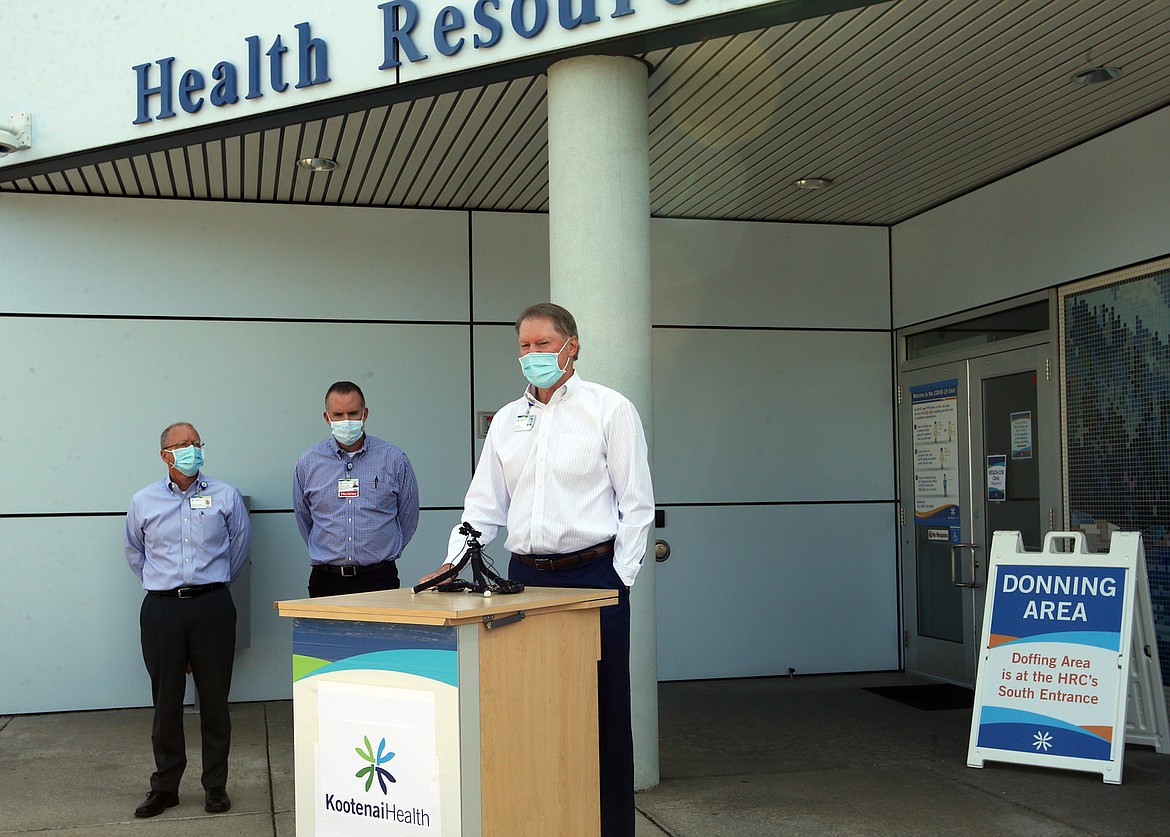
Kootenai Health CEO Jon Ness said Tuesday that the best thing Idahoans can do to ease the strain on local hospitals is to get vaccinated against COVID-19. KAYE THORNBRUGH/Press
Kaye Thornbrugh is a second-generation Kootenai County resident who has been with the Coeur d’Alene Press for six years. She primarily covers Kootenai County’s government, as well as law enforcement, the legal system and North Idaho College. | September 8, 2021 1:40 AM
COEUR d’ALENE — Surging COVID-19 cases have pushed Kootenai Health and other area hospitals to crisis standards of care for the first time since the pandemic began.
It’s a day that health care workers in North Idaho hoped would never come.
The Idaho Department of Health and Welfare announced Tuesday that Panhandle Health District and the Idaho North Central District entered into crisis standards because of “a massive increase in patients with COVID-19 who require hospitalization.”
That means resources are stretched so thin patients can no longer expect the level of care they would receive under normal circumstances.
“Care for COVID patients is taking away from care for non-COVID patients,” said Dr. Robert Scoggins, chief of staff and medical director of critical care at Kootenai Health. “It’s nothing I’ve ever experienced in my career.”
Crisis standards of care are guidelines that health care providers follow in order to decide how to best treat patients in a disaster or emergency.
Initially, crisis standards can mean patients are receiving care in a place where they wouldn’t otherwise, such as the Kootenai Health classroom that has been converted to a care room for up to 22 patients. So far, seven patients have been admitted to the unit.
Nurses may provide care to more patients than they would normally, or monitor vital signs less frequently.
In extreme instances, hospital care teams have to choose how to ration resources, such as oxygen.
“We may have to make hard decisions about who gets what and when,” said Jeremy Evans, Kootenai Health’s COVID incident commander.
No single health care provider would make that kind of decision, he noted. Kootenai Health has a multi-disciplinary ethics committee that has established protocols to guide allocating resources and care.
Kootenai Health reported that 108 people were hospitalized Monday due to COVID-19, with 39 in critical care.
“We’re at the limit of what we can handle,” Scoggins said. “It just keeps growing.”
That's due to several factors: the delta variant, low vaccination rates and staffing shortages.
Evans described the delta variant as “aggressive,” adding that it’s more contagious and makes people sicker than other versions of the coronavirus.
Still, COVID-19 vaccines provide strong protection against it.
“The one thing that could make a difference is to increase the vaccination rate in our community,” Kootenai Health CEO Jon Ness said during a Tuesday afternoon press conference.
In Idaho, about 40% of people over the age of 12 are fully vaccinated. It’s one of the lowest vaccination rates in the country.
Since the beginning of the most recent surge, 97% of patients hospitalized for COVID-19 at Kootenai Health are unvaccinated.
Data from IDHW shows the overwhelming majority of people who are dying from COVID-19 are unvaccinated.
Infections among vaccinated people, called breakthrough infections, are rare.
Vaccinated people who contract COVID-19 are likely to experience a much milder case than they would have without vaccination.
Kootenai Health has not admitted a single patient for adverse reactions to the COVID-19 vaccine.
As school resumes this week, Evans urged parents to vaccinate their children over the age of 12.
Kootenai Health has no pediatric ICU and limited pediatric beds. Children who need extra care — whether for COVID-19 or another ailment — will likely have to go elsewhere.
But there aren’t enough beds in the region to accommodate them.
Evans said the hospitals where Kootenai Health normally transfers pediatric patients, mostly in Spokane and Seattle, are full.
Though children often fare well against COVID-19, they can pass the virus on to more vulnerable people.
“They may not get sick,” Evans said. “But their parents or grandparents will.”
Ness said the state of Idaho has secured full-time health care workers to help staff overwhelmed hospitals. These workers will head to the Boise and Coeur d’Alene areas this week.
“That help could not be coming at a better time than right now,” he said.
Still, the additional workers won’t fully bridge the gap.
The best thing Idahoans can do to ease the strain on area hospitals is to get vaccinated against COVID-19, Ness said.
“Help your local hospital help you,” he said.
ARTICLES BY KAYE THORNBRUGH

Stateline shooter pleads guilty to manslaughter
A DoorDash driver who fatally shot a pedestrian during a road rage incident near Stateline Speedway has pleaded guilty to voluntary manslaughter, though whether a judge will accept the pretrial settlement offer in the case remains to be seen.
Stateline shooter pleads guilty to manslaughter
Prosecutors originally charged Edsel Johnson with first-degree murder
A DoorDash driver who fatally shot a pedestrian during a road rage incident near Stateline Speedway has pleaded guilty to voluntary manslaughter, though whether a judge will accept the pretrial settlement offer in the case remains to be seen.

Kootenai County history revealed
Community members get close-up look at time capsule contents
Liz Boutin is no stranger to historical artifacts. A museum professional and fine artist, Boutin said she's handled Egyptian and Greek items that date back to antiquity. But she had a new experience this summer, after local historical preservationists retrieved a 100-year time capsule from inside the outer wall of the old Kootenai County courthouse.