
Kalispell sets record for hottest summer
MATT BALDWIN | Hagadone News Network | UPDATED 4 years, 6 months AGO
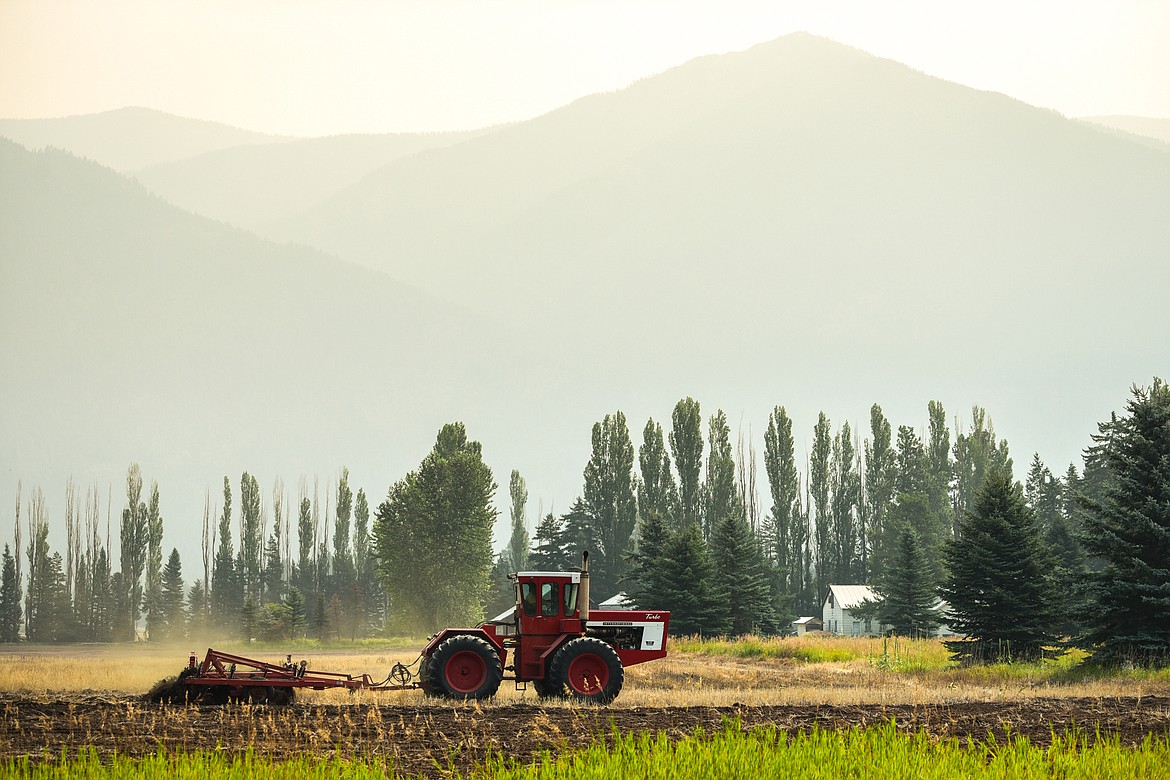
A farmer cultivates a field as smoke from neighboring wildfires masks a view of the Swan Range along Montana Highway 206 on Wednesday, Aug. 4. (Casey Kreider/Daily Inter Lake)
Hagadone Media Montana REGIONAL MANAGING EDITOR Matt Baldwin is the regional editor for Hagadone Media Montana, where he helps guide coverage across eight newspapers throughout Northwest Montana. Under his leadership, the Daily Inter Lake received the Montana Newspaper Association’s Sam Gilluly Best Daily Newspaper in Montana Award and the General Excellence Award in 2024 and 2025. A graduate of the University of Montana School of Journalism, Baldwin has called Montana home for nearly 30 years. He and his wife, Sadie, have three daughters. He can be reached at 406‑758‑4447 or [email protected]. IMPACT: Baldwin’s work helps ensure Northwest Montana residents stay connected to their communities and informed about the issues that shape their everyday lives. | September 23, 2021 1:00 PM
This summer was the hottest on record in Kalispell, according to new climate data from the National Weather Service in Missoula.
The average temperature for the city between June 30 and Sept. 22 was 66 degrees, which is 3.9 degrees higher than normal.
The hottest day was July 31 when thermometers set a daily record at 101. While that was the only triple-digit day of the summer, 19 days in July and August reached the 90s or higher.
The average July temperature was 71.5, making it the second hottest July in the last two decades.
According to National Weather Service senior forecaster Bob Nester, a contributing factor to the hot summer was a strong high pressure ridge that lingered over the West and Northern Rockies from late June through early August.
That ridge kept needed precipitation at bay, as well. Kalispell’s summer rainfall was below average, with just 3.65 inches falling on the city for the season.
Kalispell's weather station is at Glacier Park International Airport.
To the south, Missoula recorded its third hottest summer ever, with an average temperature of 68.8 — 3 degrees higher than a normal summer. Missoula had a record 22 consecutive days with a maximum temperature over 90.
Precipitation in the Garden City was below average as well, with just 2.3 inches hitting the rain gauge.
THE HOT and dry summer contributed the state’s early and active wildfire season, with more than 2,406 fires burning around 886,000 acres in Montana so far this year.
Nester noted that large wildfires in the Northern Rockies started a full two weeks earlier than normal.
According to a wildfire briefing from Gov. Greg Gianforte’s office, officials estimate 53 homes have been lost to wildland fires this year and that the state has spend about $55.7 million fighting wildfires since the start of the current fiscal year.
The hot summer also prompted numerous fishing restrictions across Montana due to low river flows and warming water temperatures.
The restrictions included what are commonly known as "hoot owl" rules, which mean fishing is prohibited from 2 p.m. to midnight each day. Some waters were closed to fishing at all times of day.
Northwest Montana remains in a "severe drought," according to the National Integrated Drought Information System.
ARTICLES BY MATT BALDWIN

PHOTOS: No Kings protest draws crowd to Whitefish
A No Kings protest against the Trump administration drew hundreds of people to Grouse Mountain Fields in Whitefish on Saturday, March 28, 2026. The event, hosted by Flathead Democracy, was one of thousands held across the U.S., according to national event organizers.
Avalanche danger high after 2 to 3 feet of new snow
Dangerous backcountry conditions prompted a special avalanche warning Friday morning after Northwest Montana mountains were buried in 2 to 3 feet of snow.
Avalanche danger high after 2 to 3 feet of new snow
Dangerous backcountry conditions prompted a special avalanche warning Friday morning after Northwest Montana mountains were buried in 2 to 3 feet of snow.