
An updated option: Manufactured homes may be an option in tight market
JOEL MARTIN | Hagadone News Network | UPDATED 4 years, 5 months AGO

Valley Quality Homes manager Ray Acheson, left, and sales rep Rudy Salazar stand in front of a 2,400-square-foot manufactured home. The industry has come a long way from the perception of an ephemeral trailer house, they said.
Joel Martin/Columbia Basin Herald
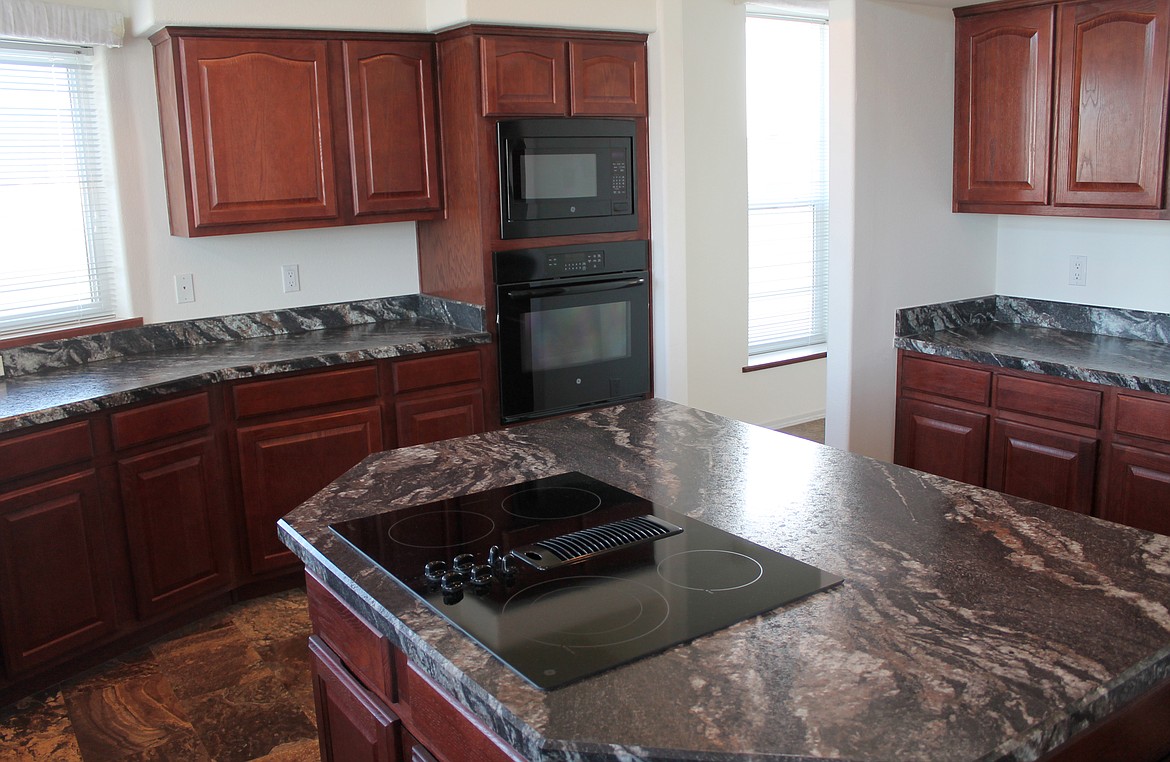
Valley Quality Homes manager Ray Acheson described this kitchen in a manufactured home as “a Guy Fieri kitchen on steroids.”
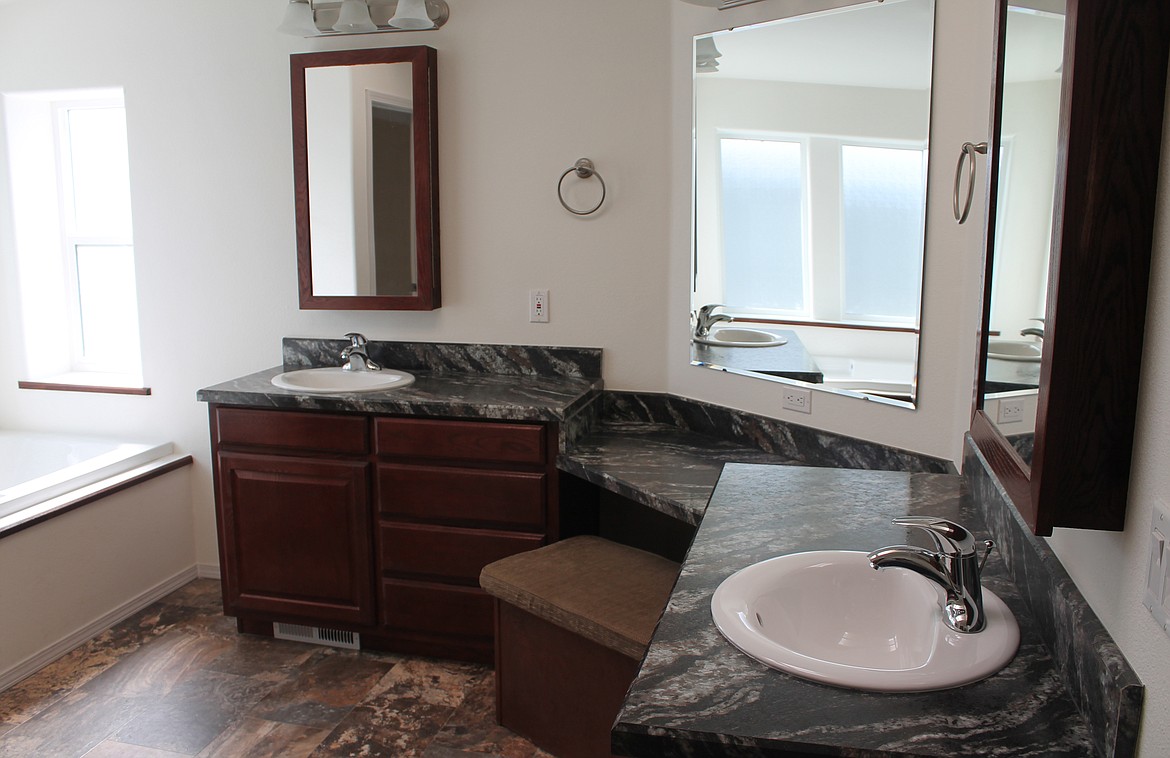
The master bathroom in a 2,800-square-foot Valley Quality Homes house.
Joel Martin has been with the Columbia Basin Herald for more than 25 years in a variety of roles and is the most-tenured employee in the building. Martin is a married father of eight and enjoys spending time with his children and his wife, Christina. He is passionate about the paper’s mission of informing the people of the Columbia Basin because he knows it is important to record the history of the communities the publication serves. | April 1, 2022 1:00 AM
MOSES LAKE — “It’s not Grandma’s trailer house anymore.”
That’s how Rudy Salazar, sales rep at Valley Quality Homes in Moses Lake, sums up the changes he’s seen in the manufactured home market.
“Our manufactured home industry has really evolved into a very, very competitive alternative to the real estate market out there. We're seeing an influx of a lot of people coming into it.”
In the 1980s and ’90s, manufactured home dealers dotted the real estate landscape, in the Basin and elsewhere. Today Valley Quality Homes, headquartered in Yakima, is one of the few still operating in the area, and the only one still located in Moses Lake.
Valley Quality Homes manufactures all its own products, Salazar said, whereas many dealers merely buy and sell homes built by other manufacturers. Salazar believes the difference in construction standards is one of the reasons for the lower presence.
“A lot of times when you buy a home, it's from one manufacturer, but a dealer sells it and they tell you to call the manufacturer (if there are problems),” Salazar said. “I think over the years, some other manufactured homes companies kind of fell by the wayside, basically because of quality. So that’s a big factor for most folks, because the quality of the home is definitely on the table.”
“Eighty or 90% (of home manufacturers) use chipboard flooring, and chipboard roofing or particle board,” said Valley Quality Homes manager Ray Acheson. “We use plywood flooring, we use plywood roofing. Most manufacturers have a 20-pound roof load, some might have a 30-pound roof load. Our lowest roof is 40 pounds per square foot.”
The change in quality standards has been driven largely by Washington state’s comparatively consumer-friendly regulations. Dealers in other states aren’t bound to those same standards, Acheson said. Consumers can order homes online from out of state and have them shipped in, Acheson said, but local manufacturers are bound to higher standards.
“Washington state is a consumer state,” Acheson said, “So, a lot of (dealers) have gone to Oregon or Salt Lake City or something like that, because those are business states. And they don't have to have quite as good protection for their clients if they're operating.”
“And what they do a lot of times is they'll have a factory down there, and they'll open up a little dealership right there ... And they have aggressive ways that they do it,” Acheson added. “They take 10% down, and then they don't really check on the (building) permit because they don't care. They just get them out there. And then you're forced to pay, where we do a lot of that stuff. We actually require a copy of the building permit before we'll even deliver the home.”
Manufactured homes are also financed in much the same way as site-built, Salazar and Acheson said.
“If you do FHA, VA, conventional, any of those - we still require 10% down,” Acheson said. “But those are a fixed rate, 30 years, they're bought by the federal government. They're part of a mainstream buying process. And then what we do is we have the title eliminated in most cases, rezoned as a single family dwelling, and the banks lend on them the same as houses.”
But what about resale value? Manufactured homes have a reputation for quick depreciation, which Acheson and Salazar said was unjustified.
“I think that was a perception back then,” said Salazar. “But I think that has vastly changed since the quality of the homes, the reputation of the homes, has increased. So has, I think, valuation on those as well.”
Acheson said the cost comparisons for building a traditional home versus a manufactured home show value for the size of the home leaning in favor of manufactured homes. He said the cost to build sometimes can outweigh the perceived value of a traditional home, anecdotally.
“So you know, you could pay a lot of builders right now charging $200 to $250 per foot where we only charge $110,” he added.
A home, site-built or manufactured, is a major investment, and getting burned can be very expensive. Salazar and Acheson offered some suggestions for folks looking into the possibility of a manufactured home.
Internet research is good, Acheson said, but it’s not a substitute for making phone calls. The state Department of Labor and Industries is a good place to start, he said, as is the Better Business Bureau. Local building officials are an excellent source of information as well, he added. He suggested consumers ask whether the dealer they’re considering follows through on promises made, and whether they keep contact with the consumer directly or merely direct them to a phone number.
“‘How long have you been in business?’ is a good question to ask,” Acheson said. “Do you have service after the sale? I mean, do you deliver?’ A lot of them don't now, especially the internet ones, they don't even include delivery. They give you like 15 names: ‘Here's some people that we think in that area might put them together or deliver them.’”
“All dealers actually are responsible for following up on service,” he added. “But a lot of them find that it's easier to tell you to call the manufacturer itself.”
Salazar said cost follows value and modern manufactured homes offered locally may seem more expensive than in the past, but it’s worth it for the peace of mind.
“These aren't really the trailer houses of yesteryear,” Salazar said. “I mean, these homes are exceptional homes, and they're basically nice looking homes that will sit on a structured form.”

ARTICLES BY JOEL MARTIN

Quincy National Night Out scales down
QUINCY — Quincy’s National Night Out was more compact this year, which worked out well, said QPD Sgt. Joe Westby, who’s in charge of event planning for the Quincy Police Department. “National Night Out is a big event, and the fact that we’re able to shrink it up is like a breath of fresh air,” Westby said. “If you're always doing the same thing, it's kind of nice to switch things up and see how it works.” National Night Out took place Thursday on the block of C Street next to the police station, a shift from previous years when it was held at Lauzier Park. The smaller space meant fewer emergency vehicles for children to explore, but it also meant less walking for attendees. Grant County Fire District 5 brought a fire truck, and the Grant County Sheriff’s Office had a patrol boat. Renew, the Grant County behavioral health agency, had a booth and so did Quincy Partnership for Youth. Veterans Operation Creation sang the national anthem, and the Quincy Animal Shelter brought kittens that piled over each other making friends with passersby. As before, the QPD served grilled hot dogs.

Quincy Police retirements leave big shoes to fill
QUINCY — There are some big shoes to fill at the Quincy Police Department. “We’re losing 48 years of experience between them,” Quincy Police Chief Ryan Green said at the retirement party for Capt. Jorge Trujillo and Det. Damon Powell Thursday. Trujillo, who grew up in Sunnyside, has been with QPD for 19 years, he said, coming on as a patrol officer fresh out of the military. From there he served as a field training officer, a detective and finally captain. “I consider him my left-hand man,” Green said. “He runs the operations side of the house … He knows the agency very well, and he knows the community.” Trujillo has some projects around the house to tackle now that he’s retired, he said.

Big fun on a small scale
Wheat Land Communities’ Fair opens Thursday
RITZVILLE — The Wheat Land Communities’ Fair isn’t as big or as flashy as some of the county fairs around central Washington, but the folks who keep it going like it just the way it is. “It’s somewhere you can go and get an old-time traditional feeling, and you’re comfortable letting your kids roam the grounds and experience all that it has to offer,” said Board Member Lori Williams. “It’s more of a feeling than (one) specific thing,” The fair starts Thursday in Ritzville and runs through Sunday. Starting Friday, the 56th Ritzville Rodeo will take place alongside the fair at the rodeo grounds. This year the entertainment budget was expanded, Williams said, to be able to offer more fun that’s covered by the cost of admission. For the kids, there’s face painting, balloon art, Lego crafts, races, contests and games. Children can also ride on a little train towed around the fairgrounds behind a tractor.