
ACSO training details dangers of fentanyl
CHERYL SCHWEIZER | Hagadone News Network | UPDATED 4 years, 4 months AGO

Adams County Sheriff’s deputy Tanner Gilbert studies a fentanyl pill during training Wednesday in Othello. Pills containing the dangerous drug often have a potentially lethal dosage of the narcotic.
CHERYL SCHWEIZER/COLUMBIA BASIN HERALD
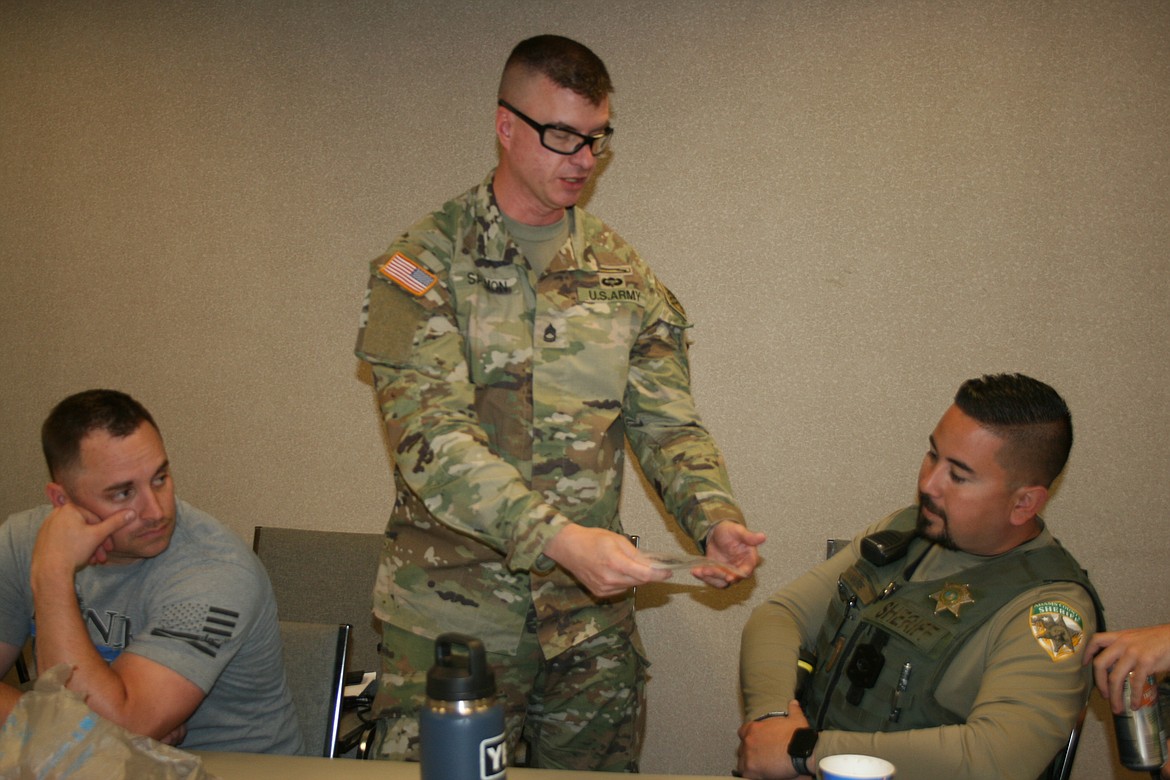
Sergeant first class Scott Salmon hands out an example of a fentanyl pill to Adams County Sheriff’s deputies.
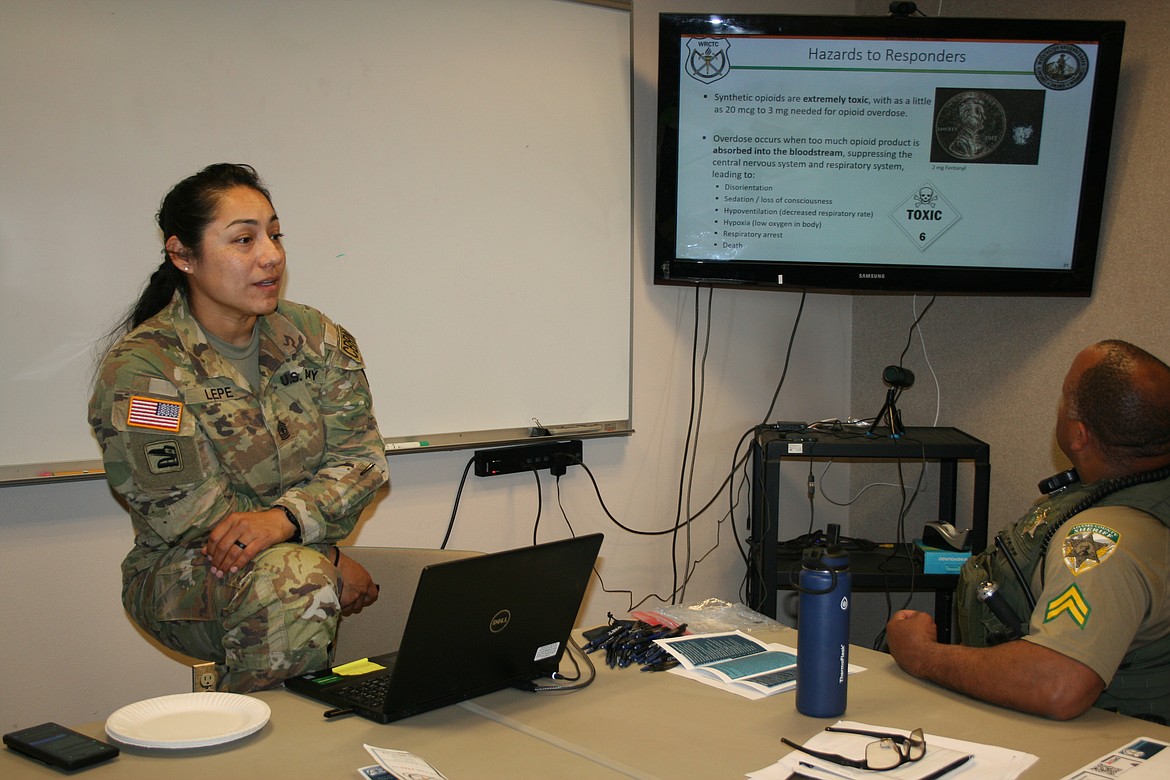
First sergeant Maria Lepe details some of the hazards of fentanyl to first responders and law enforcement officers during training for Adams County Sheriff’s deputies Wednesday.
Senior Reporter Cheryl Schweizer is a journalist with more than 30 years of experience serving small communities in the Pacific Northwest. She began her post-high-school education at Treasure Valley Community College and enerned her journalism degree at Oregon State University. After working for multiple publications, she has settled down at the Columbia Basin Herald and has been a staple of the newsroom for more than a decade. Schweizer’s dedication to her communities and profession has earned her the nickname “The Baroness of Bylines.” She covers a variety of beats including health, business and various municipalities. | April 28, 2022 1:20 AM
OTHELLO — There are not necessarily an infinite number of ways to package and distribute fentanyl, but there are a lot. And law enforcement officers and corrections department staff encounter them all.
U.S. Army first sergeant Maria Lepe of the Western Regional Counterdrug Training Center laid out some of the possibilities for deputies with the Adams County Sheriff’s Office during a training session on the drug Wednesday.
“The characteristics we have are powders or pills or liquids or blotter paper,” she said. “A lot of the blotter paper is kind of like what you see a lot in the jail. Normally, meth gets put on the blotter paper, but now there’s also the potential risk of fentanyl.”
Fentanyl has been around about 60 years, Lepe said - but it’s a relatively new problem for law enforcement. Overdose deaths from synthetic opioids including fentanyl were about 12 times higher in 2019 than 2013, according to the Centers for Disease Control.
“We want the officers to know how to handle the product safely, how to respond to situations when they come across them,” Lepe said.
U.S. Army sergeant first class Scott Salmon, also with the Counterdrug Training Center, said any new drug brings its share of urban legends, and part of the training is to make sure law enforcement officers have the facts, not just rumors.
“We are dispelling a lot of those myths so that the officers can more effectively not only handle the evidence (safely), but also be more confident in their ability to do investigations, make arrests and ultimately get folks off the street with this stuff,” Salmon said.
Currently, fentanyl is most commonly distributed in pill form, Salmon said. The pills are made to look like prescription medications such as opioids or anxiety medicine.
“The counterfeiters are getting really good at it, but they haven’t really mastered the craft yet,” he said.
A counterfeit pill might be flaking apart or have pits in it, or if it’s colored, the color will be inconsistent, Salmon said. So a bag filled with pills of a slightly different color could be a tipoff to the presence of fentanyl, he said.
The pills themselves do not present a hazard to officers, if they’re still in pill form, he said.
“The only way you can get high off that fentanyl pill is by ingesting it,” Salmon said, pointing to a pill in an evidence bag.
According to the DEA, about 42% of fentanyl pills contain about 2 miligrams of fentanyl - a potentially lethal dose.
Fentanyl in liquid form can be absorbed through the skin which can make it dangerous, Lepe said.
“If you get it on your skin, yes, you can absorb it, because it will react with your skin,” she said. “So wearing gloves is extremely important.”
In answer to a question from Lepe, Adams County Sheriff Dale Wagner said deputies don’t do field tests for fentanyl.
“Currently, if we suspect that it’s fentanyl we don’t test it. We just don’t deal with it. We send it off to the lab,” Wagner said.
ACSO does have testing capability, but the department has been advised against doing the testing themselves, Wagner said.
“You just don’t know what you’re getting into,” he said.
He asked what other agencies around Washington were doing.
“Some agencies do field testing if it’s in the form of powder,” Lepe said.
“That’s the most dangerous (form),” Wagner said.
Fentanyl frequently is mixed with other drugs, and sometimes users know what they’re getting, but sometimes they don’t, Lepe said.
“The pills, though, they are sending (those) to the lab,” Lepe said. “It’s just safer to send it to the lab and get exactly what’s in that pill.”
Cheryl Schweizer may be reached at [email protected].
ARTICLES BY CHERYL SCHWEIZER

Road projects on hold for Labor Day weekend
MOSES LAKE — With Labor Day weekend dead ahead, drivers will be able to move freely about the state. Most road projects are on hold for the holiday weekend. Nobody will be working on the Hansen Road overpass on Interstate 90, but the lane restrictions that are in effect will continue through the end of the project.

Cost estimates for water source alternatives given to Moses Lake City Council
Protected under the U.S. Endangered Species Act, efforts are ongoing to keep it self-sufficient
MOSES LAKE — It’s going to cost a lot of money to provide alternative water sources for the city of Moses Lake, but some of the possible alternatives will cost more than others. City officials provided the Moses Lake City Council with costs for various alternatives Tuesday.

Dryer vent cleaning is important -- but often overlooked
MOSES LAKE — Not all the maintenance a house needs is visible. Sometimes a potential problem just goes unnoticed until it causes trouble, sometimes serious trouble. But a lot of potential problems give off warning signs. Clothes dryers often do when they need a good cleaning.