
THE FRONT ROW with MARK NELKE: 35 seconds in Idaho high school basketball
Coeur d'Alene Press | UPDATED 3 years, 9 months AGO
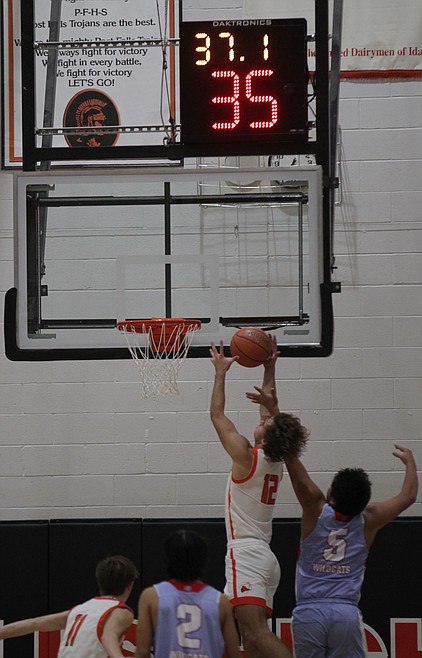
MARK NELKE/Press Post Falls and Lapwai played last Tuesday in Post Falls in the first game in North Idaho to use a shot clock.
There was a buzz in the Post Falls High gym the other night.
And it wasn’t from the extra electricity used to run the shot clock.
A 35-second shot clock will go into effect at Idaho state basketball tournaments beginning in the 2023-24 season.
But teams are allowed to use them in the regular season this year and next, if they choose.
On Tuesday, the first shot clock game in North Idaho was played — Lapwai boys at Post Falls.
If you’ve seen Lapwai play, a shot clock is almost unnecessary.
And Post Falls wasn’t holding the ball either.
Still, more than a year away from when teams will HAVE to play with a shot clock, schools in North Idaho are trying to get used to it. Clocks are up in some schools, either not up or still on order for other schools.
ALL COACHES are in favor of it, to varying degrees.
Post Falls boys coach Mike McLean, for one, would use it in every game if he could. When Idaho teams cross the border and play at Washington schools, they use a shot clock, as Washington has had a clock for years.
The sooner the better in Idaho, McLean said.
“My thought is, it makes the game cleaner, there isn’t all that fouling and all that other garbage that comes from not having a shot clock,” he said. “If we have to use them the following season for real, there has to be a little bit of a learning curve. Not just the players and coaches, but the staff (people running the clock) and the officials. I would much rather use it this year and learn, than wait until you absolutely have to use it.
“I don’t know why people act like it’s a big change. All of our kids in the North grow up playing AAU in Spokane. They have been playing with a shot clock since third grade. So the only people who are having an issue with this are the adults. Kids have no issue with this.
“At Post Falls, we do what’s best for the kids, not what’s easiest for the adults. What’s best for the kids is playing with a shot clock. It’s going to be coming in, so we’re going to be playing with it as much as we can.”
A SHOT clock benefits teams that play solid team defense, making the opponent burn up clock while looking for a “good shot.” In the past, teams could just “back it out and set it up.”
Soon, no longer.
“I coached in Washington most of my life, so I'm very comfortable with them,” second-year Coeur d’Alene boys coach Jon Adams said.
“I think it would be good for us; we play a lot of teams down south that like to slow it down, try to get a good shot,” said St. Maries coach Bryan Chase, whose Lumberjacks have played in three of the last four state 2A title games, and play a hounding style of defense that a clock would benefit. “And we get shots up pretty quick.”
“I’m glad we have it,” said Tony Hanna, who formerly coached at Timberlake and Coeur d’Alene, and is now in his second season as Lakeland boys coach. “I just like it because end-of-game strategies are so much better. I like to know I can stop somebody and I'm going to get the ball back.”
“I think the shot clock will be great for the game,” Kellogg boys coach Mike Martin said. “It won’t change too much of the normal flow with how quick most teams like to play, but it will make for more crunch time plays in the last couple minutes. Teams won’t be able to play keepaway up two possessions with just a couple minutes left to play.
“I am in total favor of using the shot clock,” Sandpiont boys coach Brian Childs said. “I coached with it (in Washington) and without it (in Indiana and Idaho), and I prefer using it. It’s just where the game has evolved to, and I am glad we have adopted it.”
LAKE CITY boys coach Jim Winger had an interesting take.
The Timberwolves have played each of their first three games with a shot clock — the first two in Spokane.
The runnin’, dunkin’, high-flyin’ T-Wolves like to get the ball and go, so a clock really wouldn’t matter, Winger said.
“I really wish it was in effect this year; I think that would be the best thing to ever happen to us,” he said.
However, he said he doesn’t anticipate using it in games at Lake City. The Inland Empire League voted not to use the shot clock in league games this year, in part because not all teams have them installed. In fact, none of the leagues in North Idaho are using it in league play.
But why not use them at Lake City home games?
“It would benefit us, but it’s kind of a false positive, because it’s not going to be used in league or at state,” he said. “So I don’t see any reason to use it in nonleague games, at home, if it’s not going to be used in league play, or at the state tournament.”
IN THE “olden days,” a shot clock might have been needed to prod the girls into shooting. But that hasn’t been the case in years.
“I am in favor of the shot clock. I think it only makes the game better,” Lake City girls coach James Anderson said. “I think we are trying to play with a lot more speed and we don't see a lot of possessions where we're up against the shot clock. The shot clock for girls in Idaho is going to be at 35 seconds which I think doesn't really impact possessions very much. If they're going to put in a shot clock they need to put it at 24 seconds, or 30 at the most. We played with a shot clock at Meridian (recently) and it had no effect on our offense whatsoever. They had a few possessions where they were up against the clock but it didn't necessarily impact the game. I just think it (35 seconds) is too long to have a big impact on the game.”
“I am a big fan of Idaho getting shot clocks,” Coeur d’Alene girls coach Nicole Symons said. “It helps keep the pace of the game up and for girls moving on to college (such as her daughter, Madi, who has signed with Wyoming, and Skylar Burke from last year’s Viking team, now playing at UC Santa Barbara). It is nice for them to play with it too. I wish we had ours installed so we could use them.”
In reality, a shot clock wouldn’t have come into play much anyway — mostly late in a quarter when a team might decide to hold the ball a bit long waiting for the final shot.
Other than that …
“I was a proponent for a shot clock and glad the IHSAA adopted it,” Sandpoint girls coach Will Love said. “That might surprise some coaches in our league because we benefited several times from holding the ball in the last 2 or 3 minutes of a game. But I believe the shot clock will ultimately improve play and make the product more entertaining.”
He said he’d like to use a clock this year in Idaho, but Sandpoint’s clocks weren’t scheduled to arrive until the end of the season anyway.
Either way, the Bulldogs have been preparing for the clock.
Sandpoint and Lake City participated in a two-day clinic this summer where they worked with Alex Sarama, a coach from Europe known for his offensive concepts.
“One reason I wanted to work with Alex is for the pace of play he encourages and his emphasis on player decision-making during the run of play — things I believe will be important when we start playing regularly with a shot clock.
“In our first three games this season, though, I can only think of one offensive possession for us where a shot clock might have come into play,” Love added. “We scored on it, and I’ve been telling myself that Karlie (Banks) just beat the buzzer when she released the shot.”
MEANWHILE, BACK in Post Falls …
At The Arena in Post Falls, the Trojans have painted in the restricted arc under the basket — used in college and the pros to help determine block/charge calls.
It is not being used in high school basketball — yet.
“We use it for teaching purposes,” McLean said. “That should be the next thing that comes in. We’re trying to be up in the forefront; what’s best for the kids.
“Nobody in the country, once they get a shot clock, nobody takes them away,” he added. “It’s a better product to watch; it’s a safer product to watch. It’s a better product to play; it’s a safer product to play.”
Mark Nelke is sports editor of The Press. He can be reached at 208-664-8176, Ext. 2019, or via email at [email protected]. Follow him on Twitter @CdAPressSports.