
Bigfork High School’s PLC team explains initiative to help struggling students
TAYLOR INMAN | Hagadone News Network | UPDATED 4 years, 1 month AGO
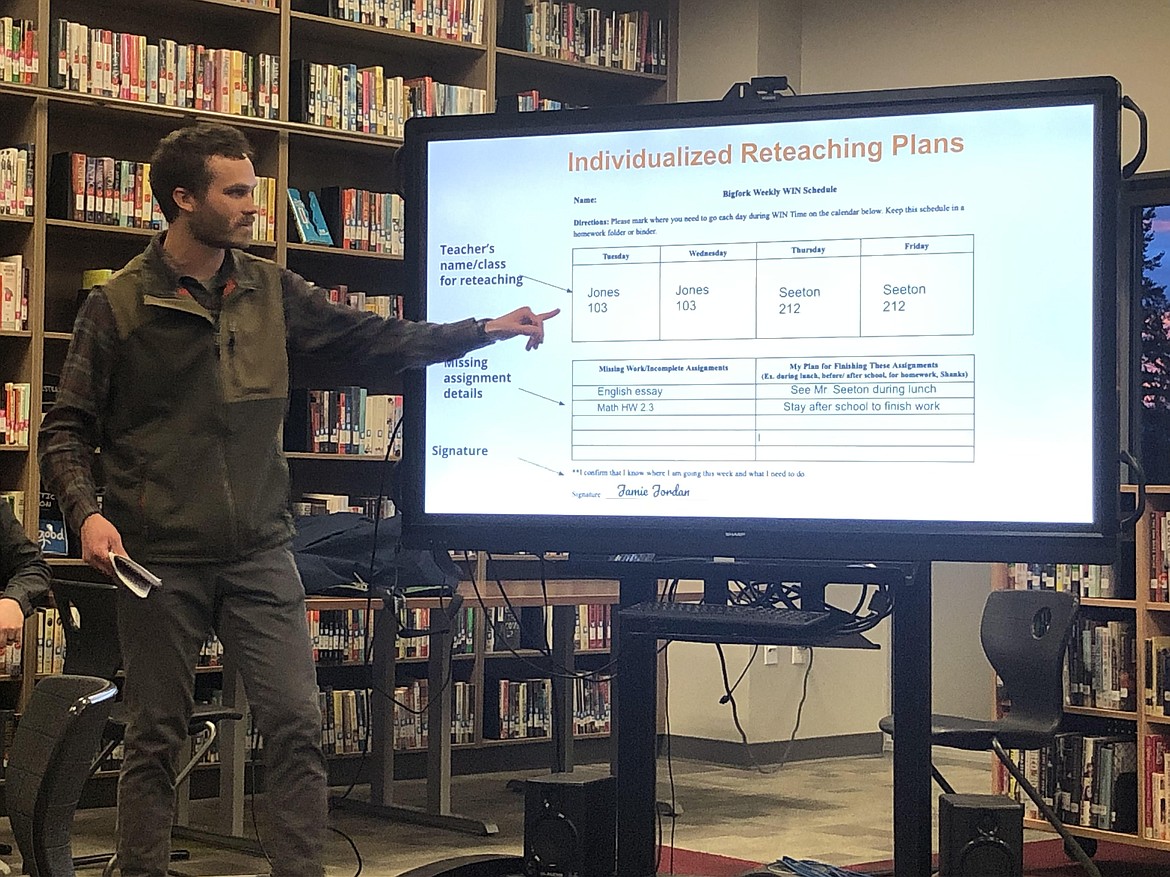
Bigfork High School english teacher Caleb Seton outlined how students use their WIN, or "What I Need" Time during school; a period each day that gives students one-on-one time with teachers in classes that they are not meeting standards in. (Taylor Inman/ Bigfork Eagle)
REPORTER AND PODCAST HOST Taylor Inman covers Bigfork and the north shore of Flathead Lake for the Bigfork Eagle and the Daily Inter Lake. Her reporting focuses on local government, community issues and the people who shape life in Northwest Montana. Inman began her journalism career at Murray State University’s public radio newsroom and later reported for WKMS, where her work aired on National Public Radio. In addition to reporting, she hosts and contributes to Daily Inter Lake podcasts including News Now. Her work connects listeners and readers with the stories shaping communities across the Flathead Valley. IMPACT: Taylor’s work expands local journalism through both traditional reporting and digital storytelling. | February 15, 2022 11:00 PM
Bigfork High School’s Professional Learning Community, or PLC, team explained their recent initiative at the school board meeting last week to catch-up students who are struggling. Having a PLC is a method to foster collaborative learning for teachers and find better ways to teach students. High School Principal Mark Hansen introduced members of their PLC team, who lamented their goals of focusing on learning, building a collaborative culture and looking closely at results. He said staff meets on Wednesday mornings to discuss strategies and look at the data to determine if strategies are working.
“We believe all students can learn at a high level, we have to assess that regularly…We’re not just giving the content, we’re ensuring their learning. It’s not: ‘you got it? If you didn’t, too bad, so sad, we’re moving on, you figure it out somewhere down the line,’ that’s what we’re working on,” Hansen said.
Bigfork’s PLC team has been focused on redefining curriculum standards in a way that ensures students leave the classroom with the core skills needed to understand the subject. Stormy Taylor and Cynthia Wilondeck from the high school history department outlined what this means when it’s put into action. They used the state’s geography standard to explain how they make sure students fully understand the skills they need to learn, which is: “use maps, satellite images, photographs and more to explain relationships between locations of places and regions and their political, cultural, and economic dynamics.”
“We thought this one was a good one, but as we explored it we realized that it’s a little more complicated, which is a good thing because that means it’s going to be more complicated for the students to learn. Using maps and images— that’s great we love them to be able to do that. Explaining relationships between the locations and regions— that’s another skill, so often these standards are multi-faceted...explaining relationships between places and regions and their political, cultural, and economic dynamics— that’s not easy, and that’s why we chose it as a power standard,” Taylor said.
She said this was the jumping off point for their new learning initiative and that it was very beneficial to take a closer look at how to attack those objectives, and think about how students feel when they try to learn them.
Students go to a sort-of home room class on Monday to hear from their teacher about areas they need to improve in. That teacher will tell the student which of their teachers they need to meet with that week, so during their What I Need time, or WIN time, each day they will go sit down with that teacher and get one-on-one time to determine what about the curriculum they are not understanding.
English teacher Caleb Seton outlined that process for those in attendance at the meeting.
“We have 30 minutes built in each day for re-learning or work completion…we get them going in the right direction, and then I think it’s important that they have time to reflect on their assessments, get somebody to talk it through with them, and see where they can improve. We increase support this way, I think,” Seton said.
Cole Jones from the math department went over data to show that this new approach to relearning is working for most students. He said they look at test scores from tests that students had to retake as one way to see how they are improving. In his classes, he said he saw a 22% improvement in test scores. The average score of students who had to do the retake was 57 before relearning, then moved up to 79 afterwards.
Other news from the school board meeting included a vote to keep the The Comprehensive School and Community Treatment program, or CSCT program, which is a school-based behavioral health service for children supported by the Children's Mental Health Bureau at the Montana Department of Public Health and Human Services. Both Superintendent Tom Stack and Elementary School Principal Brenda Clarke spoke out in support of keeping the program, which they said helps provide essential mental health services to students and allows other students to learn uninterrupted.
The board also voted to stay a part of the Montana School Board Association, with Paul Sandry voting no and everyone else voting in favor. The board voted to leave the association last year only to rejoin later on. Stack said the association provides legal advice and other important information for the school district and is worth keeping.
The next school board meeting will be held on March 9 and will include a presentation from board member Julie Kreiman. Kreiman will present clips that a social studies teacher has been showing of CNN in their classroom that caused concern among some community members present at the meeting. Sandry and other board members defended the teacher’s choice to use the clips in class, saying that they watched the clips for themselves and that they provide educational value and are not inherently political.
ARTICLES BY TAYLOR INMAN

Plant Land helps customers spring into the gardening season
Heated greenhouses at the Evergreen garden center are filled with pottery, annuals, houseplants and some early season vegetables like onions, lettuces and herbs.

Despite Barnhart objections, county OK’s gravity septics
Flathead County homeowners can now apply to install a gravity septic system for the first time since 2004.

Logan Health physicians raise awareness about colorectal cancer
It’s more important than ever to get screened for colorectal cancer, according to Logan Health gastroenterologist Dr. Kate Wisser, who said catching the disease early saves lives.