
Clearing danger: County, cities have priorities in keeping roads safe in winter
CHERYL SCHWEIZER | Hagadone News Network | UPDATED 3 years, 11 months AGO
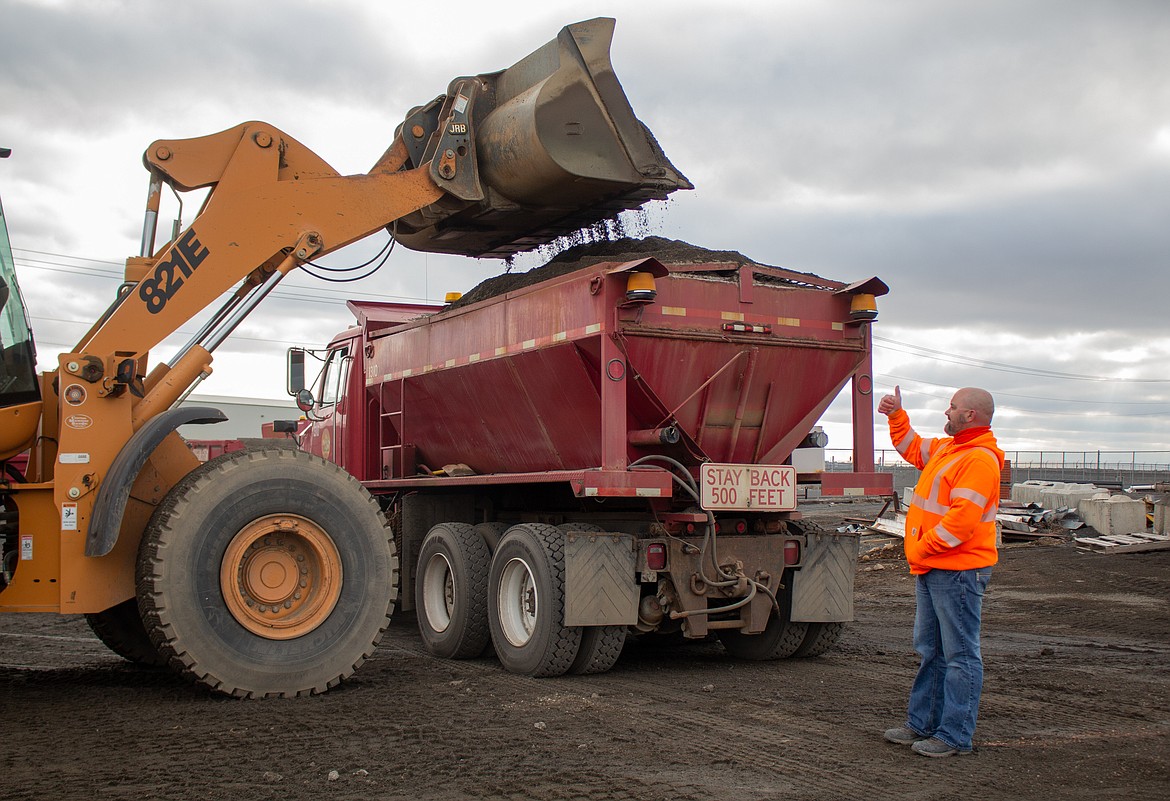
Grant County Public Works Department employee Scott Johnson signals his truck is full in preparation for a winter storm in January 2021.
File photo
Senior Reporter Cheryl Schweizer is a journalist with more than 30 years of experience serving small communities in the Pacific Northwest. She began her post-high-school education at Treasure Valley Community College and enerned her journalism degree at Oregon State University. After working for multiple publications, she has settled down at the Columbia Basin Herald and has been a staple of the newsroom for more than a decade. Schweizer’s dedication to her communities and profession has earned her the nickname “The Baroness of Bylines.” She covers a variety of beats including health, business and various municipalities. | January 6, 2022 1:07 AM
EPHRATA — Winter might not be so annoying for some people if it didn’t mean snowy and icy roads – which the Basin has faced and will deal with more before spring.
But icy roads are more than just an annoyance, of course – they can be dangerous.
Sam Castro, Grant County Public Works Department director, said the majority of collisions on icy, snowy roads are caused by people driving too fast for the road conditions.
And there are a lot of roads on which collisions can occur in Grant County; however, Castro and his team try to prevent those.
“We plan on plowing 1,625 miles of maintained county roads,” Castro said.
With so many miles to cover, county officials, and most city officials, have established snow plowing priorities to determine which roads get plowed first.
Grant County’s plowing policy is accessible here: www.grantcountywa.gov/DocumentCenter/View/4368.
In Grant County, as in most local jurisdictions, the most heavily traveled roads get attention first.
Arterials are the roads that handle the highest volumes of traffic, and the roads that connect with arterials are designated major and minor collectors, depending on the amount of traffic they get. Arterials, major and minor collectors get plowed first.
Moses Lake city officials also start with arterials, wrote Lynne Lynch, the city’s public information officer, communications and marketing specialist, in an email.
“We will start with our main arterial roads,” Lynch wrote. “Then we will move into our main routes in the city. We will try our best to keep those roads open.”
The arterial streets include Broadway Avenue, PIoneer Way, Yonezawa Boulevard, Stratford and Valley roads and Division Street, she wrote.
The city also contracts with businesses to plow some residential roads.
“We have our contractor scheduled to start plowing residential roads Thursday at noon. It normally takes them about four days to clear the residential streets,” Lynch wrote.
When the arterial roads and major and minor collectors are cleared, county crews move on to roads with a lot of local traffic. The third priority is minor collectors with lower volumes of traffic, and local access roads. Paved roads with an average daily traffic of less than 500 trips, and gravel roads averaging daily traffic of more than 100 trips are the fourth priority for county crews.
Castro said a lot of collisions occur at intersections, where people are turning from highly-traveled roads onto roads with less traffic, or trying to get onto the more traveled road from the less-busy one.
“We want to pay particular attention to intersections,” Castro said.
County officials are applying deicing chemicals when conditions warrant. Castro said equipment purchased last year for vegetation control also can apply deicing chemicals. County crews have applied the chemicals once this winter, and even though the impact was diluted by rain, it made it easier to plow. But Castro said deicing has its limits.
“It can’t be a fix-all,” he said.
Othello mayor Shawn Logan said city crews don’t start plowing until the snow reaches the 3-inch mark.
“We figure everyone can handle the first 3 inches,” Logan said.
Once plowing starts Othello, too, has a priority list.
“We start with our arterials and then we move to our residential areas,” Logan said.
Quincy city officials posted a priority list on the city’s social media page, starting with emergency routes. School bus routes are next, followed by downtown and primary streets. Avenues come next, with residential streets after that. Quincy residents are asked to move cars off the street when crews start plowing residential streets.
Ephrata city crews will start by plowing the hills and primary streets in town to accommodate emergency vehicles and school bus routes, according to the city’s website. The second priority is removing the berm from the center of Basin Street.
Basin Street is part of state Route 28, so Washington State Department of Transportation crews actually plow the street. The city has an agreement with WSDOT in which city crews will clear the berm, according to the city’s website. The third priority is residential streets, according to the website, and plowing residential streets depends on snow depth.
ARTICLES BY CHERYL SCHWEIZER
Adams Co. commissioners approve 2026 budget
RITZVILLE — Adams County Commissioners approved a $62.5 million budget Tuesday, the last step in what commission chair Mike Garza said was a difficult job. “It was a tough, drawn-out process,” Garza said. “I think we came up with something that’s as fair as it can be.”
Othello man injured in alleged vehicular assault
OTHELLO — An Othello man was airlifted to Providence Sacred Heart Medical Center after his car was hit while sitting on the shoulder about a mile west of Othello Tuesday night.
Othello man injured in alleged vehicular assault
OTHELLO — An Othello man was airlifted to Providence Sacred Heart Medical Center after his car was hit while sitting on the shoulder about a mile west of Othello Tuesday night.