
To fix, or not to fix: When it comes to cell phones, that’s often the question
CHERYL SCHWEIZER | Hagadone News Network | UPDATED 4 years, 7 months AGO
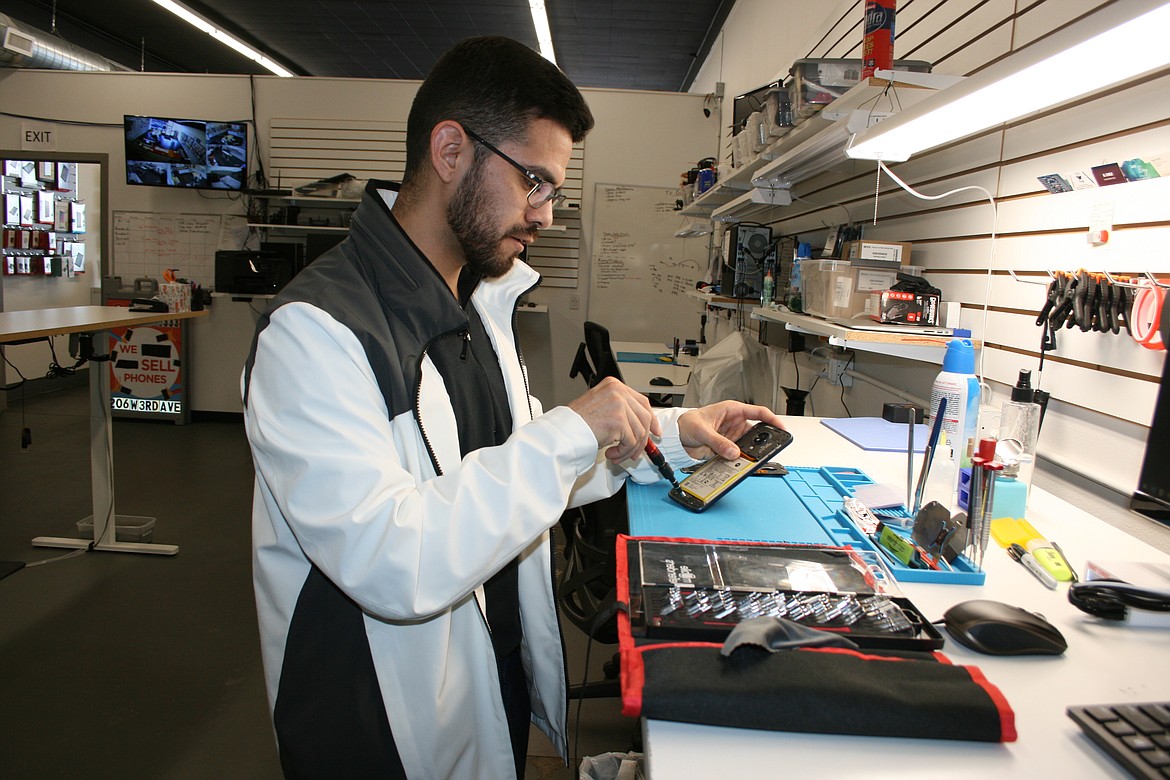
Saul Hinojosa works on a phone at the CPR Phone Repair in Moses Lake Tuesday.
Cheryl Schweizer/Columbia Basin Herald
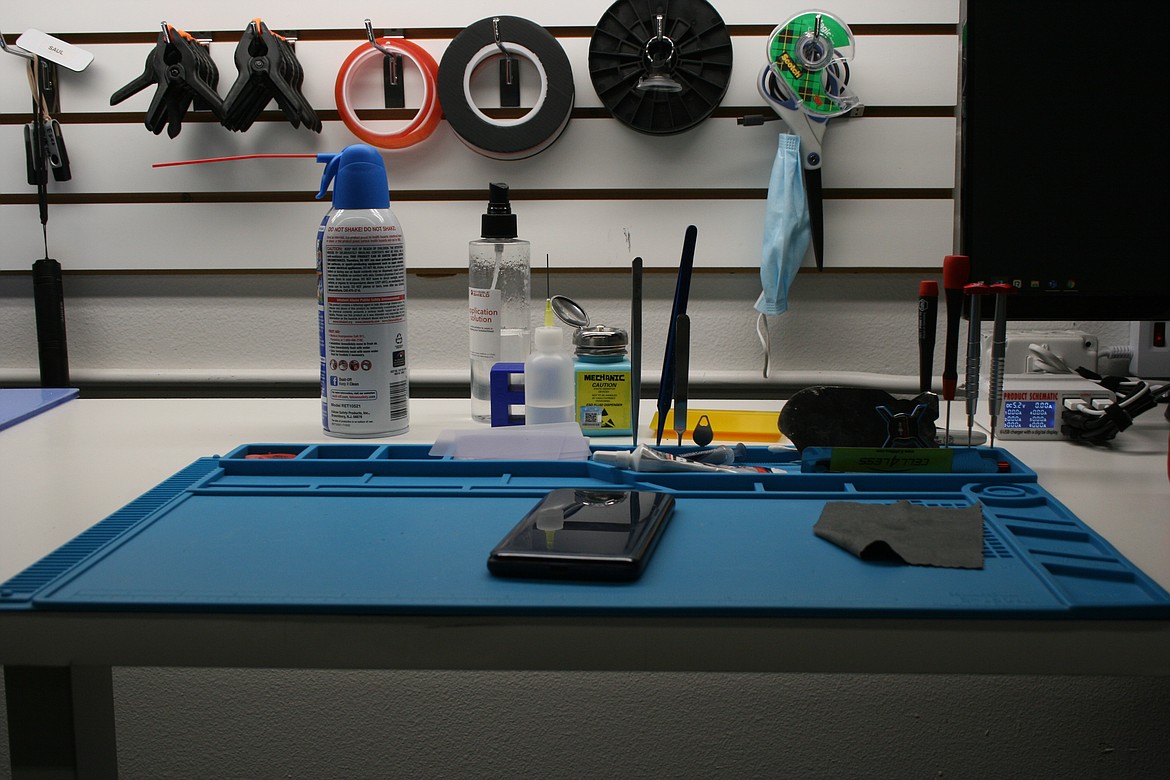
A cell phone is ready for diagnosis at CPR Cell Phone Repair in Moses Lake Tuesday.
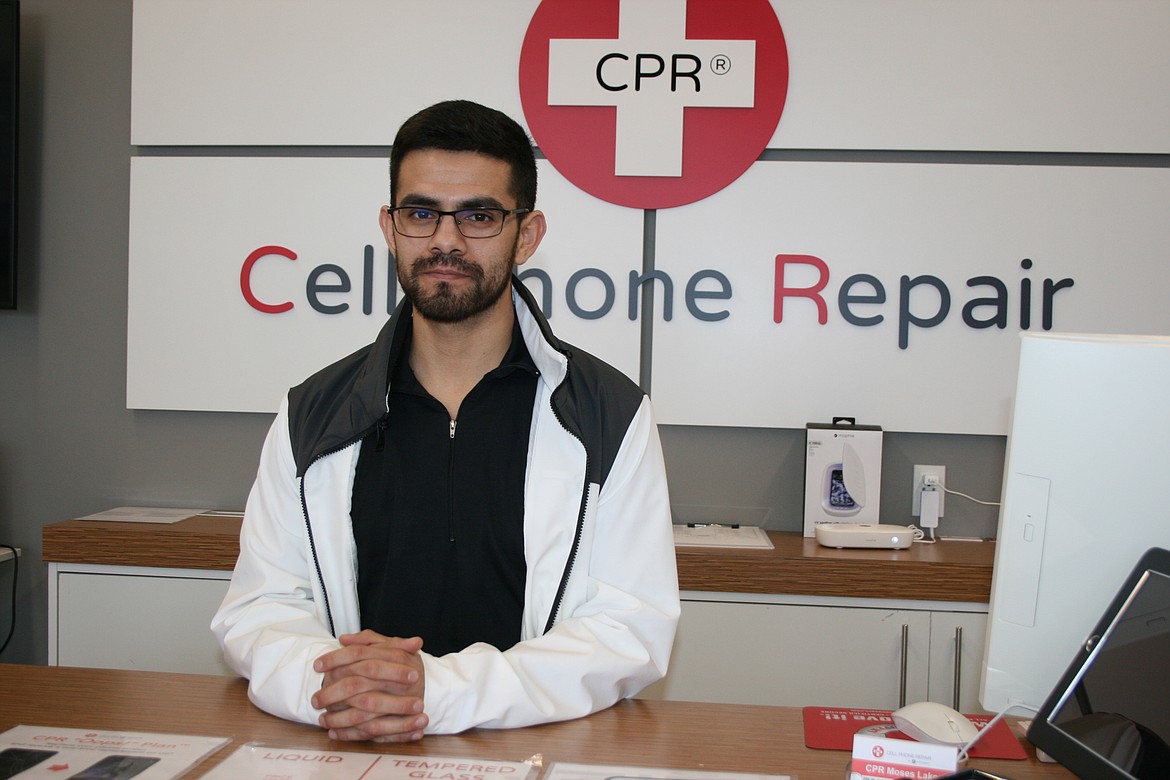
Saul Hinojosa, manager at CPR Cell Phone Repair in Moses Lake, stands behind the counter.
Senior Reporter Cheryl Schweizer is a journalist with more than 30 years of experience serving small communities in the Pacific Northwest. She began her post-high-school education at Treasure Valley Community College and enerned her journalism degree at Oregon State University. After working for multiple publications, she has settled down at the Columbia Basin Herald and has been a staple of the newsroom for more than a decade. Schweizer’s dedication to her communities and profession has earned her the nickname “The Baroness of Bylines.” She covers a variety of beats including health, business and various municipalities. | January 17, 2022 1:00 AM
MOSES LAKE — It can happen in a flash. The cell phone slips and crashes on a concrete floor. Or it’s safely stowed in a purse – except the purse gets slammed in the car door, and that crunching sound isn’t good.
Or it was lying on the seat, fell out of the car and got run over. Or maybe – well, the phone ended up in the horse trough – don’t ask how.
There’s a lot on that phone, all those contacts. And how many people even memorize phone numbers anymore when they can just look up the name? That calendar’s got a couple months worth of appointments, and good luck reconstructing it. And the pictures – the first day of school, last summer at the beach, those really cute pictures from Christmas.
That phone is an essential part of life these days.
“It’s basically a little computer. You can look up the weather, call a friend across the country, do anything, really,” said Saul Hinojosa, manager of CPR Cell Phone Repair in Moses Lake.
So the portable device that’s part of everyday life is broken. What to do now?
“The data would be the most important thing,” Hinojosa said.
For most people, the pictures, the calendar, the contacts – the data – are the crucial components. Fixing the phone itself, however, may be an economic decision.
“It really depends. If you absolutely need this specific cell phone, yes, bring it in,” Hinojosa said.
The most common problem that brings a cell phone in for repair is the vulnerable glass screen.
“It’s very, very common to break your screen,” he said.
All kinds of things happen to screens. They get slammed in car doors a lot, for instance.
“The phone falls (out of the car) perfectly as you slam the door. Getting run over is quite common, as well. People leave it on the top of a car, or they don’t realize it came out of their pocket,” he said.
“We generally recommend, at the minimum, a case and screen protector, for example,” he added. “Mine, I always have a case and screen protector. You don’t want to be traveling, or camping or something, and have your phone break.”
Another common enemy of a cell phone is water.
“Although with water damage, if it is repairable, we generally always recommend replacing it,” Hinojosa said. “Water damage can be hit or miss.”
A water-damaged phone may keep working just fine for a year, or it may die tomorrow.
“At that point it’s a board-level repair,” he said. “Most of the time, we can definitely work on it. But the customer ends up paying more than the device would ever be worth, with those kinds of repairs.”
Getting the pictures, contacts or calendar from a water-damaged phone isn’t guaranteed, he said. A cell phone that went in a drink may need the services of people who specialize in retrieving data.
Hinojosa said depending on the phone and on the problem, it might be more cost-effective to buy a new one rather than fix a broken one, for even a relatively small repair, like a broken screen. He used a nearby cell phone, about four years old, as an illustration. Replacing a broken screen would cost about $150, he said, while a new phone with similar capabilities could be purchased for less than that.
In the case of multiple problems, it might be more cost-effective just to replace the phone, he said.
Cell phone repair makes up a lot of CPR’s business, he said, but he also repairs tablets, laptops, desktops and game consoles.
“We repair all that. And from time to time, odd stuff,” he said. “That can be anything, really.”
He has fixed the controls for wheelchairs and worked on power banks with broken cables, among other things.
Hinojosa has worked at CPR for about 18 months, but he’s been interested in computers most of his life.
“Playing around with devices, I’ve been doing since I was 10 or 11. That’s when I got my first computer. Ever since then, I’ve been interested. I grew up gaming, as well, playing video games. So that’s something that also attracts me to it.”
The potential of the devices makes them really interesting.
“You can do anything on them. It’s a tool that has infinite uses,” he said.
He learned how to repair computers working on his own phone and computer, and fixing phones and computers for his family and friends.
“If the device works, we can diagnose it using a computer. If it doesn’t, we just have to use our knowledge, the tools that we have,” he said.
Cheryl Schweizer can be reached via email at [email protected].


ARTICLES BY CHERYL SCHWEIZER

Road projects on hold for Labor Day weekend
MOSES LAKE — With Labor Day weekend dead ahead, drivers will be able to move freely about the state. Most road projects are on hold for the holiday weekend. Nobody will be working on the Hansen Road overpass on Interstate 90, but the lane restrictions that are in effect will continue through the end of the project.

Cost estimates for water source alternatives given to Moses Lake City Council
Protected under the U.S. Endangered Species Act, efforts are ongoing to keep it self-sufficient
MOSES LAKE — It’s going to cost a lot of money to provide alternative water sources for the city of Moses Lake, but some of the possible alternatives will cost more than others. City officials provided the Moses Lake City Council with costs for various alternatives Tuesday.

Dryer vent cleaning is important -- but often overlooked
MOSES LAKE — Not all the maintenance a house needs is visible. Sometimes a potential problem just goes unnoticed until it causes trouble, sometimes serious trouble. But a lot of potential problems give off warning signs. Clothes dryers often do when they need a good cleaning.