
Grant Co. fair cancels poultry showings and auctions as bird flu persists
CHARLES H. FEATHERSTONE | Hagadone News Network | UPDATED 3 years, 8 months AGO
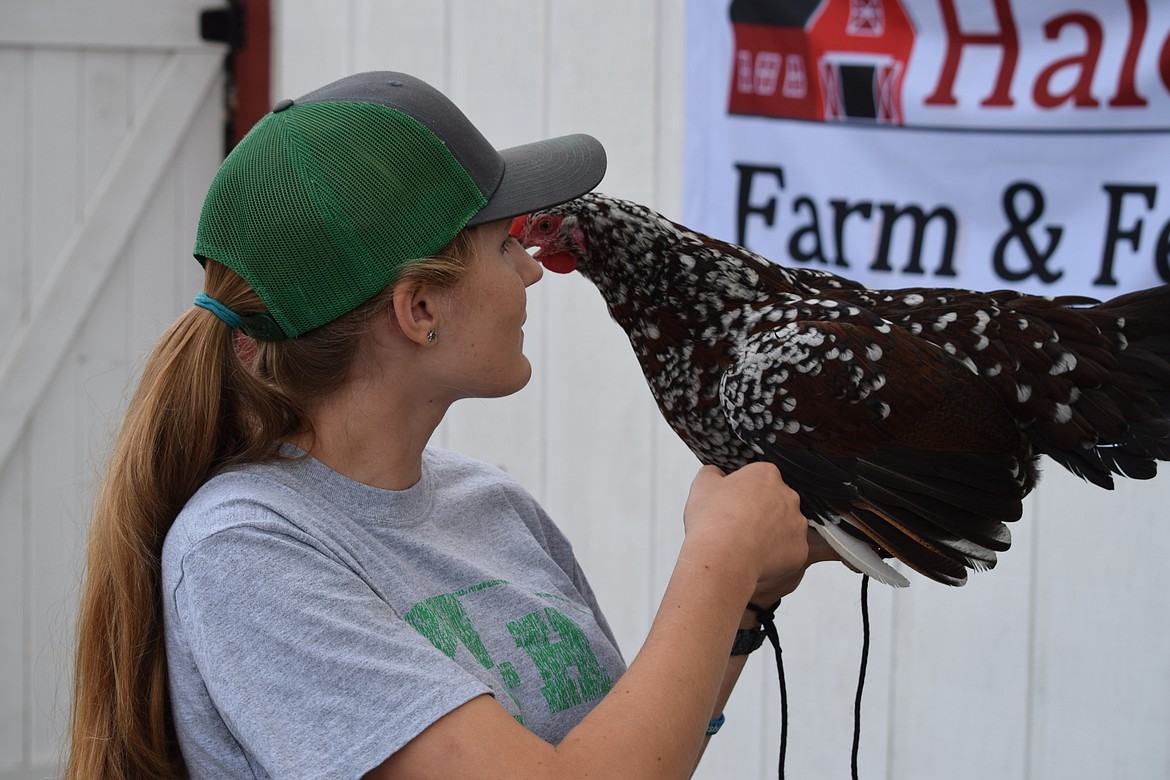
A teenager holds up a hen during the 2021 Grant County Fair. On Wednesday, organizers of this year’s fair canceled in-person poultry exhibitions and auctions in response to the ongoing H5N1 avian influenza pandemic.
FILE PHOTO
MOSES LAKE — Organizers of this year’s Grant County Fair have canceled in-person poultry exhibitions and auctions this year in response to the ongoing avian influenza outbreak.
“We made the decision to pull the plug on in-person showing of birds,” said Grant County Fairgrounds Director Jim McKiernan. “We don’t want to be the reason there’s a major outbreak.”
McKiernan said the decision was made by the fair’s livestock committee this week in cooperation with the Future Farmers of America and 4H. All three groups wanted to hold off making that decision, he said. However, the announcement by the Washington State Department of Agriculture on July 19 that another case of bird flu was found in a backyard flock in Snohomish County prompted the decision.
McKiernan said 4H and FFA students who want to show birds will be able to do so remotely, online and through website photos, the same way birds were exhibited in 2020 following the shutdowns in response to the COVID-19 pandemic.
“There will be a virtual show and auction,” he said. “Yarbro Auctioneers will do the auction.”
The H5N1 strain of avian influenza has been reported in domesticated flocks of chickens, ducks and geese in 12 counties across Washington State and detected in wild birds in 15 counties, including Grant County, where the first discovery was reported in a snow goose on April 18.
According to the U.S. Department of Agriculture’s Animal and Plant Health Inspection Service, this year’s avian influenza outbreak has hit wild and domesticated bird flocks in 37 states, with Washington seeing the largest number of backyard flock infections at 29 flocks affecting 2,100 birds. The state worst hit by the epidemic is Iowa, which has reported cases from 15 commercial flocks and 4 backyard flocks affecting 13.4 million birds.
So far, since the bird flu pandemic broke out in February 2022, APHIS reports that over 40 million birds have been affected.
According to an online presentation given in late June by Katherin Haman, a wildlife veterinarian with the Washington Department of Fish and Wildlife, the current strain of avian influenza, H5N1, was initially spread by migrating waterfowl and appears to be considerably more deadly in wild birds. A number of the confirmed cases in wild birds in Washington have been found among predatory birds such as eagles and owls that likely scavenge the carcasses of dead waterfowl, she said during the presentation.
The region’s cool, wet spring and early summer have made for a perfect environment to spread the disease, Haman added. She noted that there is no treatment or cure, so infected domesticated birds must be destroyed in order to further prevent the disease from spreading.
In an email to the Columbia Basin Herald, Haman wrote Thursday that the arrival of summer, and especially the hot, dry weather in store for Eastern Washington next week, could make the disease disappear. The bulk of bird flu cases reported to APHIS came in April and May, with significant drop offs in June and July, the agency’s avian influenza website states.
“Or there’s a possibility that it will be more similar to what’s happening in Europe and it will continue to circulate and be found in wild birds,” Haman wrote. “We just don’t know — time will tell.”
During her online presentation, Haman said that while the disease appears limited right now to birds, it has also been reported in two species of mammals — striped skunks and red fox kits. No mammal infections have been reported in Washington.
According to the Centers for Disease Control in Atlanta, only one human case of H5N1 infection has so far been confirmed during this year’s outbreak.
“It is capable of infecting humans,” Haman said. “There’s no data supporting dogs at risk, but don’t let your dog eat the carcass of a dead bird.”
Haman said flock owners should report any sick domesticated birds to the Washington State Department of Agriculture’s Sick Bird Hotline at 800-606-3056. Anyone observing a sick wild bird should report that online at the the Department of Fish and Wildlife’s website at shorturl.at/agJR2. Haman added no one should touch a dead bird, and that people who regularly handle birds or work in areas with poultry should use a 10% bleach solution to disinfect their shoes and clothes and should regularly wash their hands.
Charles H. Featherstone can be reached at [email protected].
Counties where infected domestic poultry have been reported:
Clallam
Jefferson
King
Kitsap
Okanagan
Pacific
Pierce
Snohomish
Thurston
Whatcom
Yakima
Additional counties where infected wild birds have been reported:
Asotin
Benton
Franklin
Grant
Island
San Juan
Stevens
Walla Walla
ARTICLES BY CHARLES H. FEATHERSTONE

Potato prices up, sales down for first quarter 2023
DENVER — The value of grocery store potato sales rose 16% during the first three months of 2023 as the total volume of sales fell by 4.4%, according to a press release from PotatoesUSA, the national marketing board representing U.S. potato growers. The dollar value of all categories of U.S. potato products for the first quarter of 2023 was $4.2 billion, up from $3.6 billion for the first three months of 2022. However, the total volume of potato sales fell to 1.77 billion pounds in the first quarter of 2023 compared with 1.85 billion pounds during the same period of 2022, the press release noted. However, total grocery store potato sales for the first quarter of 2023 are still above the 1.74 billion pounds sold during the first three months of 2019 – a year before the outbreak of the COVID-19 pandemic, the press release said.

WSU Lind Dryland Research Station welcomes new director
LIND — Washington State University soil scientist and wheat breeder Mike Pumphrey was a bit dejected as he stood in front of some thin test squares of stunted, somewhat scraggly spring wheat at the university’s Lind Dryland Research Station. “As you can see, the spring wheat is having a pretty tough go of it this year,” he said. “It’s a little discouraging to stand in front of plots that are going to yield maybe about seven bushels per acre. Or something like that.” Barely two inches of rain have fallen at the station since the beginning of March, according to station records. Pumphrey, speaking to a crowd of wheat farmers, researchers, seed company representatives and students during the Lind Dryland Research Station’s annual field day on Thursday, June 15, said years like 2023 are a reminder that dryland farming is a gamble.

Wilson Creek hosts bluegrass gathering
WILSON CREEK — Bluegrass in the Park is set to start today at Wilson Creek City Park. The inaugural event is set to bring music and visitors to one of Grant County’s smallest towns. “I've been listening to bluegrass my whole life,” said the event’s organizer Shirley Billings, whose family band plays on their porch every year for the crowd at the Little Big Show. “My whole family plays bluegrass. And I just wanted to kind of get something for the community going. So I just invited all the people that I know and they’ll come and camp and jam.” ...