
Grants help everyone at Wilson Creek schools be educators
CHARLES H. FEATHERSTONE | Hagadone News Network | UPDATED 3 years, 7 months AGO
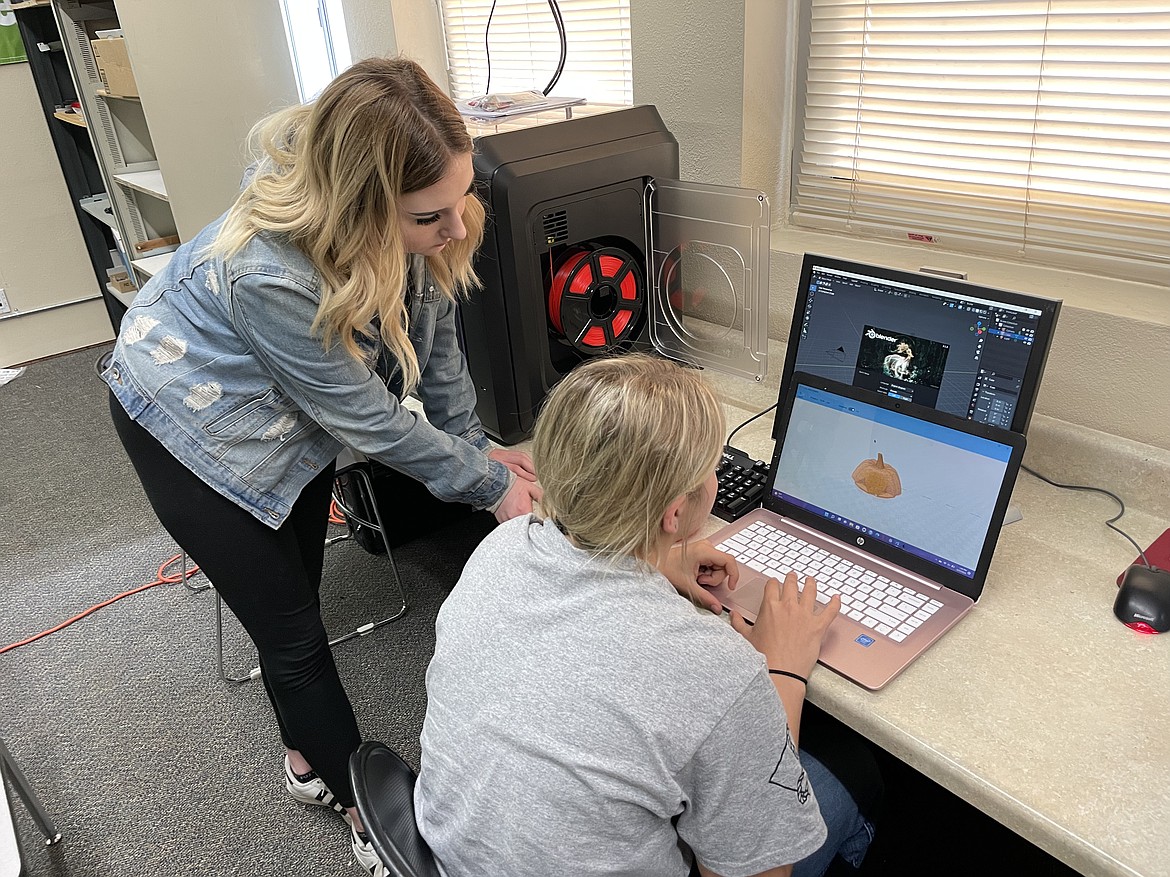
Wilson Creek School sophomore Erin Johnson (left) and freshman Josie McMillan try to figure out how to print only a portion of a pumpkin in a 3-D printer.
CHARLES H. FEATHERSTONE/COLUMBIA BASIN HERALD
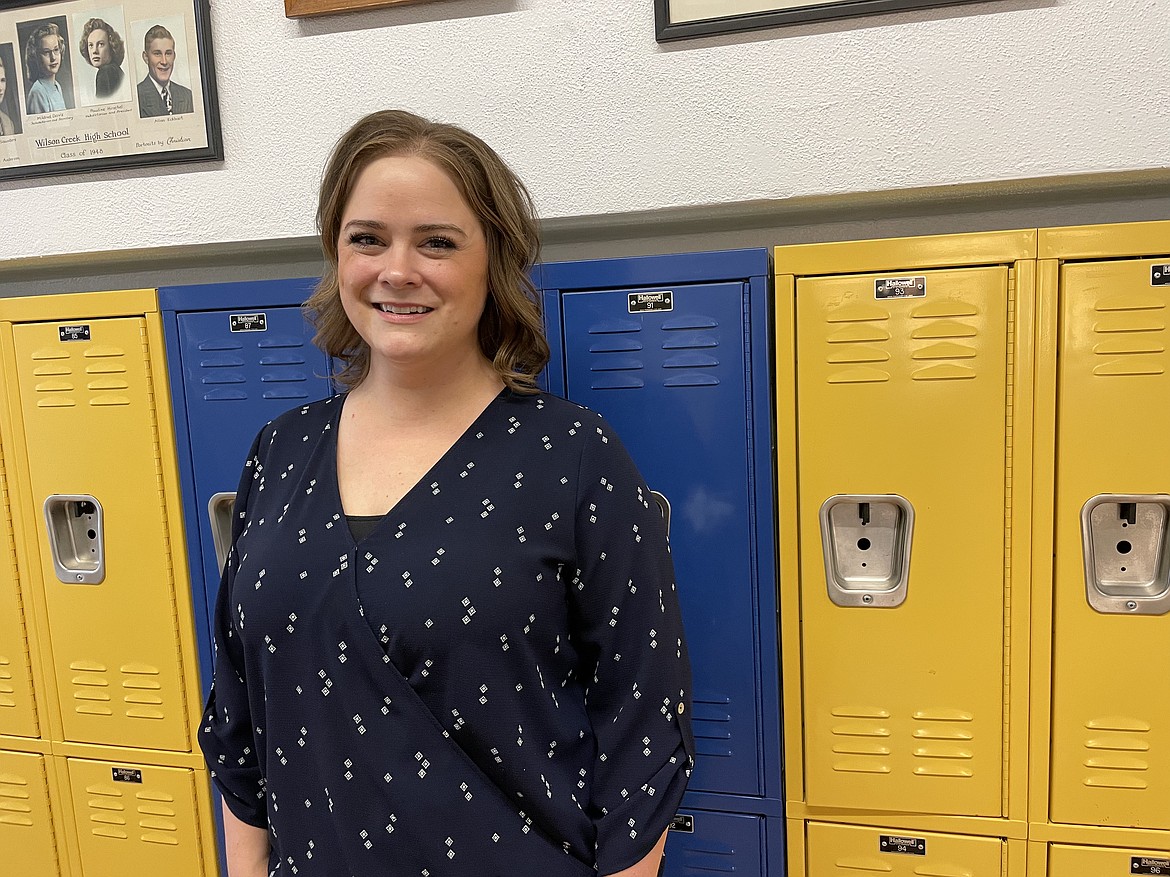
Wilson Creek School Dean of Students Anna Thomas. Thomas oversees a $15,000 grant the school district recently received to help kick off a robotics and STEM program in its elementary and secondary school.
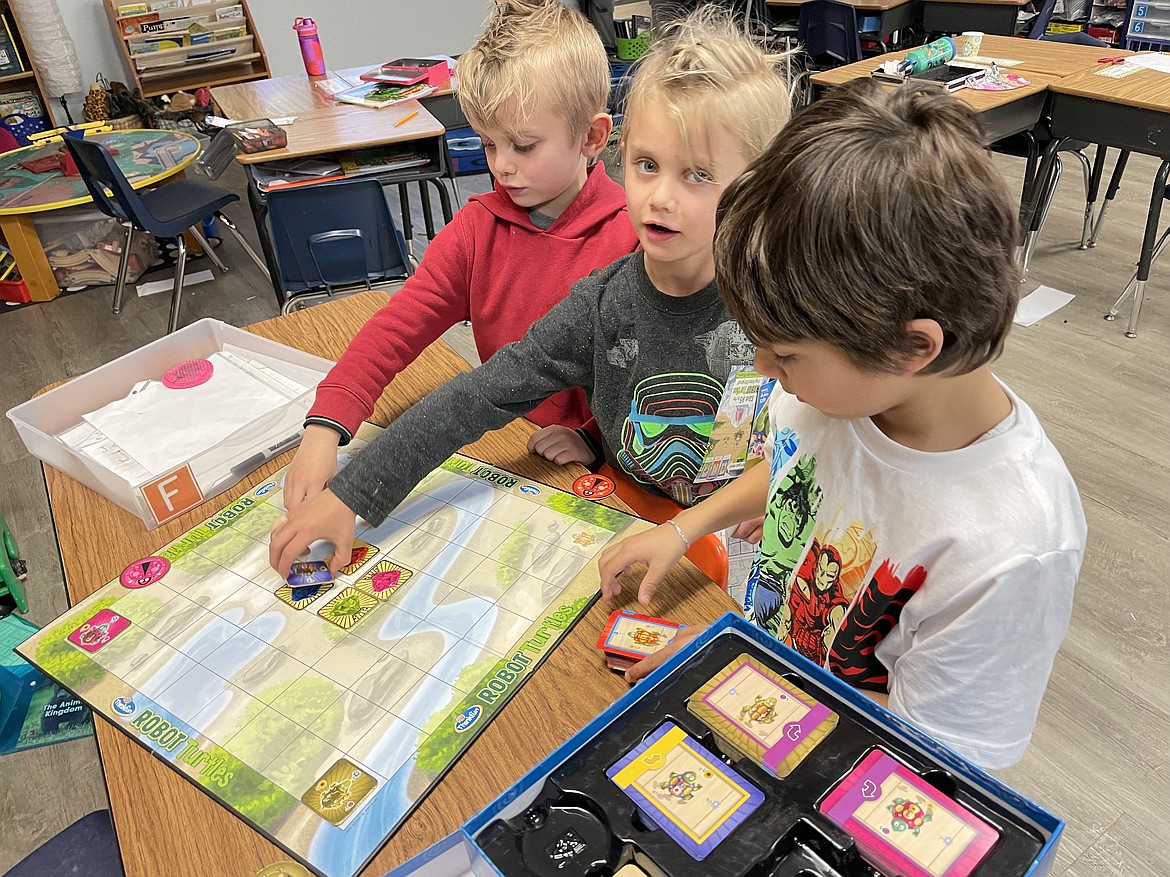
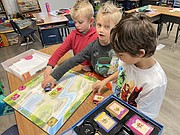
A group of Wilson Creek School kindergartners shows off the game Robot Turtles, which allows kids to learn the basics of coding by having them guide a turtle through a maze to capture a jewel.
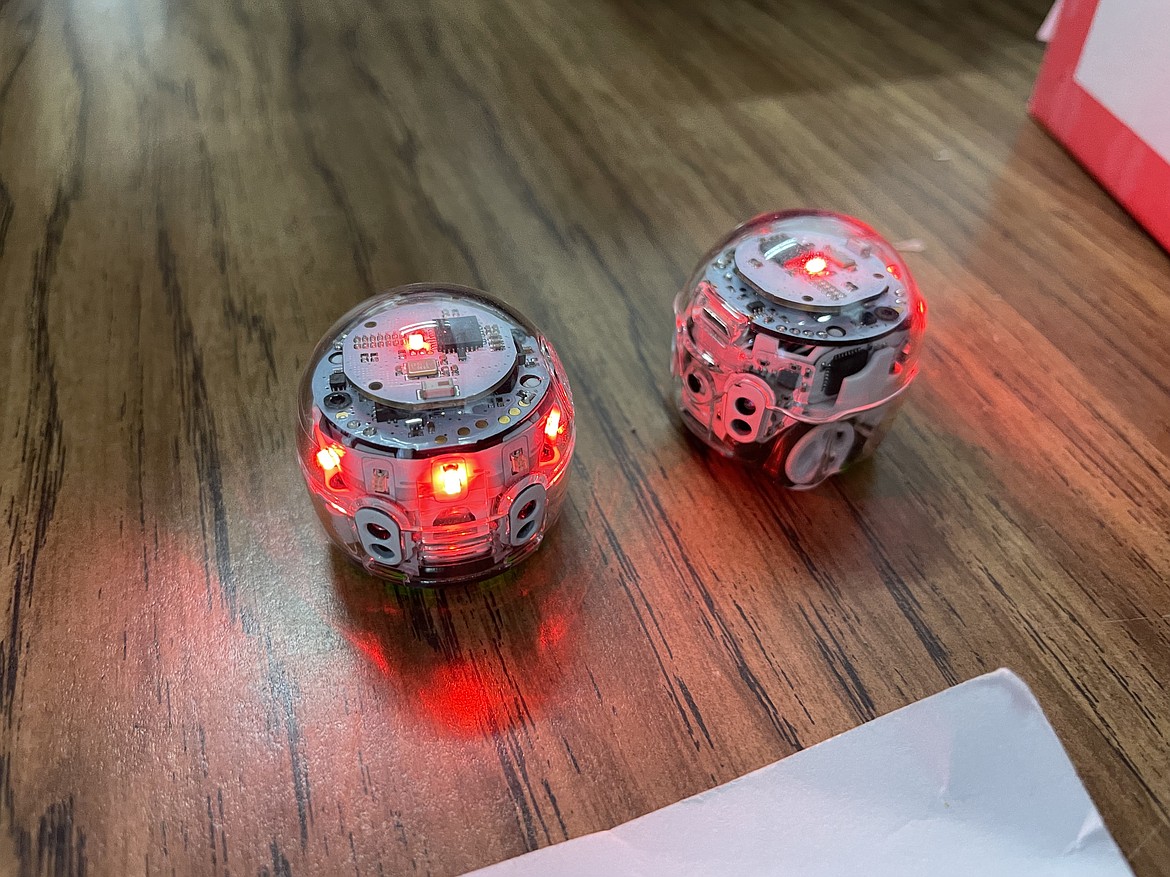
A pair of Ozobots in Veronica Clinton’s third and fourth-grade class at the Wilson Creek School.
WILSON CREEK — There aren’t a lot of school districts in Washington state where $15,000 will go very far, but Wilson Creek happens to be one of them.
“We got two grants for this year,” said Anna Thomas, dean of students at the Wilson Creek School. “Both of them went to support STEM and computer science technologies at the elementary school.”
In a district with 109 full-time students and better known for its agriculture-centered vocational education program, the grants bought a box of Ozobots, little round robots you can command by drawing lines of certain lengths and colors for them to follow; tablet computers; some games that will help kindergartners begin to learn how to think about programming computers;, and a room full of 3-D printers that students are slowly teaching themselves — and their teachers — how to use.
The goal at Wilson Creek, which has a budget of $3.7 million for the 2021-22 school year, according to Thomas, is to start having kids in this very rural corner of Grant County learn the skills for tomorrow’s jobs.
Because even farm machinery these days is networked, connected, high-tech and programmable.
“It’s one more benefit we can give our kids,” said Warden Creek Superintendent Laura Christian. “I think, especially with our size, anyone that wants to involve themselves in the program can.”
In bigger schools and school districts, Christian said it’s often first-come, first-serve - or get on a waiting list and wait for a slot to open.
“But we have the benefit of knowing each kid so we know if they’re ready, if they’ve got the skills leading into it before they even try to sign up,” she said.
STEM — science, technology, engineering and mathematics — education starts in Wilson Creek even before anyone gets a computer or a robot in their hands, Thomas said. The district’s kindergartners — all nine of them — start by playing a board game called Robot Turtles in which kids put together a series of card instructions — go forward, turn left, turn right, knock down walls — to get a turtle through a maze in order to get a jewel.
“It’s a real basic game that can be played as early as preschool,” said Veronica Clinton, who teaches third and fourth grades. “But it still has the very basics of coding and directions and getting your turtles where you want them to go.”
From there, Clinton said, her students also play with Squishy Circuits — Play-Doh-like clay that either conducts or resists electricity — and the golf-ball sized Ozobots, which can follow lines and do tasks based on the color or pattern in the lines they follow.
“They made a car with headlights that actually turned on, or lights down the back of a dinosaur,” Clinton said of the students’ squishy circuit creations.
Fourth-graders Maxx Herreid and Liam Ulman draw long lines with a fat, black felt-tip marker on a piece of clean paper, set the Ozobot down, and watch it follow the line. Different colors, and different combinations of colors, give the Ozobot instructions to slow down, speed up, turn around, flash its lights or other options.
“Here is one that can get it to do a victory dance,” Liam said and he puts down a colored marker and places the robot on the line.
Upstairs, in what used to be the Wilson Creek School library, a small group of teenagers fiddles with a half-printed plastic pumpkin and a 3-D printer. The bottom two-thirds of the pumpkin was printed when the spool of plastic filament ran out, and they want to both replace the filament and finish printing their red plastic pumpkin.
“We’re trying to cut off the top (of the computer model),” said freshman Josie McMillan as she sat intently in front of a computer screen.
It’s a somewhat perplexing task, she said, since she and sophomore Erin Johnson are trying to delete a portion of the computer model that will allow them to complete the partially-printed pumpkin and match it with what they have.
“It already has some of the eyes, so we need (to cut) a little more but I gotta figure out how to do that,” McMillan said.
For Thomas, who was a STEM education specialist in the Spokane schools before coming to Wilson Creek, the fact that students are struggling to figure out technology no one in the district really knows how to use is one of the benefits of the program.
“Often, in schools, we don’t give kids the chance to really problem-solve, to strategize and solve puzzles and things like that,” she said. “And that’s what they’re doing by themselves. It’s incredible, and that’s what we’ve been seeing.”
The goal is for the older kids, once they’ve figured out how these things work, to show everyone else, Thomas said. It’s one way Wilson Creek shows that there are some advantages to being a very small school district.
“Kids don’t fall through the cracks here. They have relationships with everyone in our school, and it’s not just the teachers,” she said. “Everybody gets to be an educator here. All of the students, they get individualized attention and individualized relationships.”
That environment is somewhat unique in education, she added.
“I’ve never seen that in another building,” Thomas said.
Charles H. Featherstone can be reached at [email protected].


ARTICLES BY CHARLES H. FEATHERSTONE

Potato prices up, sales down for first quarter 2023
DENVER — The value of grocery store potato sales rose 16% during the first three months of 2023 as the total volume of sales fell by 4.4%, according to a press release from PotatoesUSA, the national marketing board representing U.S. potato growers. The dollar value of all categories of U.S. potato products for the first quarter of 2023 was $4.2 billion, up from $3.6 billion for the first three months of 2022. However, the total volume of potato sales fell to 1.77 billion pounds in the first quarter of 2023 compared with 1.85 billion pounds during the same period of 2022, the press release noted. However, total grocery store potato sales for the first quarter of 2023 are still above the 1.74 billion pounds sold during the first three months of 2019 – a year before the outbreak of the COVID-19 pandemic, the press release said.

WSU Lind Dryland Research Station welcomes new director
LIND — Washington State University soil scientist and wheat breeder Mike Pumphrey was a bit dejected as he stood in front of some thin test squares of stunted, somewhat scraggly spring wheat at the university’s Lind Dryland Research Station. “As you can see, the spring wheat is having a pretty tough go of it this year,” he said. “It’s a little discouraging to stand in front of plots that are going to yield maybe about seven bushels per acre. Or something like that.” Barely two inches of rain have fallen at the station since the beginning of March, according to station records. Pumphrey, speaking to a crowd of wheat farmers, researchers, seed company representatives and students during the Lind Dryland Research Station’s annual field day on Thursday, June 15, said years like 2023 are a reminder that dryland farming is a gamble.

Wilson Creek hosts bluegrass gathering
WILSON CREEK — Bluegrass in the Park is set to start today at Wilson Creek City Park. The inaugural event is set to bring music and visitors to one of Grant County’s smallest towns. “I've been listening to bluegrass my whole life,” said the event’s organizer Shirley Billings, whose family band plays on their porch every year for the crowd at the Little Big Show. “My whole family plays bluegrass. And I just wanted to kind of get something for the community going. So I just invited all the people that I know and they’ll come and camp and jam.” ...