
How to build a pump track
CHERYL SCHWEIZER | Hagadone News Network | UPDATED 3 years, 10 months AGO
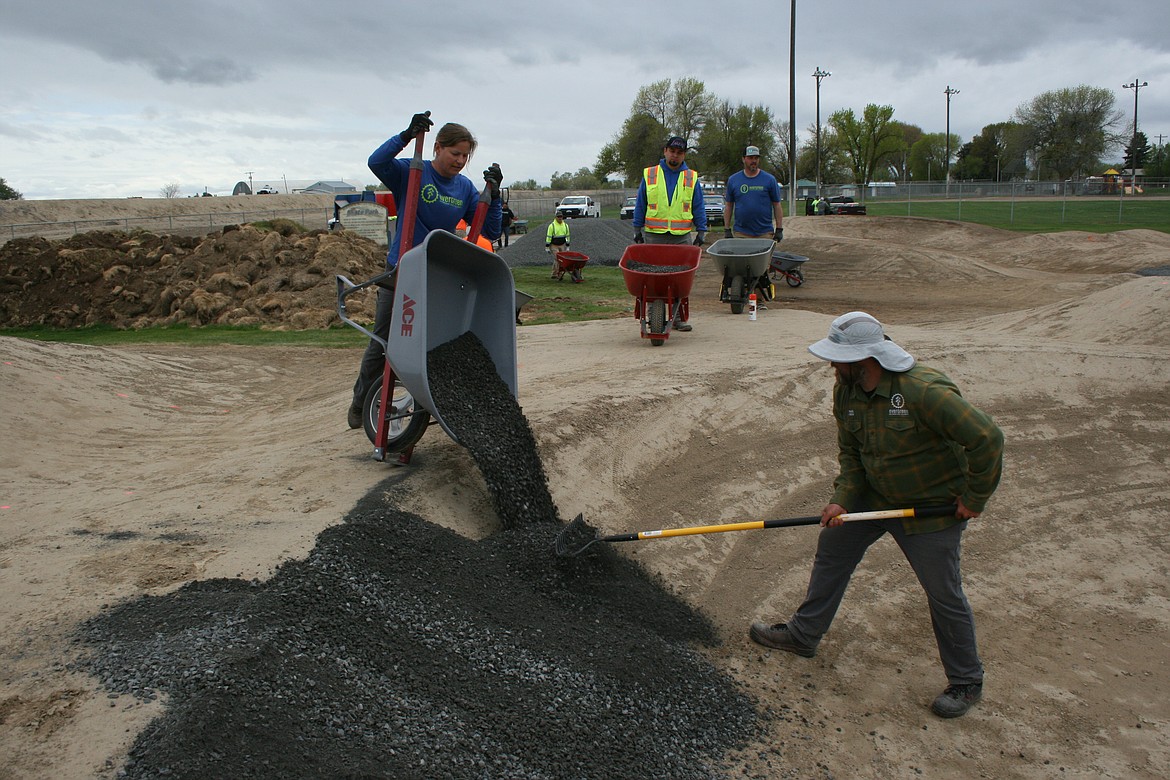
Julie Ellington (left), a volunteer with the Evergreen Mountain Bike Alliance, dumps rock on Quincy's new pump track. Designer Shawn Lorenz spreads the rock as it’s dumped.
CHERYL SCHWEIZER/COLUMBIA BASIN HERALD
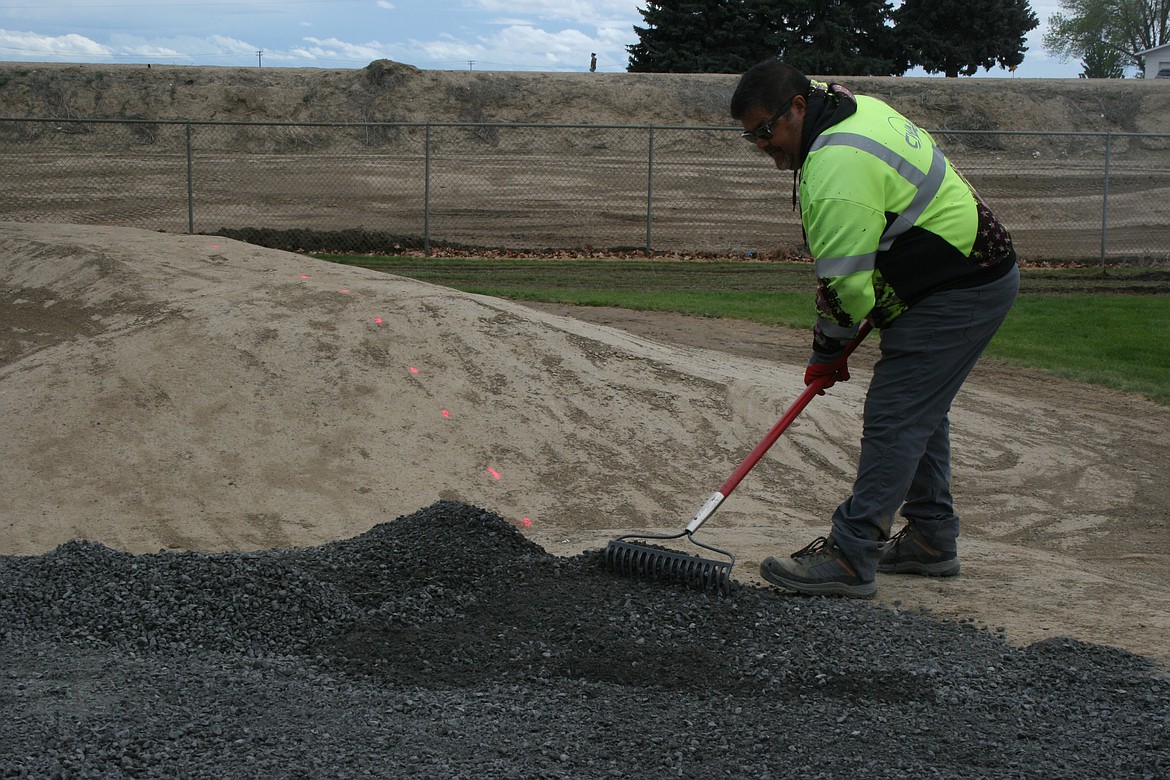
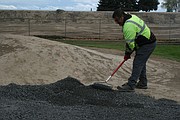
Quincy municipal employee Ray Echavarria spreads rock on the tabletop at the new pump track in Quincy’s East Park. The project is in the final stages of completion.
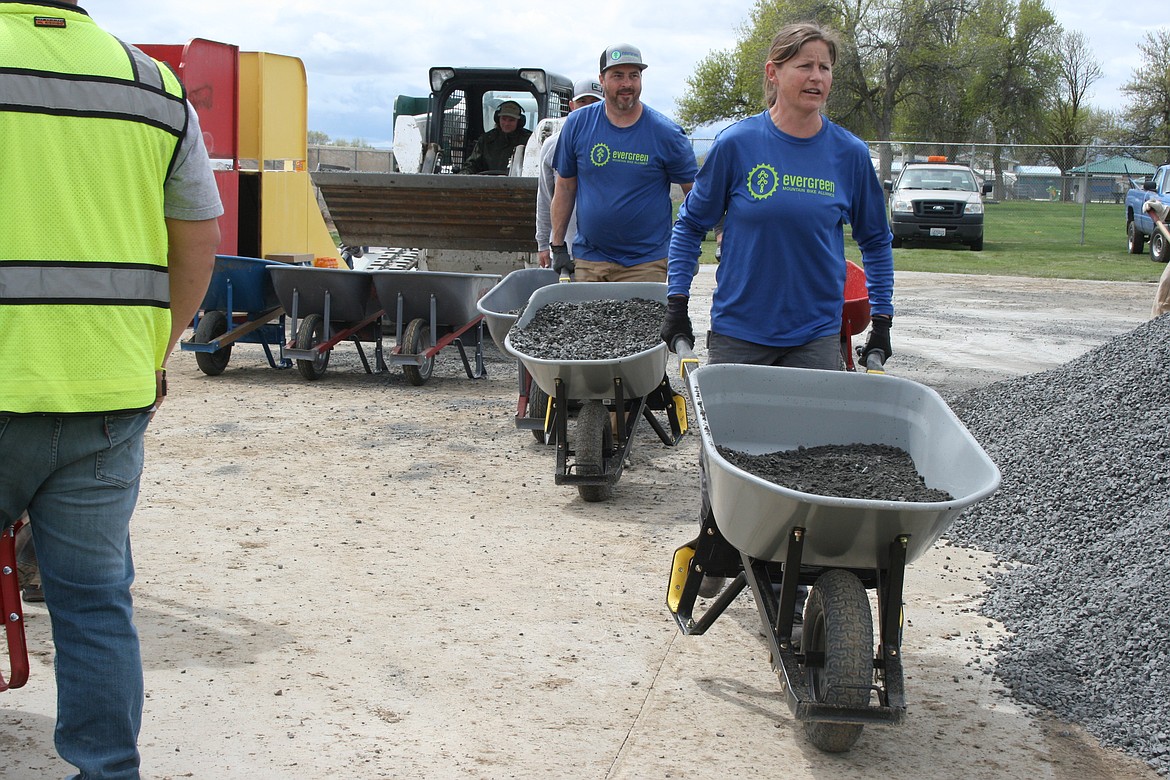
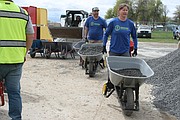
Volunteers and Quincy city workers head out with loads of rock to be spread on the pump track on May 6. The rock sets a foundation for asphalt to be added later in the construction process.
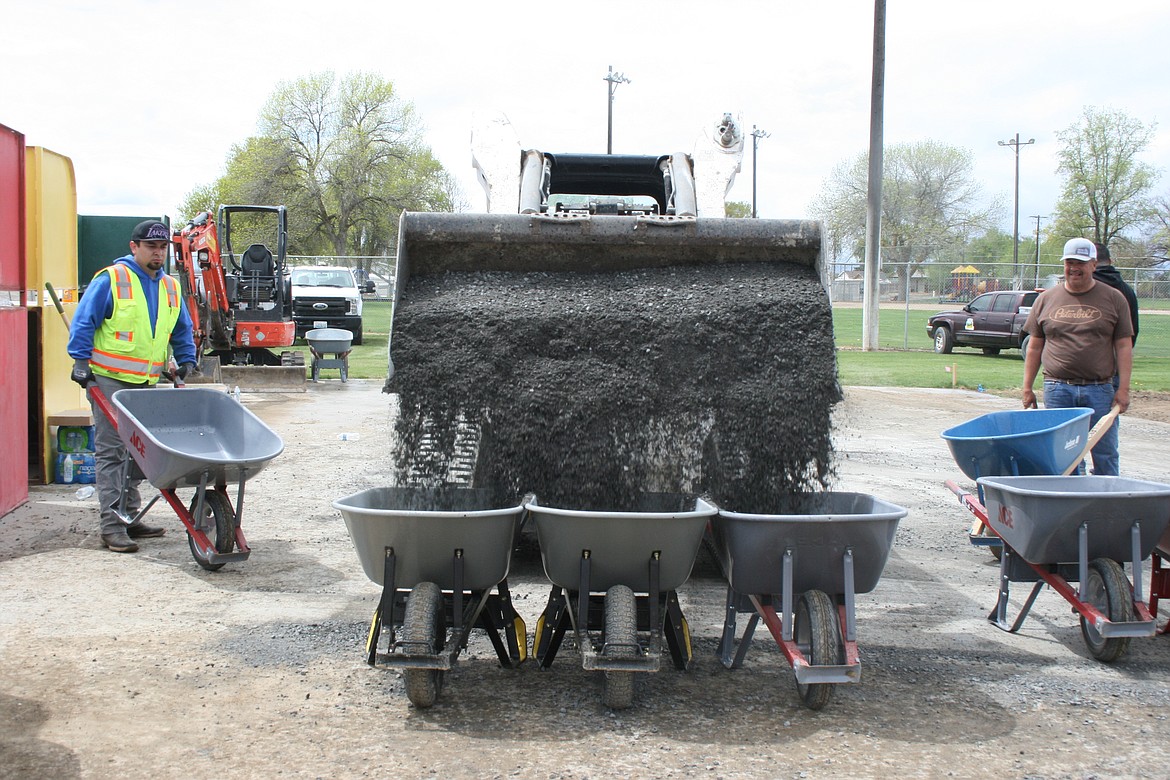
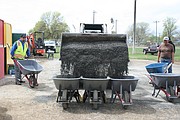
Wheelbarrows are filled with rock, ready to be wheeled out on the new pump track under construction in Quincy’s East Park
Senior Reporter Cheryl Schweizer is a journalist with more than 30 years of experience serving small communities in the Pacific Northwest. She began her post-high-school education at Treasure Valley Community College and enerned her journalism degree at Oregon State University. After working for multiple publications, she has settled down at the Columbia Basin Herald and has been a staple of the newsroom for more than a decade. Schweizer’s dedication to her communities and profession has earned her the nickname “The Baroness of Bylines.” She covers a variety of beats including health, business and various municipalities. | May 23, 2022 1:20 AM
QUINCY — Building a pump track starts with studying the lay of the land.
Shawn Lorenz of the Evergreen Mountain Bike Alliance, North Bend, designed the pump track currently under construction in Quincy’s East Park and said the design started with a picture of the park.
“The design for the Quincy track was an overhead image set precisely to a 20-foot per inch scale. And then (the design process) is using an engineering ruler to measure off feature spacing and see what fits on the land,” Lorenz said. “The design kind of forms itself - I guess organically would be a good word to use.”
A pump track, for those who have never ridden one, is all about momentum. The Quincy track has a starting ramp, and the goal is to keep the bicycle, scooter or skateboard moving without pedaling or pushing.
“Instead of pedaling to create your momentum, you’re pumping your arms in an up and down motion over the rollers to create your acceleration and your speed,” Lorenz said. “Hence the name pump track.”
The rider has to work with the track to keep going.
“If you just came in (with a) stiff arm (and stiff) leg, not much is going to happen on the track,” Lorenz said.
The track currently under construction is the first of two phases. Quincy City Council members approved a proposal from city officials to start negotiations for a second-phase design at the May 17 council meeting.
While it starts with measurements and math, Lorenz said he also draws on previous experience, both as a designer and pump track rider.
“A lot of measuring, and that’s just kind of based on features that I’ve ridden in the past, or have built in the past, and working on those measurements,” he said. “See what fits where, and where corners need to go to get you traveling in the right direction to get you back to the start ramp.
“I use a pencil so I can erase at will and alter and change things if necessary. And that’s how I get the track that’s kind of in my brain onto paper,” he said.
City manager Pat Haley said East Park had a lot of room for a pump track, so city officials asked the designers to take advantage of that. It’s actually built with two loops.
“The western, smaller loop is intended to be more of a beginner-intermediate loop, and the eastern side of the track is a kind of intermediate-expert level,” Lorenz said. “Yet ultimately - it might take you a couple of tries but even a beginner that can start to carry a little speed should be able to get through that eastern track.”
The track is built to encourage one-way traffic to avoid the risk of collision. Haley said his grandchildren are pump track riders, and one of the challenges he has seen is that more experienced riders push out less experienced riders. The East Park site was big enough to give everybody room to ride.
Of course, once there’s a design there has to be construction. Once the rollers and flat sections, called tabletops, were built, a layer of rock was required before the asphalt could be laid down. And that called for wheelbarrows - and wheelbarrows and wheelbarrows - full of rocks for the base layer. The base layer went down on May 6.
Evergreen is a nonprofit organization with chapters throughout the state, including one in North Central Washington. Volunteers from Evergreen provided some of the labor, going up and down the rollers with loaded wheelbarrows. City employees made up the rest of the crew.
Haley said the remainder of the current track will be paved when asphalt becomes available. The asphalt needed is a different mix than that used for paving roads, he said, and as a result city officials don’t know when paving will be completed and the track opened. Haley said the track should open sometime this summer.
The first section of asphalt was laid down on May 13. Haley said 10 Evergreen volunteers helped place the asphalt, all but one from the west side of the state. A lot of the interest in Quincy’s pump track is from the west side, Haley said.
There are pump tracks in Wenatchee, East Wenatchee and Leavenworth, and Haley said people are coming from the west side to go riding, in the same way golfers make a swing through different parts of the state. Quincy will be able to add its track to that list, Haley said.
The pump track is the result of a public-private partnership, which helped keep development costs low, Haley said. He estimated the cost for the first phase will be less than $200,000.
The second phase of the project would be a more compact design, more like the existing tracks in East Wenatchee and Leavenworth.
“Phase 2 will be more of a scooter component,” Haley said.
Cheryl Schweizer may be reached at [email protected] and welcomes all news tips sent to her.
ARTICLES BY CHERYL SCHWEIZER
REC Silicon reports operating loss in 2025
MOSES LAKE — REC Silicon operating revenue dropped substantially in 2025 when compared with 2024, according to the company’s annual report released March 25. The company reported $78.2 million in operating revenue in 2025, compared with $140.8 million in 2024.
Open house for Moses Lake comprehensive plan Monday
MOSES LAKE — Moses Lake residents are being invited to learn more about and give their opinions on proposed updates to sections of the city’s comprehensive plan at an open house Monday at the Moses Lake Civic Center, 411 S. Balsam St.
Samaritan posts operating loss for first two months of 2026
MOSES LAKE — Samaritan Healthcare posted net revenue losses in January and February, and while hospital officials anticipated some red ink, the losses were larger than the budget projections. Samaritan posted an operating loss of about $1.4 million in February and about $486,500 in January.