
Quincy schools discipline policy undergoing changes
CHERYL SCHWEIZER | Hagadone News Network | UPDATED 3 years, 10 months AGO
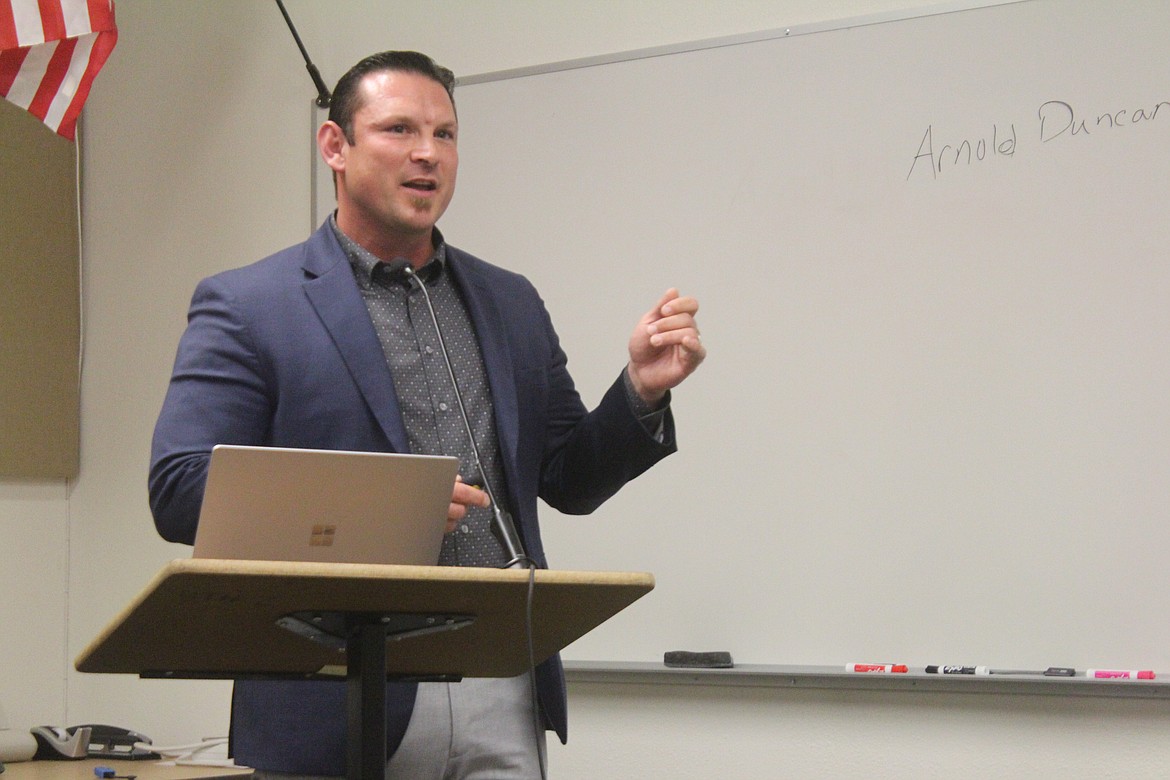
Assistant Quincy School District Superintendent DJ Garza details the district’s discipline policy for Quincy School Board members Tuesday.
CHERYL SCHWEIZER/COLUMBIA BASIN HERALD
Senior Reporter Cheryl Schweizer is a journalist with more than 30 years of experience serving small communities in the Pacific Northwest. She began her post-high-school education at Treasure Valley Community College and enerned her journalism degree at Oregon State University. After working for multiple publications, she has settled down at the Columbia Basin Herald and has been a staple of the newsroom for more than a decade. Schweizer’s dedication to her communities and profession has earned her the nickname “The Baroness of Bylines.” She covers a variety of beats including health, business and various municipalities. | October 12, 2022 4:12 PM
QUINCY — Quincy School District officials are working on a program designed to improve discipline while keeping students in school. Assistant Superintendent DJ Garza discussed the district’s “Positive Behavior Interventions and Supports” plan with Quincy School Board members at the regular meeting Tuesday.
“(The program) is a framework for building better habits for students,” Garza said. “We’re all creatures of habit, and all students come to us with a set of habits, good or bad.”
The goal is to change bad habits, hopefully before student behavior becomes a problem in the classroom. The program starts with a set of behavior expectations that are the same at all five elementary schools, Quincy Middle School and Quincy High School, Garza said.
Board member Chris Baumgartner said each school is different and asked how the plan takes that into account.
Garza said the goal is to ensure all schools have the same expectations and use the same disciplinary tools. Administrators can adjust from there, he said.
Superintendent Nik Bergman said it’s important that a student who might transfer from one school to another will have the same disciplinary standards. It’s also important to ensure consistency when students get to QMS or QHS, Bergman said.
The results will tell administrators if and where the program is working, Garza said. If the program is working, about 80 to 85% of students will meet the standards.
“We should only have about 10 to 15% of students in that (second) tier. When a student moves into needing that second tier, (it) means something is going on, that student is not being successful with those positive reinforcements within a classroom,” Garza said. “That second tier is really a behavior plan of some sort for that student.”
The third phase is for students who don’t meet the behavior plan.
“(The third phase) should only be about 5% of your student population,” Garza said.
Board member Tricia Luach asked about parental involvement, and Garza said the goal is to get parents involved immediately when a child is disciplined. Classroom teachers should be contacting parents first, and school administrators should be getting involved when a student is sent to the second phase, he said.
“Parents are part of this process because we can’t do this by ourselves,” he said.
In answer to a question from board member Heather Folks-Lambert, Garza said district administrators are still working to refine the criteria to determine if and where the program is working. The program already is in place, he said, but some parts of it need more work.
“The data will show us,” he said. “(The district) will be able to gather this data over time.”
Students who end up in the second phase will have a behavior contract and must meet the stipulations in that contract. They will have daily meetings with school staff members to talk about what went right and wrong, Garza said. At least one staff member per school will be in charge of the check-in-check-out system, and more staff members can be added if necessary, he said.
Monitoring students who have been assigned to the higher phases has presented some challenges, Garza said.
“When there’s an issue with a student and we need Tier Two support, we’re seeing a little bit of a bottleneck,” he said.
Cheryl Schweizer may be reached at [email protected]. Find more news on education and other local issues by downloading the Columbia Basin Herald app - available for iOS and Android devices.
ARTICLES BY CHERYL SCHWEIZER

Road projects on hold for Labor Day weekend
MOSES LAKE — With Labor Day weekend dead ahead, drivers will be able to move freely about the state. Most road projects are on hold for the holiday weekend. Nobody will be working on the Hansen Road overpass on Interstate 90, but the lane restrictions that are in effect will continue through the end of the project.

Cost estimates for water source alternatives given to Moses Lake City Council
Protected under the U.S. Endangered Species Act, efforts are ongoing to keep it self-sufficient
MOSES LAKE — It’s going to cost a lot of money to provide alternative water sources for the city of Moses Lake, but some of the possible alternatives will cost more than others. City officials provided the Moses Lake City Council with costs for various alternatives Tuesday.

Dryer vent cleaning is important -- but often overlooked
MOSES LAKE — Not all the maintenance a house needs is visible. Sometimes a potential problem just goes unnoticed until it causes trouble, sometimes serious trouble. But a lot of potential problems give off warning signs. Clothes dryers often do when they need a good cleaning.