
Cleaning up history
JOEL MARTIN | Hagadone News Network | UPDATED 4 years, 1 month AGO
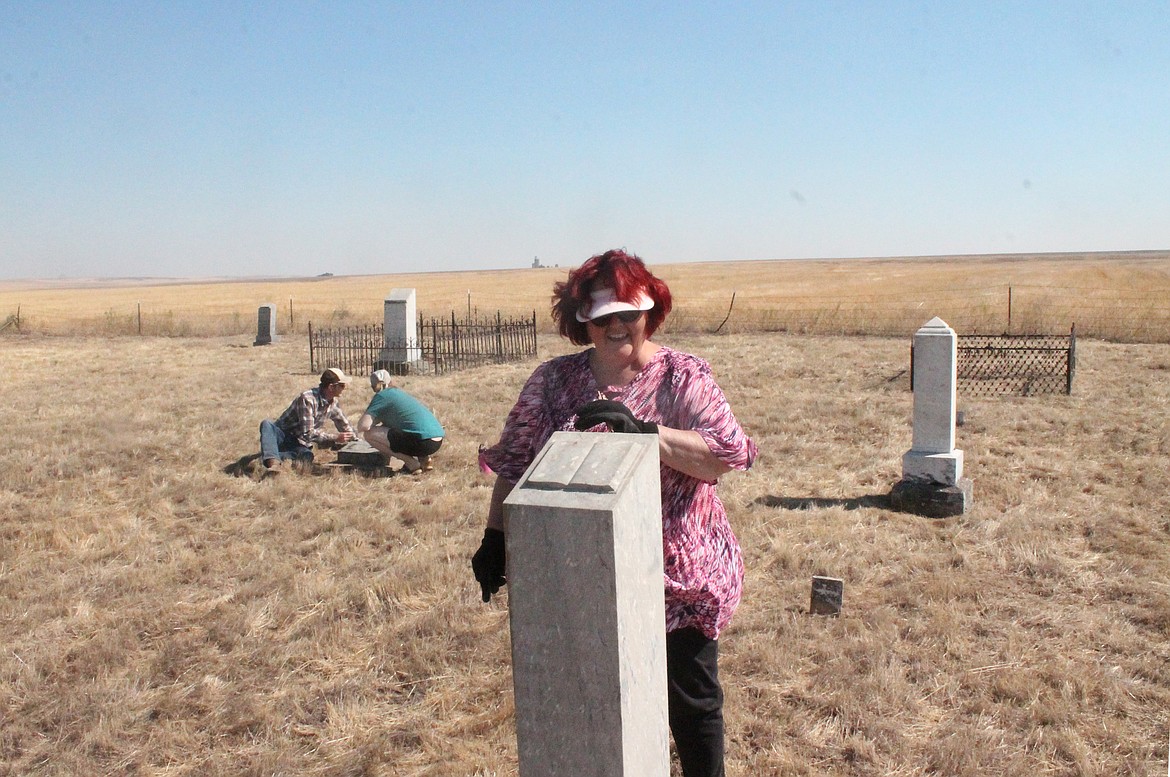
Judy Evans Lindhag cleans up a headstone at the Welsh Cemetery Saturday morning. Behind her, Aren Orsen, left, and Liz Orsen carefully remove buildup from a headstone. The Orsens work in historic preservation, they said, so they know a bit about old cemeteries. They were the ones who brought the cemetery’s existence to the attention of the Puget Sound Welsh Association.
JOEL MARTIN/COLUMBIA BASIN HERALD
Joel Martin has been with the Columbia Basin Herald for more than 25 years in a variety of roles and is the most-tenured employee in the building. Martin is a married father of eight and enjoys spending time with his children and his wife, Christina. He is passionate about the paper’s mission of informing the people of the Columbia Basin because he knows it is important to record the history of the communities the publication serves. | September 14, 2022 2:13 PM
HARTLINE — On a lonely gravel road somewhere between Hartline and Almira, there’s a small graveyard that is the only tangible evidence of a once-thriving community.
“The whole Welsh settlement was about a 15-mile strip north of Hartline, Wilbur, Govan and Almira, just kind of a strip right through there,” said Judy Evans Lindhag, whose family homesteaded next to the cemetery. “In the old time, they called it the ‘Welsh township,’ but it was never a town.”
Lindhag was one of about a dozen people who gathered at the Welsh Cemetery Saturday morning to clean up headstones and clear away brush. The work day was planned by Mary Lynne Evans, president of the Puget Sound Welsh Association in Seattle.
The seeds were planted when Aren Orsen and his wife Liz, of Electric City, were looking over some foreclosed land in the area, noticed the little cemetery in the middle of nowhere and wondered if there was a Welsh historical organization that might be interested in knowing about it. The nearest they could find was the PSWA, so Aren sent off an email to Evans asking if the group was interested in knowing more.
“I said ‘Of course we're interested,’” said Evans.
Evans then contacted the owner of the land around the cemetery, a local farmer, to see if it would be all right to come out and see it, and that put her in touch with some of the descendants of the Welsh homesteaders, including Lindhag, Cindy Williams Rohde and a longtime member of the PSWA, 92-year-old Kay Jones Vea, who had grown up in Almira but now lives in Woodinville. Vea’s grandfather James Jones had come with his brother to the Big Bend.
“That first winter they lived here, they lived in a place that was dug in the ground. They almost froze to death. So they went back to Wales and he decided he would stay there. And then he came back to America because my grandmother said she wouldn't raise children in the mines.”
James Jones came from Criccieth, in northwestern Wales, and his wife Mary from Machynlleth, Vea said. None of Vea’s family is buried in the Welsh Cemetery, she said; they’re at the Almira Cemetery, which is still in use.
Rohde did have family buried in the little Welsh Cemetery. She busied herself cleaning up the headstones of her great-great-grandfather Benjamin Williams, whose stone says he was born in Blaenpant, in southwestern Wales, in 1829 and her great-grandmother Mary Williams, who lived from 1826 to 1901.
“They went to Pennsylvania to the mines, because they were miners and farmers, and then they came out here,” Rohde said. “They settled here in Almira because they found a place with a good spring – it has an artesian well – and a proper Welsh church. That's why they came here.”
The community wasn’t a very long-lived one; the earliest death recorded in the cemetery was in 1894 and the last in 1920. But while it lasted, it was active. Next to the cemetery was the Zion Welsh Calvinistic Methodist Church, where the Welsh immigrants would meet to worship in their own language. There was a school as well, to educate the farm children. The community even had a baseball team, the Salt Grass Boys, Williams said.
The Welsh settlers held a Fourth of July picnic every year at Williams Grove, just east of Almira, and the cleanup crew headed over to that site to hold their own picnic after the work was done. The current landowner preferred that they not use the actual land, so the picnic was held on the side of the road looking over the original site. The picnic included homemade bara brith, or “speckled bread,” and griddle-fried Welsh cakes, both traditional Welsh fare.
Music would have been a strong tradition among the Welsh settlers, Lindhag and Vea both said. On one of the graves, Lindhag found a large metalwork in the shape of a traditional Welsh harp. The settlers also held a regular eisteddfod, which is a music and poetry contest, Vea said.
“I won the contest when I was 6 years old, singing,” she said.
The population began to diminish in the 1930s, according to a 1978 historical note from the Welsh-American newspaper Ninnau, owing largely to drought and the Depression. The church building was moved in the 1940s to a neighboring farm to be used as a shed, Lindhag said.
The church, school and baseball team may all be distant relics, but a few of the families still work the same land their Welsh ancestors staked out. Kay Vea’s nephew operates the Jones homestead, she said.
“There are four original Welsh families that are still here,” Lindhag said. “Edwardses, Williamses, Llewellyns and Joneses. So there are four that are still farming today.”
Joel Martin can be reached via email at [email protected].
ARTICLES BY JOEL MARTIN
Endless battle
Noxious Weed Control Board works to keep invasive plants under control
MOSES LAKE — Some of the nastiest plants in Grant County were the topic of a class led by Jay Johnson, a consultant with the Grant County Noxious Weed Control Board, Tuesday. The Noxious Weed Control Board, as its name would suggest, is tasked with keeping weeds under control in Grant County. That’s not a small job; the board’s website lists 129 species of noxious weeds that are found around Grant County. A noxious weed is defined as an invasive, non-native plant that threatens agricultural crops, local ecosystems or fish and wildlife habitat, according to the Noxious Weed Control Board. Washington state law requires that these weeds be identified and their spread kept to a minimum, if not completely eradicated. “We’re one of those agencies a lot of people don’t really understand,” Johnson said. “We’re a county office and … our funding is tax-based assessment. When you get your tax bill and you look down at all the expenses that you pay for, there we are.”

BASIN EVENTS: Oct. 16-24
COLUMBIA BASIN — Whether you feel like shopping, crafting, learning or seeing a show, there’s something happening for you this week in the Basin. Oct. 16 ‘My Family (Mi Familia)’ screening Spanning three generations, “My Family (Mi Familia)” is a heartfelt drama that follows the Sánchez family as they build their lives in East Los Angeles. Through love, hardship, triumph, and sacrifice, the film explores the immigrant experience, the strength of family bonds, and the traditions that connect one generation to the next. Lowrider show and taco truck before the screening. Sponsored by Columbia Basin Allied Arts, EDUBS C/S and the Moses Lake Creative District. $12 per person. Doors open at 6 p.m., film begins at 7 p.m. at the Moses Lake Civic Center Auditorium, 401 S. Balsam St. Tickets and info: www.cba-arts.org.
Moses Lake author encourages women to look beyond church culture norms
MOSES LAKE — A Moses Lake author’s book, “A Christian Woman Striving to Live Her Faith in a Man-Controlled World,” takes aim at the role to which many churches relegate the female half of their congregations. “It’s to encourage women in the faith,” Linda Curran said. “A lot of churches say, ‘Teach Sunday school, do this, do that, but don’t (evangelize.)’" In her book, Curran recounts a time when she moved to a new community and joined a church there. She was surprised to learn that, as a new female member, she had been automatically assigned church cleaning duties. When she questioned it, she wrote, she was met with condescension and her objections were brushed aside. In other churches, she said, women who were capable of teaching were relegated to “women’s ministry.”