
‘Full of knowledge’
JOEL MARTIN | Hagadone News Network | UPDATED 3 years, 5 months AGO
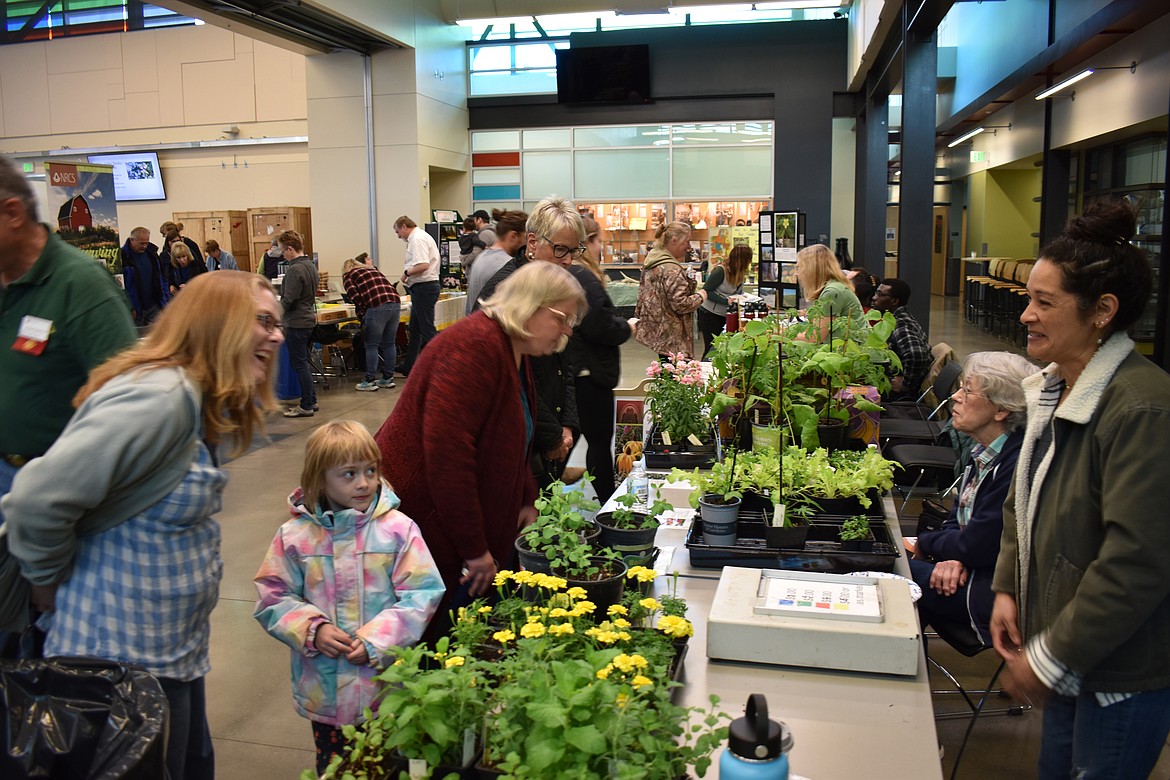
Five-year-old Celestine Reiman and her mom Anjie Rieman, left, talk plants with Maria Reimers, right, at the Columbia Basin Eco-Gardening Symposium Saturday. Celestine was hoping to plant something for her kindergarten teacher, Anjie said.
JOEL MARTIN/COLUMBIA BASIN HERALD
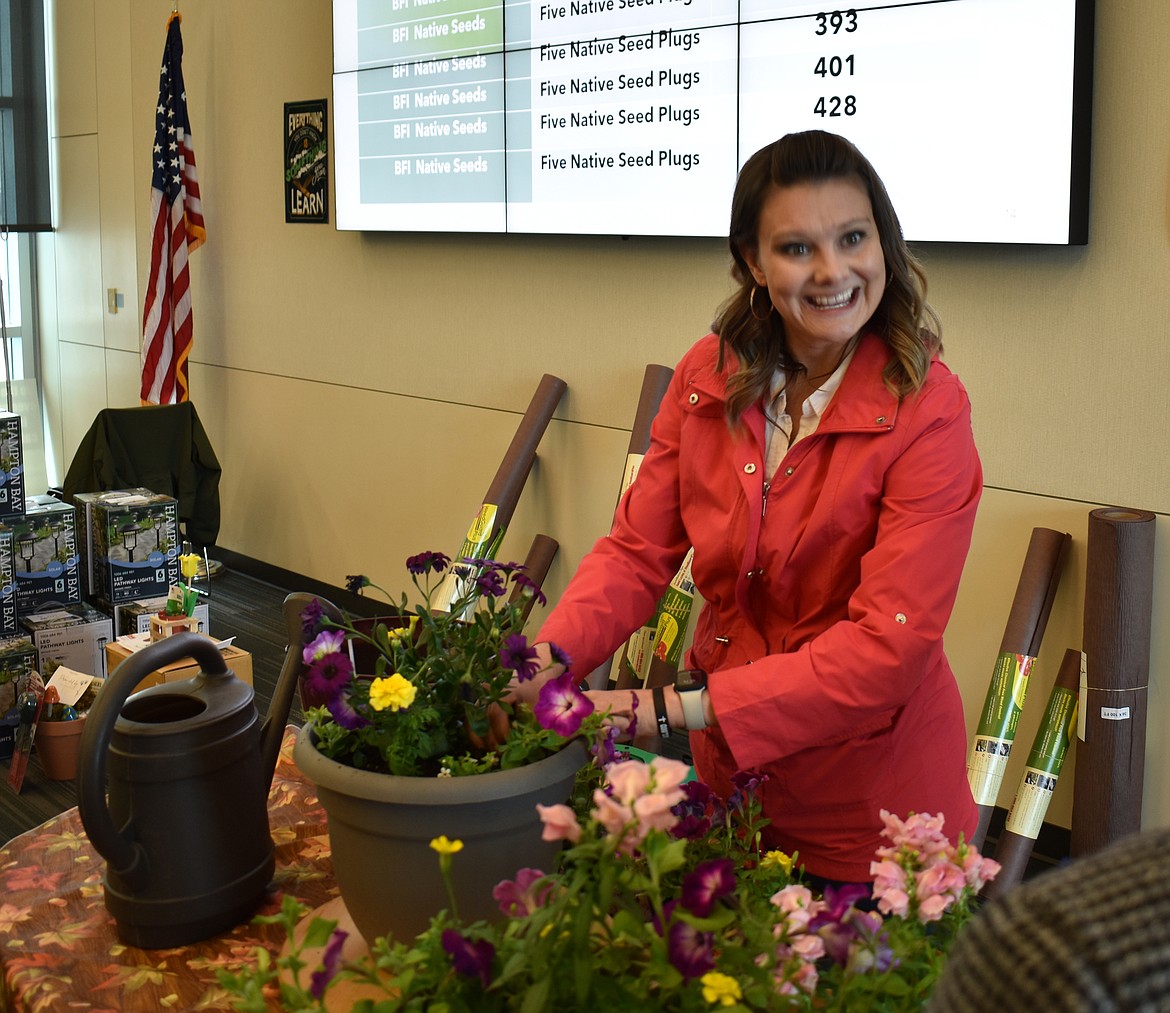
WSU Master Gardener Bobbie Bodenman demonstrates planting techniques at the Columbia Basin Eco-Gardening Symposium Saturday.
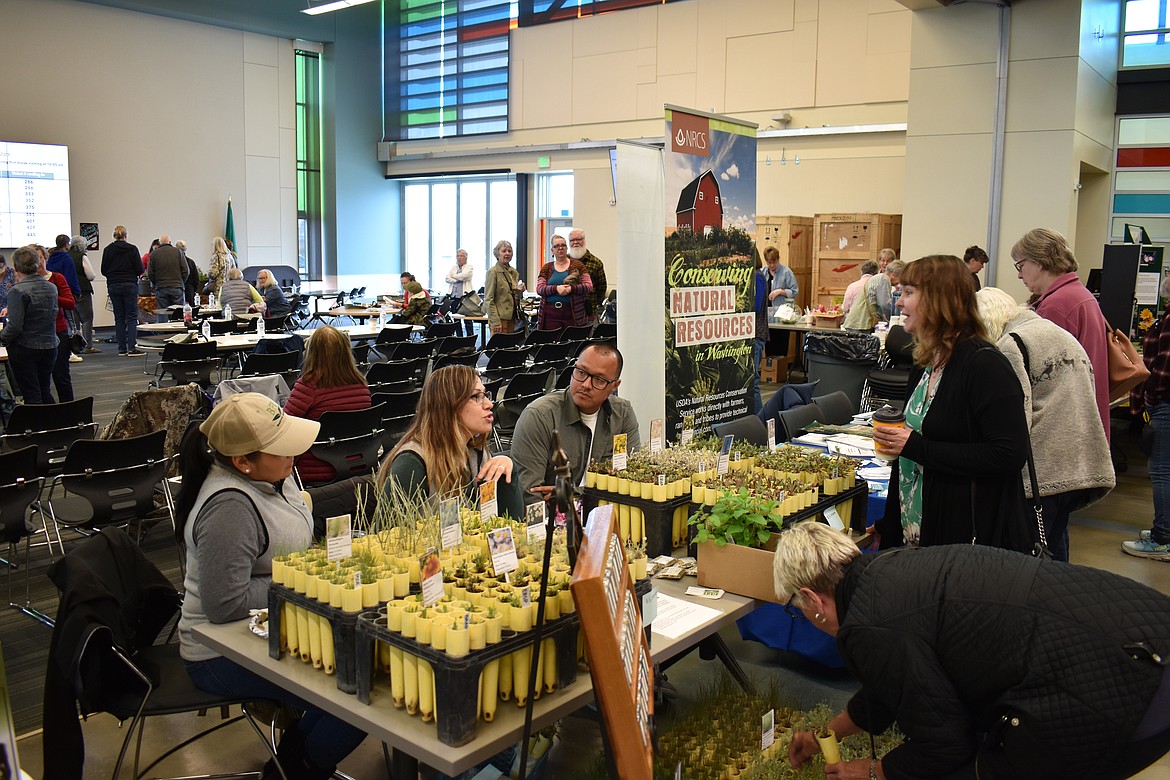
From left: Edith Gonzalez, Linda Duran and Rico Duran, of BFI Natural Seeds, discuss a variety of plants with attendees at the Columbia Basin Eco-Gardening Symposium Saturday.
Joel Martin has been with the Columbia Basin Herald for more than 25 years in a variety of roles and is the most-tenured employee in the building. Martin is a married father of eight and enjoys spending time with his children and his wife, Christina. He is passionate about the paper’s mission of informing the people of the Columbia Basin because he knows it is important to record the history of the communities the publication serves. | April 28, 2023 1:30 AM
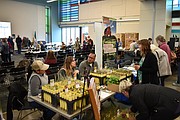
MOSES LAKE — The Columbia Basin Technical Skills Center was a hive of activity Saturday, hosting the sixth annual Columbia Basin Eco-Gardening Symposium.
“The list of the exhibitors didn't look that long,” said Dinah Rouleau, project manager with the Columbia Basin Conservation District. “But when you went there was filled up with a lot of really full informational booths and really knowledgeable people.”
The CBCD presents the event every year in conjunction with the Washington State University Extension Grant-Adams Master Gardeners. The focus is on native plants and gardening in an environment where water is scarce. There were three presentations by speakers, as well as a number of booths set up by businesses and organizations devoted to eco-friendly agriculture and horticulture. There were about 80 or 90 people attending, Rouleau estimated.
The first presentation was by Katie Doonan, entitled “Climate Change and Planning for Uncertainty.” Doonan is the Extension Coordinator for WSU’s Center for Sustaining Agriculture and Natural Resources, based in Puyallup.
“I think some of the biggest (effects of climate change) are just those environmental challenges that we normally see throughout a garden season,” Doonan said in an interview later. “But they're becoming a lot more common and a lot more intense, like heat stress, and drought challenges and changing conditions that we haven't necessarily seen before with pests and weeds.”
There are some steps gardeners can take to adapt to the changing climate, Doonan said, like using compost in garden soil.
“That works in a couple of ways to actually help us become resilient to climate change,” she said. “Because it's reducing our food waste and our garden waste and all that that could theoretically go to the landfill and create more methane and more emissions in the atmosphere. But you can also use it in your garden soil to increase your water infiltration, so you're able to better protect the water that you do have and use it more efficiently while also reducing waste streams.”
Using compost as a mulch on top of the soil can also reduce soil temperatures and protect the soil from the sun, she added.
The talk maintained an upbeat tone, Rouleau said, which isn’t always the case when something like climate change is being addressed.
After Doonan’s presentation, the audience dispersed a little toward a snack table and the various exhibitors that were set up. Master Gardener Bobbie Bodenman gave a demonstration called “Filler and Thriller,” in which she showed how to pot plants to their best advantage. Her arrangement included bacopa, marigolds, Purple Passion petunias and African daisies.
The second presentation was “Containing Invasive Pests in the Pacific Northwest,” by Mike Bush, with the Washington State Department of Agriculture’s invasive pest program.
“I learned a few things,” Rouleau said after the presentation. “Like I didn't know about the spotted lantern fly and how we need to worry about, even in our heritage garden, planting anything with fruits or berries, or near orchards or vineyards or anything of that sort, because it's a really big pest for them … It's something I really need to be more mindful of.”
Another break followed Bush’s talk, including a mini-demonstration of bee boxes by the CBCD. Rouleau showed how to set up a bee box for mason bees, and how to harvest cocoons in the winter and let them hibernate in a refrigerator until they’re ready to be set out in the spring.
The final presentation was on heritage gardening and the use of drought-tolerant native plants, given jointly by Rouleau and Heather Wendt, who is the assistant manager of both Benton and Franklin conservation districts.
“Everybody seemed really supportive,” Rouleau said. “I met so many people that just came and talked to me at my booth about how they're excited that this is an option.”
The key to gardening in water-scarce, changing conditions is adaptability, Doonan said, which was a common thread throughout the symposium.
“The fact that people are being receptive to new ways of doing things is really encouraging in the face of climate change,” she said. “I think the biggest way to become adaptable to climate change is just being open to new ideas and new strategies, and not just relying on historical ways of thinking and things that worked in the past.”
Joel Martin may be reached via email at [email protected].
ARTICLES BY JOEL MARTIN
Endless battle
Noxious Weed Control Board works to keep invasive plants under control
MOSES LAKE — Some of the nastiest plants in Grant County were the topic of a class led by Jay Johnson, a consultant with the Grant County Noxious Weed Control Board, Tuesday. The Noxious Weed Control Board, as its name would suggest, is tasked with keeping weeds under control in Grant County. That’s not a small job; the board’s website lists 129 species of noxious weeds that are found around Grant County. A noxious weed is defined as an invasive, non-native plant that threatens agricultural crops, local ecosystems or fish and wildlife habitat, according to the Noxious Weed Control Board. Washington state law requires that these weeds be identified and their spread kept to a minimum, if not completely eradicated. “We’re one of those agencies a lot of people don’t really understand,” Johnson said. “We’re a county office and … our funding is tax-based assessment. When you get your tax bill and you look down at all the expenses that you pay for, there we are.”

BASIN EVENTS: Oct. 16-24
COLUMBIA BASIN — Whether you feel like shopping, crafting, learning or seeing a show, there’s something happening for you this week in the Basin. Oct. 16 ‘My Family (Mi Familia)’ screening Spanning three generations, “My Family (Mi Familia)” is a heartfelt drama that follows the Sánchez family as they build their lives in East Los Angeles. Through love, hardship, triumph, and sacrifice, the film explores the immigrant experience, the strength of family bonds, and the traditions that connect one generation to the next. Lowrider show and taco truck before the screening. Sponsored by Columbia Basin Allied Arts, EDUBS C/S and the Moses Lake Creative District. $12 per person. Doors open at 6 p.m., film begins at 7 p.m. at the Moses Lake Civic Center Auditorium, 401 S. Balsam St. Tickets and info: www.cba-arts.org.
Moses Lake author encourages women to look beyond church culture norms
MOSES LAKE — A Moses Lake author’s book, “A Christian Woman Striving to Live Her Faith in a Man-Controlled World,” takes aim at the role to which many churches relegate the female half of their congregations. “It’s to encourage women in the faith,” Linda Curran said. “A lot of churches say, ‘Teach Sunday school, do this, do that, but don’t (evangelize.)’" In her book, Curran recounts a time when she moved to a new community and joined a church there. She was surprised to learn that, as a new female member, she had been automatically assigned church cleaning duties. When she questioned it, she wrote, she was met with condescension and her objections were brushed aside. In other churches, she said, women who were capable of teaching were relegated to “women’s ministry.”