
Soap Lake Conservancy pushing for Outstanding Resource Water classification
GABRIEL DAVIS | Hagadone News Network | UPDATED 2 years, 4 months AGO

Judith Gorman, president of the Soap Lake Conservancy, stands in the Soap Lake Community and Senior Center, where the in-person public hearing for Soap Lake’s designation as an Outstanding Resource Water will be held on September 19 at 5:30 p.m.
GABRIEL DAVIS/COLUMBIA BASIN HERALD
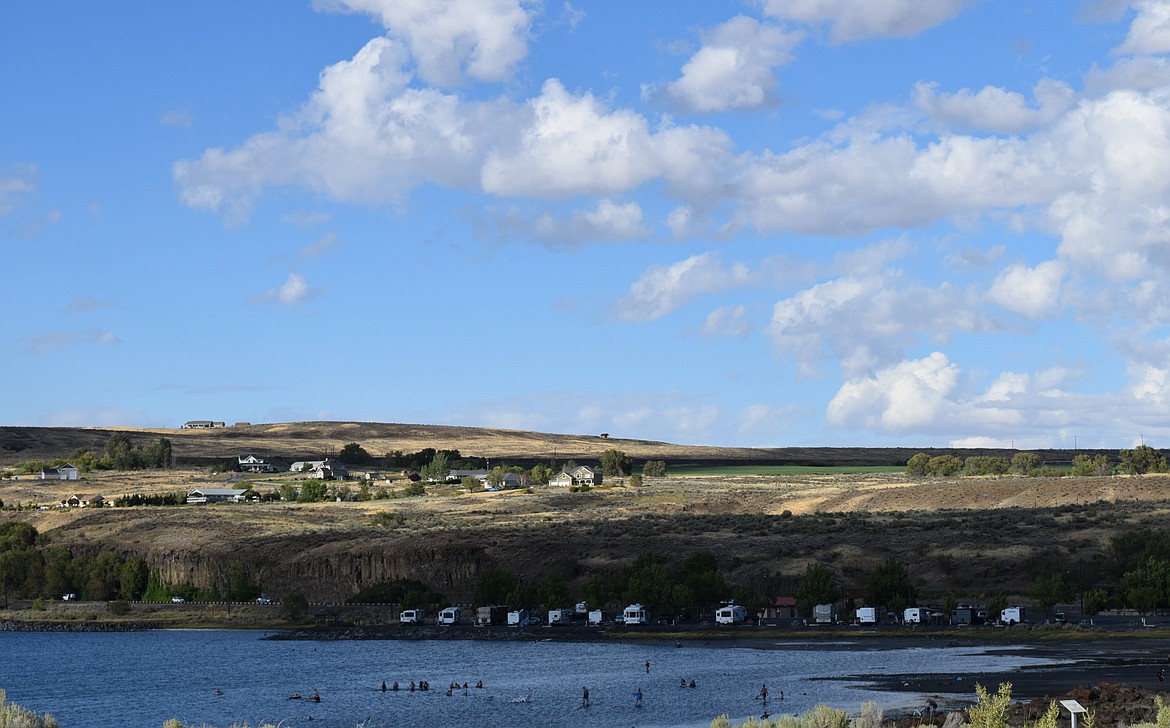
The south end of Soap Lake, the subject of the Soap Lake Conservancy and the Confederated Tribes of the Colville Reservation’s application for Outstanding Resource Water status to provide more protections for the lake from pollutants and dilution of the lake’s unique mineralization.
Gabriel Davis is a resident of Othello who enjoys the connections with his sources. Davis is a graduate of Northwest Nazarene University where he studied English and creative writing. During his free time, he enjoys reading, TV, movies and games – anything with a good story, though he has a preference for science fiction and crime. He covers the communities on the south end of Grant County and in Adams County. | August 16, 2023 6:55 PM
SOAP LAKE – The Soap Lake Conservancy and the Confederated Tribes of the Colville Reservation are pushing for Soap Lake to be designated as an Outstanding Resource Water by the Department of Ecology, the proposal for which is open to public comment until Sep. 27.
The Soap Lake Conservancy and the CTCR submitted an application to the Department of Ecology in 2021 to assign Soap Lake Tier III (B) status as an Outstanding Resource Water, which would apply certain environmental protections to the lake. The Department of Ecology explained the motivation behind accepting the nomination of Soap Lake in an informational sheet on its website.
“Soap Lake is a truly unique lake in Washington,” stated the informational sheet. “The water is naturally salty and has many minerals. The lake has a unique layer of deep, very salty water that never mixes with the rest of the lake. Soap Lake is culturally significant to Tribes and is a popular tourist destination due to its unique water. We propose designating Soap Lake based on its unique and regionally rare habitat, unique recreational value, and statewide ecological significance.”
The Department of Ecology will be proposing three bodies of water for Tier III (A) status and one – Soap Lake – for Tier III (B), which is a slightly lower designation that provides fewer protections from pollutants and environmental changes due to Soap Lake not qualifying for all of the DOE’s requirements.
“The Department of Ecology of the state accepted our application and said we meet tier 3B. We meet three out of the four criteria,” said Judith Gorman, president of the Soap Lake Conservancy, “The one we don't meet is the lake is not pristine. It's not what it used to be.
Gorman said the Conservancy is concerned with the dilution of the unique mineralization of the lake just as much as potential pollutants. The application for Outstanding Resource Water status stated that Soap Lake is relatively pollutant-free, but is not pristine and that past additions of fresh water to the lake have lowered the lake’s mineralization.
“It's lost a fair amount of its mineralization but it's still very unique in that it's a layered lake. So it has three layers. It does not turn over like freshwater lakes. Freshwater lakes turn over annually, mixing themselves to oxygenate. This lake doesn't have fish in it. It has a low oxygen level. Has a variety of minerals.”
Gorman said that Soap Lake has also been an important body of water for scientific study for decades due to the unique layering and composition of the lake and that the lake should be preserved for more study. She also said the Outstanding Resource Water status affects more than Soap Lake residents.
“We have lots and lots of tourists who come here every summer and spring and fall to Take advantage of the healing waters,” said Gorman.
The application for Soap Lake’s Outstanding Resource Water status also stated that Soap Lake is culturally significant to several Native American tribes, including the Moses-Columbia, Chief Joseph Band of Nez Perce, Entiat, Chelan, Okanogan, Palus and Wenatchi tribes.
“Each of these tribes are now included in the confederacy of the CTCR tribal government, and have identified Soap Lake for its natural contributions to the spiritual and physical health of its aquatic minerals and water quality, food and medicine security source, and as an economic trading and community center,” said the application.
According to the Department of Ecology’s website, the public comment period for the ORW application will last until Sep. 27. Members of the public can comment through a written letter, online through a forum on the Department of Ecology’s website, or at the in-person Public Hearing scheduled for Sep. 19 at 5:30 p.m. at the Soap Lake Community and Senior Center. Anyone is eligible to participate in the public comment period, said Gorman
Gorman said that the status would not change the way that city ordinances and processes will work.
“Decisions will not be made in any different kind of way. The city council will still have the right to decide what's going to be going on in the city in terms of building, issues, shoreline issues…the decision process that exists now will continue to take place. What is different is that the lake will not be allowed to become more polluted, or to become less mineralized, is my hope,” said Gorman.
Gabriel Davis may be reached at [email protected].
ARTICLES BY GABRIEL DAVIS

Work-based learning lets students build their own futures
MOSES LAKE — Work-based learning provides education opportunities for the workforce to receive hands-on training and technical education and prepare themselves to enter various industries. Educators and workforce development professionals from Eastern Washington discussed some the training they offer and the benefits of their programs. Next Generation Zone, an affiliate of WorkSource based in Spokane, provides job training opportunities for youth and young adults ages 16 to 24. Program Coordinator Kate Martin said there are multiple benefits to the program. “One of them is a paid work experience, and that’s where we reach out to area employers who are willing to take a young person and train them,” she said. “This is a short-term learning experience, so it’s typically about 240 hours; sometimes it could be longer or shorter. We’re the actual employer; we cover all of their wages, taxes, the L&I, and the employer just agrees to give them the experience and train them in whatever field it is that they’re wanting to go into.”

Serving schools: ESD superintendents reflect on operations, priorities
MOSES LAKE — Educational service districts are government-mandated agencies put in place to provide services to school districts across the state. ESD Superintendents discussed what they do and their priorities in operating their districts. ESD 105, led by Superintendent Kevin Chase, serves four counties, including Kittitas, Yakima and portions of Klickitat and Grant counties and provides support for 25 school districts – including Royal School District and Wahluke School District – and more than 66,000 students. “We help them collaborate with each other as well or collaborate with other partners,” Chase said. “(It’s) a lot of advocacy work, either regionally or across the state, or even federally, working on different issues that impact our education. And we provide very specialized services in certain situations in order to meet the needs of our students in our region and of our school districts.”

Columbia Basin Project making headway through Odessa Groundwater program
CASHMERE — The Columbia Basin Project is making gradual progress toward completion with particularly significant accomplishments for the Odessa Groundwater Replacement Program in the last six months or so, according to Columbia Basin Development League Executive Director Sara Higgins. “When we’re dealing with a project of this size, advancement is kind of like watching paint dry, but yes, there have been (developments),” she said. “There are a lot of exciting things happening right now.” There are more than 300 miles of main canals, about 2,000 miles of lateral canals and 3,500 miles of drains and wasteways in the irrigation project, according to the U.S. Bureau of Reclamation website. The CBDL advocates for the operation of those waterways and for the project to continue “build-out.”