
Water masters
JOEL MARTIN | Hagadone News Network | UPDATED 3 years, 1 month AGO

Abby Rettkowski, 5, of Moses Lake, fills and sets siphons in the World-Famous Siphon-Setting Contest Saturday at the Grant County Fair.
JOEL MARTIN/COLUMBIA BASIN HERALD
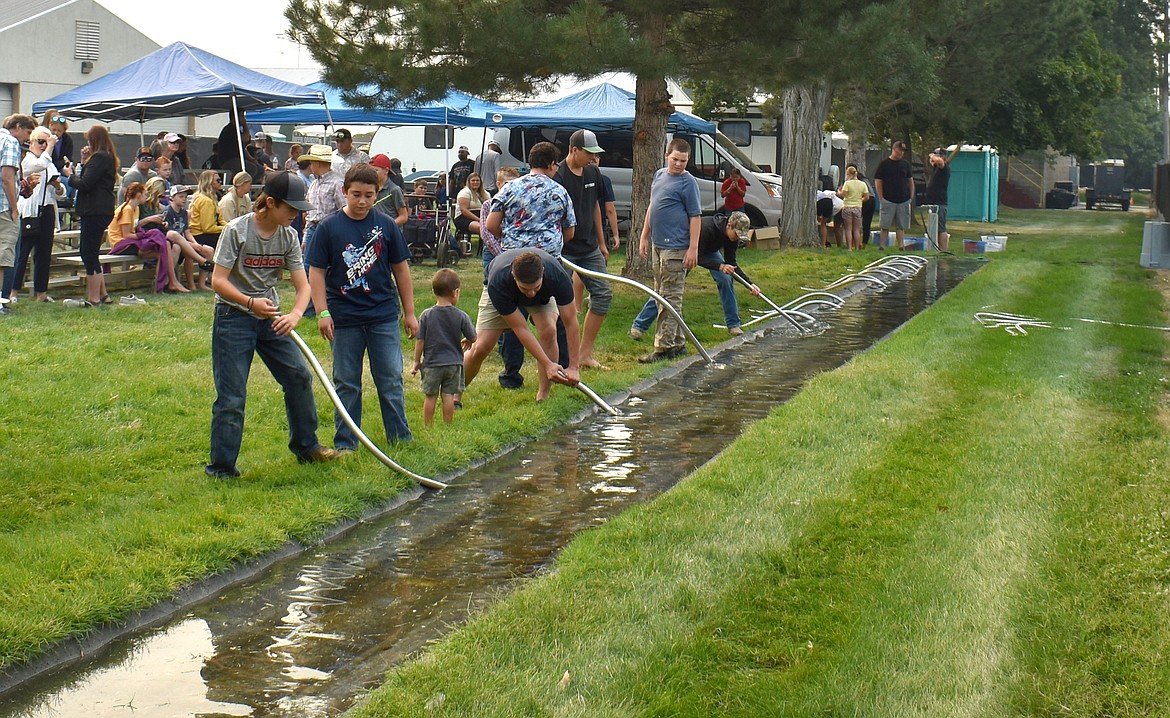
Competitors in the World-Famous Siphon-Setting Contest get in a little practice before the contest starts Saturday morning at the Grant County Fair.
Joel Martin has been with the Columbia Basin Herald for more than 25 years in a variety of roles and is the most-tenured employee in the building. Martin is a married father of eight and enjoys spending time with his children and his wife, Christina. He is passionate about the paper’s mission of informing the people of the Columbia Basin because he knows it is important to record the history of the communities the publication serves. | August 24, 2023 1:20 AM
MOSES LAKE — It’s a little ironic that the World-Famous Siphon-Setting Contest may be the best-kept secret at the Grant County Fair.
“It’s kind of a hidden gem,” said Stacie Palmer. She and her husband, Craig Palmer, have managed the contest every year at the fair since the late 1990s. The contest is older than that, she added; nobody seems to remember exactly how old.
“We’ve always called it the world championship,” said Craig Palmer, even if it’s just about the only contest of its kind. “There is another one — we looked it up years ago — down in southern Idaho somewhere.”
Just as a rodeo is mostly a display of skills a working cowboy uses regularly, the siphon-setting contest is an opportunity to show off expertise learned on the farm. Irrigating with siphons, or rill irrigation, used to be the standard way of getting water to crops, and despite the growing popularity of circle irrigation, some farmers still use it.
“My granddad still uses siphons on his farm,” said Kason Whitaker, 16, of Moses Lake, who was there to show some other contestants how it’s done.
Anyone who’s ever tried (legitimately or otherwise) to get fuel out of a vehicle’s gas tank is familiar with the basic process of siphoning. You dip one end of a tube into the liquid, close off the other end to create a vacuum, then lower the blocked end and turn it loose. As long as the outflow is closer to the ground than the inflow and no air gets inside, the liquid will keep flowing through the tube. Rill irrigation uses a rigid metal pipe shaped sort of like a question mark to take water out of a concrete ditch and run it into a furrow in the ground between rows of a crop.
It’s back-breaking work because the setter has to double over to reach down into the trench. But a practiced setter can fill and pull out a tube surprisingly quickly. In the fair contest, competitors are timed on how long it takes them to fill and place a set number of siphons of varying sizes — eight 1-inch tubes for children 10 and younger and 20 tubes ranging between one and two inches for the adults. There are penalties for siphons that don’t maintain a continual flow or that aren’t placed precisely right in the row.
“It's kind of an art,” Craig said. “I mean, once you get how to pump it it's pretty simple. You can stick it all the way down in the water, and then just cover the end of it. And you want (to make) the best time and try to keep ahead of it.”
As the concrete ditch filled with water for the contest — the one at the fair is closed at both ends and pumped full from a water truck for the contest — Whitaker was showing a couple of other teens the trick to rapid siphon-setting.
“A lot of people push the end up out of the water,” he said, demonstrating. “You want to push down. You’re trying to push the water through the tube.”
The Palmers own Spot On Spraying in Moses Lake, and they sponsor the contest themselves. Prizes are $20 for first place, $15 for second and $10 for third, all paid out of the Palmers’ pocket, Stacie said. Winners also get a T-shirt in blue, red or white.
“We had ribbons for the first year or two and decided that the T-shirts — people would utilize that better,” Stacie Palmer said. “So you get to wear your trophy around. We've actually seen some of them this year, (people) walking around in the T-shirts from years past.”
The T-shirt is the key to one more prize; anybody who comes to the Block 40 food booth gets a free ice cream cone. The shirts are donated by Shirt Builders in Moses Lake, Stacie said, and Lep-Re-Kon Harvest Foods contributes donuts for the contest.
“Sometimes we have a little game beforehand, where it's questions about Grant County,” she said. “Like, how many potatoes are grown this year? Different farm-related things.”
Just like on a family farm, children get an early start in a siphon setting. Todd Palmer, Craig and Stacie’s son, said he’s been setting siphons his whole life, and three, maybe four of his own children were competing this year.
“The 2-year-old said she wanted to do it, but we’ll see if she really does,” he said.
Joel Martin may be reached via email at [email protected].
ARTICLES BY JOEL MARTIN

Endless battle
Noxious Weed Control Board works to keep invasive plants under control
MOSES LAKE — Some of the nastiest plants in Grant County were the topic of a class led by Jay Johnson, a consultant with the Grant County Noxious Weed Control Board, Tuesday. The Noxious Weed Control Board, as its name would suggest, is tasked with keeping weeds under control in Grant County. That’s not a small job; the board’s website lists 129 species of noxious weeds that are found around Grant County. A noxious weed is defined as an invasive, non-native plant that threatens agricultural crops, local ecosystems or fish and wildlife habitat, according to the Noxious Weed Control Board. Washington state law requires that these weeds be identified and their spread kept to a minimum, if not completely eradicated. “We’re one of those agencies a lot of people don’t really understand,” Johnson said. “We’re a county office and … our funding is tax-based assessment. When you get your tax bill and you look down at all the expenses that you pay for, there we are.”

BASIN EVENTS: Oct. 16-24
COLUMBIA BASIN — Whether you feel like shopping, crafting, learning or seeing a show, there’s something happening for you this week in the Basin. Oct. 16 ‘My Family (Mi Familia)’ screening Spanning three generations, “My Family (Mi Familia)” is a heartfelt drama that follows the Sánchez family as they build their lives in East Los Angeles. Through love, hardship, triumph, and sacrifice, the film explores the immigrant experience, the strength of family bonds, and the traditions that connect one generation to the next. Lowrider show and taco truck before the screening. Sponsored by Columbia Basin Allied Arts, EDUBS C/S and the Moses Lake Creative District. $12 per person. Doors open at 6 p.m., film begins at 7 p.m. at the Moses Lake Civic Center Auditorium, 401 S. Balsam St. Tickets and info: www.cba-arts.org.

Moses Lake author encourages women to look beyond church culture norms
MOSES LAKE — A Moses Lake author’s book, “A Christian Woman Striving to Live Her Faith in a Man-Controlled World,” takes aim at the role to which many churches relegate the female half of their congregations. “It’s to encourage women in the faith,” Linda Curran said. “A lot of churches say, ‘Teach Sunday school, do this, do that, but don’t (evangelize.)’" In her book, Curran recounts a time when she moved to a new community and joined a church there. She was surprised to learn that, as a new female member, she had been automatically assigned church cleaning duties. When she questioned it, she wrote, she was met with condescension and her objections were brushed aside. In other churches, she said, women who were capable of teaching were relegated to “women’s ministry.”