
On the front line
JOEL MARTIN | Hagadone News Network | UPDATED 3 years, 1 month AGO
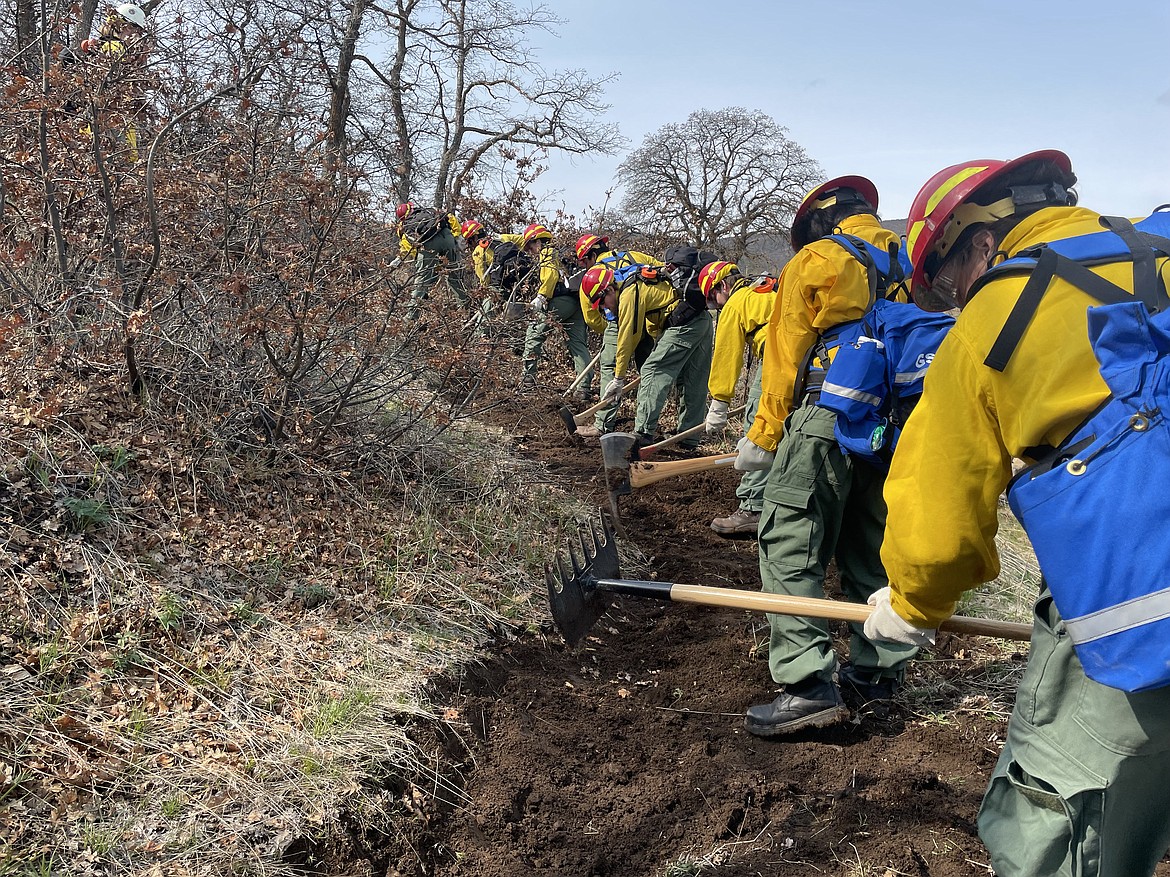
Job Corps students train for firefighting duty. Students at the Columbia Basin Job Corps Center do their training on top of their regular trade program.
COURTESY PHOTO/COLUMBIA BASIN JOB CORPS CENTER
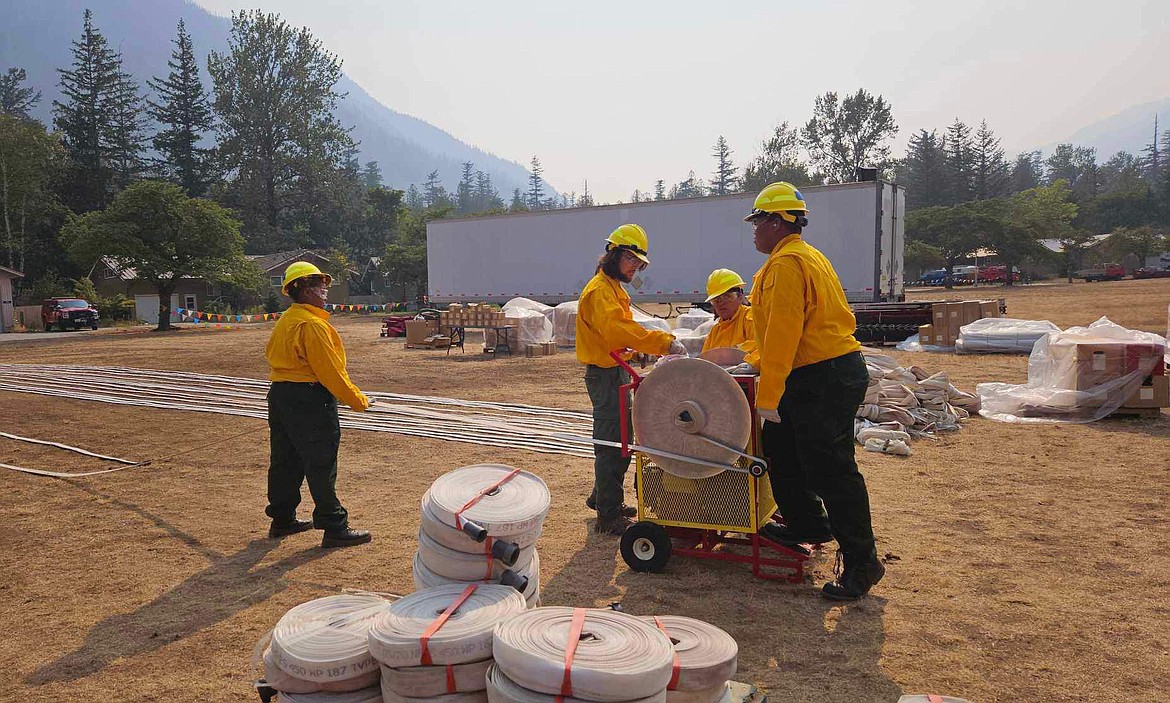
Students from a Columbia Basin Job Corps Center support crew at a fire camp in Washington. The support crew training isn’t as rigorous as firefighter training, said Susan Mann, laiason specialist for the CBJCC, but it’s vital work.
Joel Martin has been with the Columbia Basin Herald for more than 25 years in a variety of roles and is the most-tenured employee in the building. Martin is a married father of eight and enjoys spending time with his children and his wife, Christina. He is passionate about the paper’s mission of informing the people of the Columbia Basin because he knows it is important to record the history of the communities the publication serves. | August 30, 2023 5:31 PM
MOSES LAKE — Wildfire season is frustrating. There’s smoke in the air, closed-off roads and evacuation alerts galore, but other than being careful with barbecues and praying for the firefighters’ safety, most area residents don’t see the fire line except in the newspaper or on TV.
At the Columbia Basin Job Corps Center in Moses Lake, that isn’t the case. Students from the local center, along with Job Corps students across the country, are heading off to the firelines for weeks at a time, both to fight the fires and as support firefighting crews.
“They've been out since late June,” said Susan Mann, liaison specialist at the CBJCC. “They did a little bit of prescribed fires in the early spring, and then throughout the fire season, as fires start cropping up across the nation. We try to keep them as close to home as possible, but they have supported fires in other states as well.”
The Columbia Basin Job Corps Center has been operated by the U.S. Forest Service since 2009, Mann said, and that’s when students began being trained for firefighting work. Mann wasn’t sure how many CBJCC students were currently engaged in firefighting, but she said more than 200 students from 24 Forest Service Job Corps Centers nationwide were serving in firefighting operations.
It’s not a part of their regular studies, but rather an extracurricular activity.
“Our program is called a militia program,” said Ben Eddings, who has served as the assistant fire management officer for both CBJCC and the Fort Simcoe Job Corps Center in White Swan since 2019. “So they go to their regular trade during the day. Then after that, there's a captain there who works with them for about an hour and a half doing physical training. And then they become available to go out on fires.”
The training is pretty rigorous, Eddings said. Students start with the National Wildfire Coordinating Group’s S-190 course, “Introduction to Wildland Fire Behavior,” which covers the primary wildland fire environment components fuels, weather, and topography, how those components interact and how fire behavior affects risks to firefighters, according to the NWCG website. From there, they go to S-130, which is actual hands-on firefighting training.
“We do the field training portion on a flag fire,” Eddings said. “Then we get them red cards and take them out on wildfires, or send them to different districts that have a need for beginning firefighters.”
“(There) are our actual wildland firefighters that are out on the front lines fighting fires that have been everywhere since the fire season began,” Mann said. “And then we send out teams of eight to 10 students along with one of our staff who has been specially trained as a fire camp crew boss to go out and support the fire camps. We're working on our third rotation of that. We had a crew that went out for the maximum 21 days that just returned last week, we have another crew out currently, and we're about to activate our third crew for fire camp support.”
The staff members who do the training are also doing it as an extracurricular activity, over and above their regular capacity, Mann added.
“So they'll go out with the students for two or three weeks at a time and pause on those efforts and then come back and play catch up when they get back on campus,” she said.
The Job Corps students fill a vital role, Mann said, for agencies that are often stretched to the limit when the season is at its peak.
“It's been a real benefit,” she said. “There's a shortage of workers for these fires. As well as a shortage of firefighters, there's a shortage of trained personnel to support the fire camps where the firefighters come back and get rest and food and supplies and all the things they need. So it's definitely a benefit to the agencies that we support.”
The firefighting training is a benefit for the students as well.
“In addition to getting this extra training, that can be a job opportunity for them when they graduate,” Mann said. “(It can) provide networking, all of those life skills that you need when you're going out and working on an emergency in that kind of capacity. It's life-changing to them.”
“They're also earning money when they're on assignment,” Eddings said. “They get hired as (temporary) firefighters through the Okanagan-Wenatchee National Forest. And so every hour that they're out on a resource order, I believe they get roughly $21 an hour.”
“You know, it's expensive to launch into adulthood nowadays,” Mann said. “So for our students, it gives them the ability to earn some wages while they're here and maybe be able to buy a car or set themselves up for an apartment, things of that nature. It really helps our students prepare to launch into adulthood when they graduate, and go on to their jobs and their careers.”
Bigger things are in the works, Eddings said. The Job Corps center is preparing to offer firefighting training as one of its full-time trade programs.
“The students that come to that are going to be selected out of the militia program primarily, and they'll go to that trade all day,” he said. “That'll be their main focus. We have a type 6 fire engine (coming). It's like a brush truck that you would see at the counties, pickup crew cab with a tank on the back. They're gonna use that along with another truck to go around to different fires.”
The program will be a year-long course, he explained.
“The goal is to get them into a federal firefighting job. And they teach all of the basic firefighting classes and then go into classes like pumps and water handling, chainsaw use and more stuff along that line like fire weather and fire behavior. So they get a really good exposure to fire as a beginning firefighter.”
The benefits are great, but it’s far from easy, Mann said. The firefighters and support crews are earning their money and education the hard way.
“They're working 16-hour days,” she said. So there's obviously fatigue and heat stress and stress management attached to that. So they they get specialized training and how to deal with that, as well as how to just be aware of their surroundings should the fire get bigger … It is rigorous work. They're working 16-hour days for 14 to 21 days straight.”
Joel Martin may be reached via email at [email protected].
ARTICLES BY JOEL MARTIN
Endless battle
Noxious Weed Control Board works to keep invasive plants under control
MOSES LAKE — Some of the nastiest plants in Grant County were the topic of a class led by Jay Johnson, a consultant with the Grant County Noxious Weed Control Board, Tuesday. The Noxious Weed Control Board, as its name would suggest, is tasked with keeping weeds under control in Grant County. That’s not a small job; the board’s website lists 129 species of noxious weeds that are found around Grant County. A noxious weed is defined as an invasive, non-native plant that threatens agricultural crops, local ecosystems or fish and wildlife habitat, according to the Noxious Weed Control Board. Washington state law requires that these weeds be identified and their spread kept to a minimum, if not completely eradicated. “We’re one of those agencies a lot of people don’t really understand,” Johnson said. “We’re a county office and … our funding is tax-based assessment. When you get your tax bill and you look down at all the expenses that you pay for, there we are.”

BASIN EVENTS: Oct. 16-24
COLUMBIA BASIN — Whether you feel like shopping, crafting, learning or seeing a show, there’s something happening for you this week in the Basin. Oct. 16 ‘My Family (Mi Familia)’ screening Spanning three generations, “My Family (Mi Familia)” is a heartfelt drama that follows the Sánchez family as they build their lives in East Los Angeles. Through love, hardship, triumph, and sacrifice, the film explores the immigrant experience, the strength of family bonds, and the traditions that connect one generation to the next. Lowrider show and taco truck before the screening. Sponsored by Columbia Basin Allied Arts, EDUBS C/S and the Moses Lake Creative District. $12 per person. Doors open at 6 p.m., film begins at 7 p.m. at the Moses Lake Civic Center Auditorium, 401 S. Balsam St. Tickets and info: www.cba-arts.org.

Moses Lake author encourages women to look beyond church culture norms
MOSES LAKE — A Moses Lake author’s book, “A Christian Woman Striving to Live Her Faith in a Man-Controlled World,” takes aim at the role to which many churches relegate the female half of their congregations. “It’s to encourage women in the faith,” Linda Curran said. “A lot of churches say, ‘Teach Sunday school, do this, do that, but don’t (evangelize.)’" In her book, Curran recounts a time when she moved to a new community and joined a church there. She was surprised to learn that, as a new female member, she had been automatically assigned church cleaning duties. When she questioned it, she wrote, she was met with condescension and her objections were brushed aside. In other churches, she said, women who were capable of teaching were relegated to “women’s ministry.”