
Rural Community Leadership program going strong
GABRIEL DAVIS | Hagadone News Network | UPDATED 2 years AGO
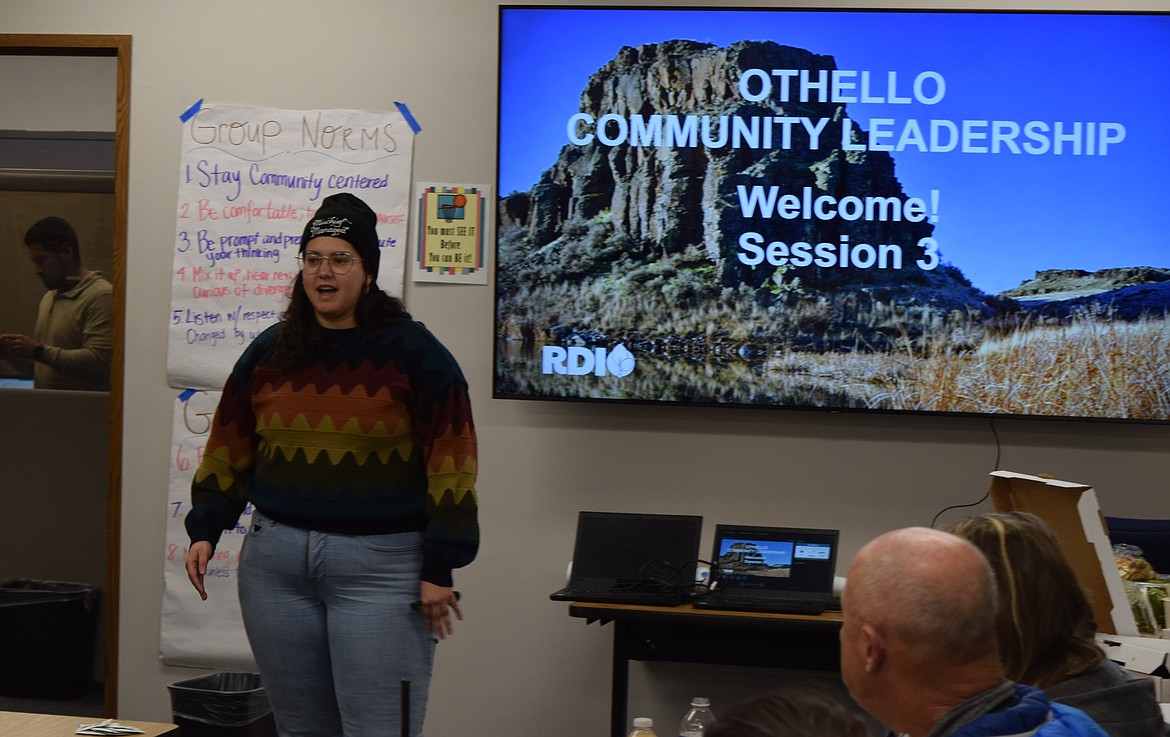
Rural Development Initiatives Bilingual Program Training Associate Ada Márquez Acevedo kicks off the third session of the Rural Community Leadership Program Nov. 30 at SkillSource’s Othello location.
GABRIEL DAVIS/COLUMBIA BASIN HERALD
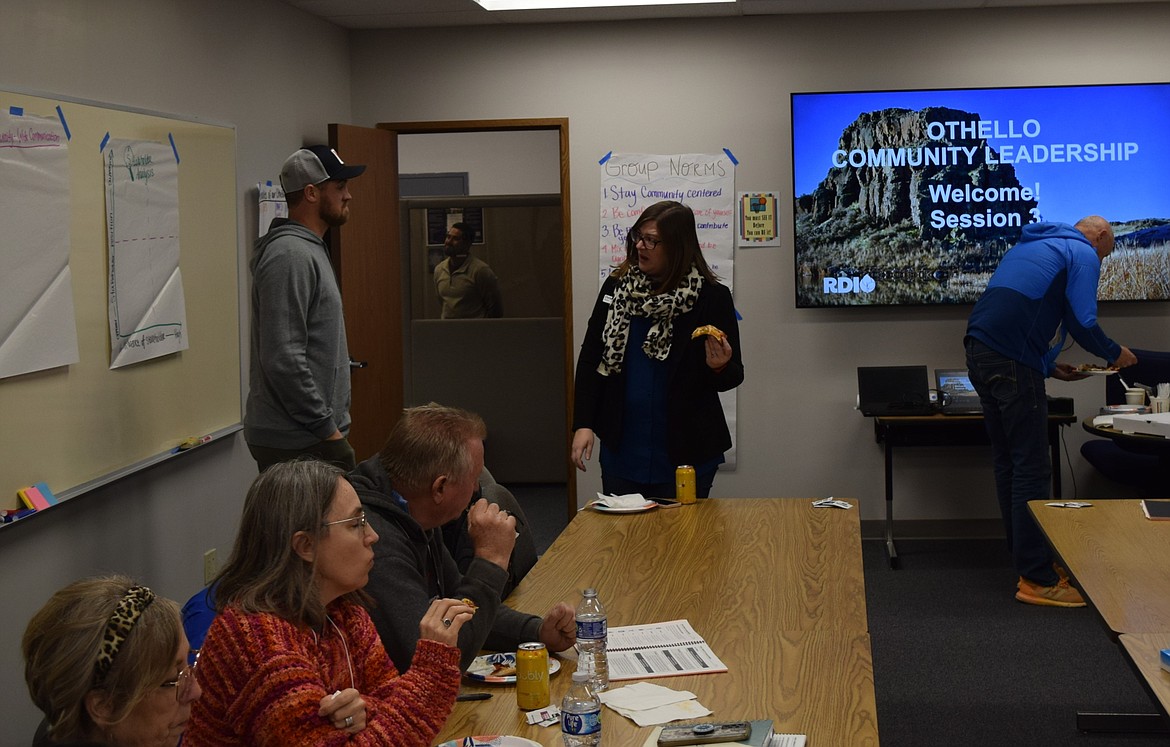
Rural Development Initiatives Leadership Services Business Manager and Rural Community Leadership Program Lead Trainer Christine Gilmore, standing right, speaks to Adams County Development Council Executive Director Kyle Niehenke, standing left, prior to the program’s Nov. 30 session.
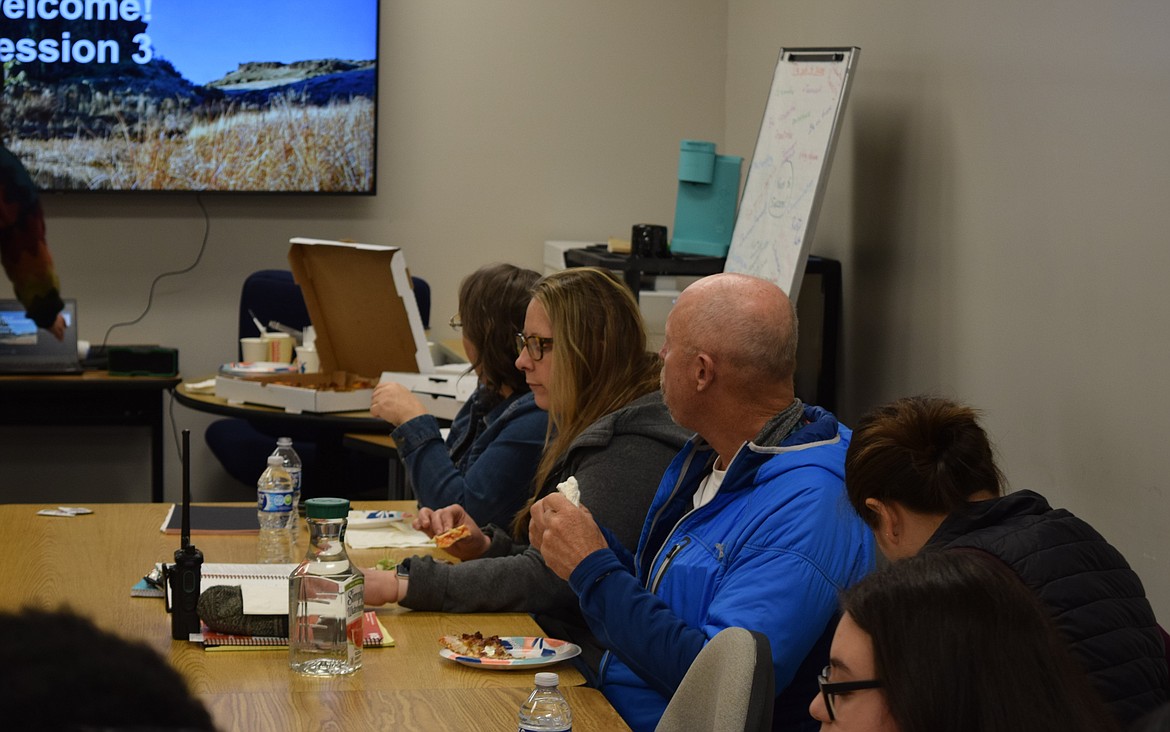
Cohort members of the Rural Community Leadership Program, led by Rural Development Initiatives, eat dinner before convening for the Nov. 30 in-person session held at SkillSource in Othello.
Gabriel Davis is a resident of Othello who enjoys the connections with his sources. Davis is a graduate of Northwest Nazarene University where he studied English and creative writing. During his free time, he enjoys reading, TV, movies and games – anything with a good story, though he has a preference for science fiction and crime. He covers the communities on the south end of Grant County and in Adams County. | December 6, 2023 5:44 PM
OTHELLO — Othello’s Rural Community Leadership Program, a program under the Elevate Othello umbrella, had its third session and second in-person session Nov. 30 at SkillSource’s Othello location and is going well, according to the program’s organizers.
The leadership program is led by Christine Gilmore, the leadership services business manager with Rural Development Initiatives, Inc., the organization in charge of partnering with local agencies to implement the Elevate Othello program.
“I think this program is going fantastic. We have such a diverse group of cohort members from diversity in age, diversity in economics, diversity in work, diversity in even just interest areas, so I think it's going really, really well. People seem to be enjoying it and learning and really taking it in,” Gilmore said. “What I'm loving about Othello in general is just this hunger for their community. Every place we go has this hunger to help their community, but it is just so evident in Othello and just the people here are so invested in what they're doing and what they want for their community.”
Gilmore elaborated on the purpose of the leadership program.
“So this is a part of the Elevato Othello program that is geared towards building the capacity of local people, and we have different programs that are part of it. This happens to be one of them,” she said. “It's about building the capacity of local people at the community level to be leaders. And we don't talk about leadership in a hierarchical sense, but more like, ‘What do you want to get done in your community and for your community?’”
Elevate Othello is funded through the United States Department of Agriculture’s Rural Placemaking Innovation Challenge grant.
“RDI was awarded it based off our work and our collaborations in Othello, but it's Othello’s project,” Gilmore said. “This program is designed to build the capacity of people to work together to get stuff done for the community. We look at things like how to work in groups, how to deal with conflict, learned topics like appreciative inquiry, or tonight, we're doing asset mapping in the community; it's like, ‘What are the things that work well in this community?’”
Cohort member Kyle Niehenke, who is the executive director of the Adams County Development Council, which is a sponsor of Elevate Othello, also said the leadership program has been going well.
“It's very much how to be a leader within the community, so like how to get volunteers to do something, or how to be the voice of, ‘What does my community truly need someday from a people level?’” Niehenke said. “It's very much more geared to using people within your community and getting them to feel like they are important so that then you can actually do things as a community versus just relying on your city council or your government.”
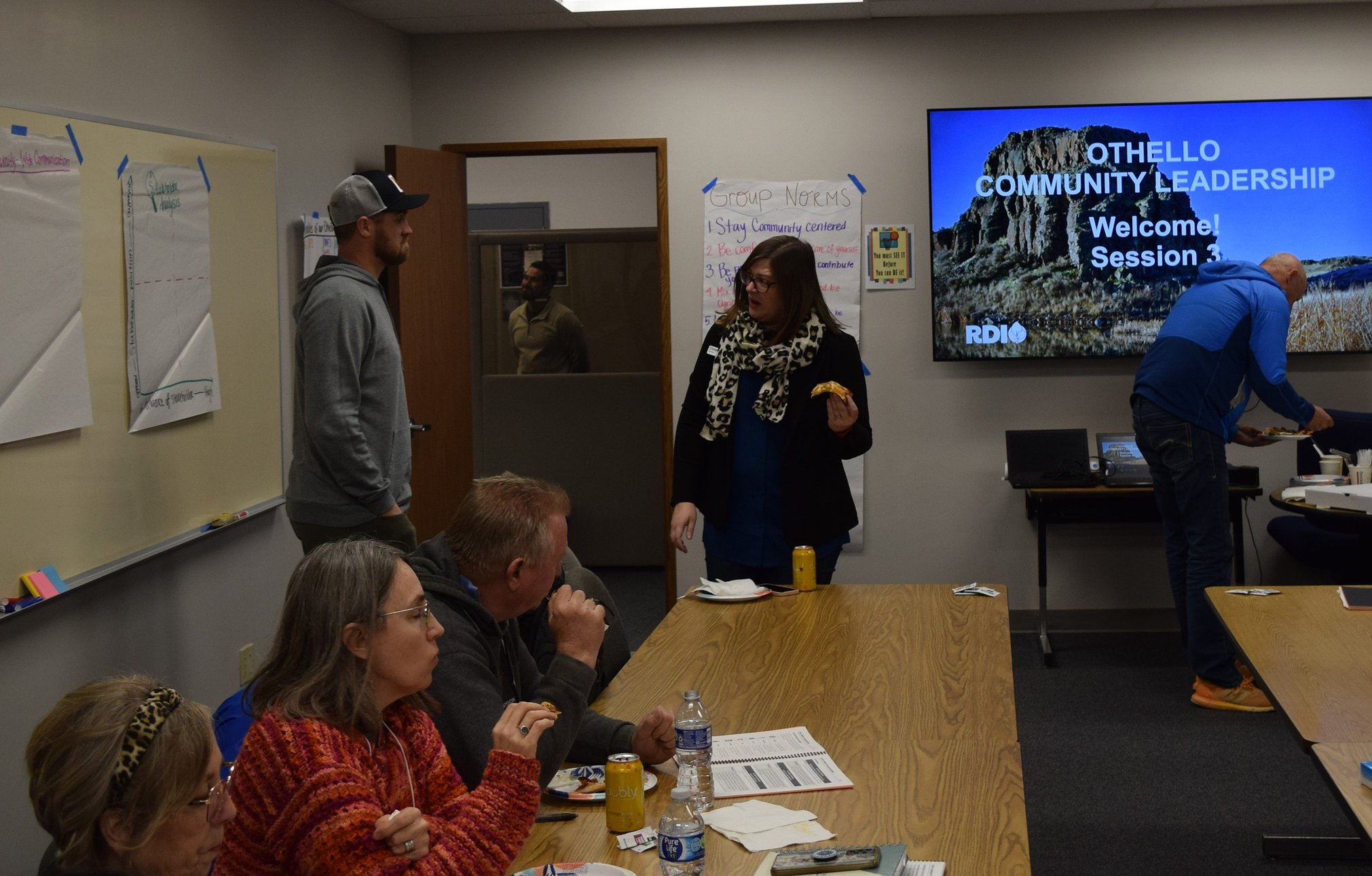 Rural Development Initiatives Leadership Services Business Manager and Rural Community Leadership Program Lead Trainer Christine Gilmore, standing right, speaks to Adams County Development Council Executive Director Kyle Niehenke, standing left, prior to the program’s Nov. 30 session.
Niehenke also spoke about having youth in the program.
“I think there's three that are in high school, maybe even four, and they're really bright young adults,” he said. “They want to be involved in Othello, they want to be leaders, which is cool because we don't have a lot of that demographic or age group who want to be as involved in their community. I mean, they obviously want to do something after high school and come back and get involved, which is cool.”
Both Gilmore and Niehenke said that the two main priorities the cohort members have identified as the potential projects to use RDI’s funds toward are community-wide communication for events and updates and a new community center.
“They came together as individuals on the same priorities,” Gilmore said. “Everybody was saying the same thing.”
Cohort member Kim Coreson said the program has been productive and is a good mixture of training and workshopping.
“I have really appreciated that the very first session I went to, we talked about personality types,” Coreson said. “It really helps you say, ‘OK, I see the world like this but not everybody does,’ and how are they seeing it?”
The leadership program has three more sessions spread out over the next several months before RDI will turn the cohort loose to keep their project up on their own.
“We anticipate doing a second cohort,” Gilmore said. “That's one thing that we are researching and figuring out how we continue to build. It's not just a one-and-done program. As we know, building a pipeline of community leaders, it doesn't just stop at one time, so we want to make sure that this is an opportunity for years to come for other people in the community and grow that pipeline for the community.”
Gabriel Davis may be reached at [email protected]. Download the Columbia Basin Herald app on iOS and Android.
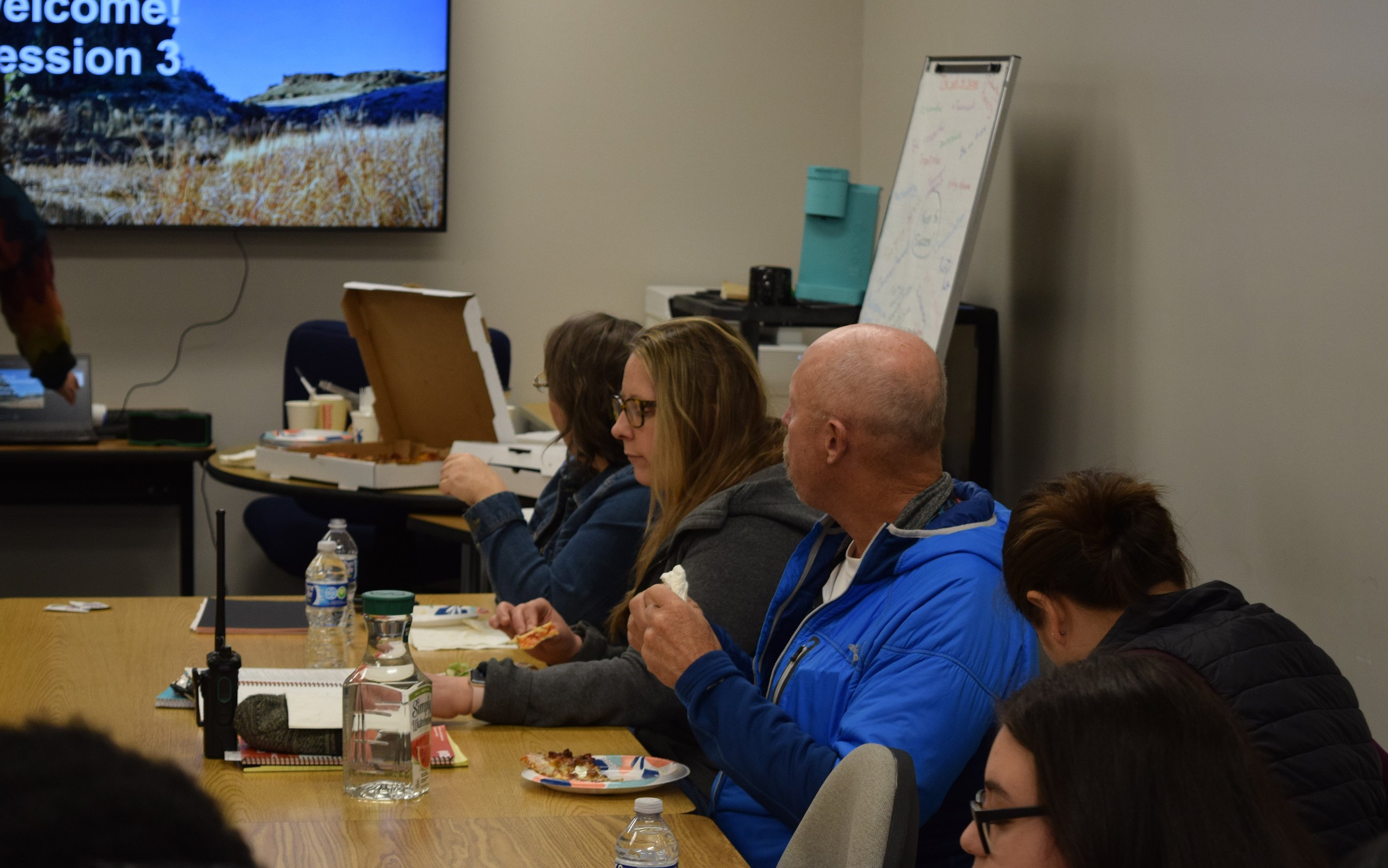 Cohort members of the Rural Community Leadership Program, led by Rural Development Initiatives, eat dinner before convening for the Nov. 30 in-person session held at SkillSource in Othello.
ARTICLES BY GABRIEL DAVIS

Work-based learning lets students build their own futures
MOSES LAKE — Work-based learning provides education opportunities for the workforce to receive hands-on training and technical education and prepare themselves to enter various industries. Educators and workforce development professionals from Eastern Washington discussed some the training they offer and the benefits of their programs. Next Generation Zone, an affiliate of WorkSource based in Spokane, provides job training opportunities for youth and young adults ages 16 to 24. Program Coordinator Kate Martin said there are multiple benefits to the program. “One of them is a paid work experience, and that’s where we reach out to area employers who are willing to take a young person and train them,” she said. “This is a short-term learning experience, so it’s typically about 240 hours; sometimes it could be longer or shorter. We’re the actual employer; we cover all of their wages, taxes, the L&I, and the employer just agrees to give them the experience and train them in whatever field it is that they’re wanting to go into.”

Serving schools: ESD superintendents reflect on operations, priorities
MOSES LAKE — Educational service districts are government-mandated agencies put in place to provide services to school districts across the state. ESD Superintendents discussed what they do and their priorities in operating their districts. ESD 105, led by Superintendent Kevin Chase, serves four counties, including Kittitas, Yakima and portions of Klickitat and Grant counties and provides support for 25 school districts – including Royal School District and Wahluke School District – and more than 66,000 students. “We help them collaborate with each other as well or collaborate with other partners,” Chase said. “(It’s) a lot of advocacy work, either regionally or across the state, or even federally, working on different issues that impact our education. And we provide very specialized services in certain situations in order to meet the needs of our students in our region and of our school districts.”

Columbia Basin Project making headway through Odessa Groundwater program
CASHMERE — The Columbia Basin Project is making gradual progress toward completion with particularly significant accomplishments for the Odessa Groundwater Replacement Program in the last six months or so, according to Columbia Basin Development League Executive Director Sara Higgins. “When we’re dealing with a project of this size, advancement is kind of like watching paint dry, but yes, there have been (developments),” she said. “There are a lot of exciting things happening right now.” There are more than 300 miles of main canals, about 2,000 miles of lateral canals and 3,500 miles of drains and wasteways in the irrigation project, according to the U.S. Bureau of Reclamation website. The CBDL advocates for the operation of those waterways and for the project to continue “build-out.”