
Ruff times
JOEL MARTIN | Hagadone News Network | UPDATED 3 years, 8 months AGO
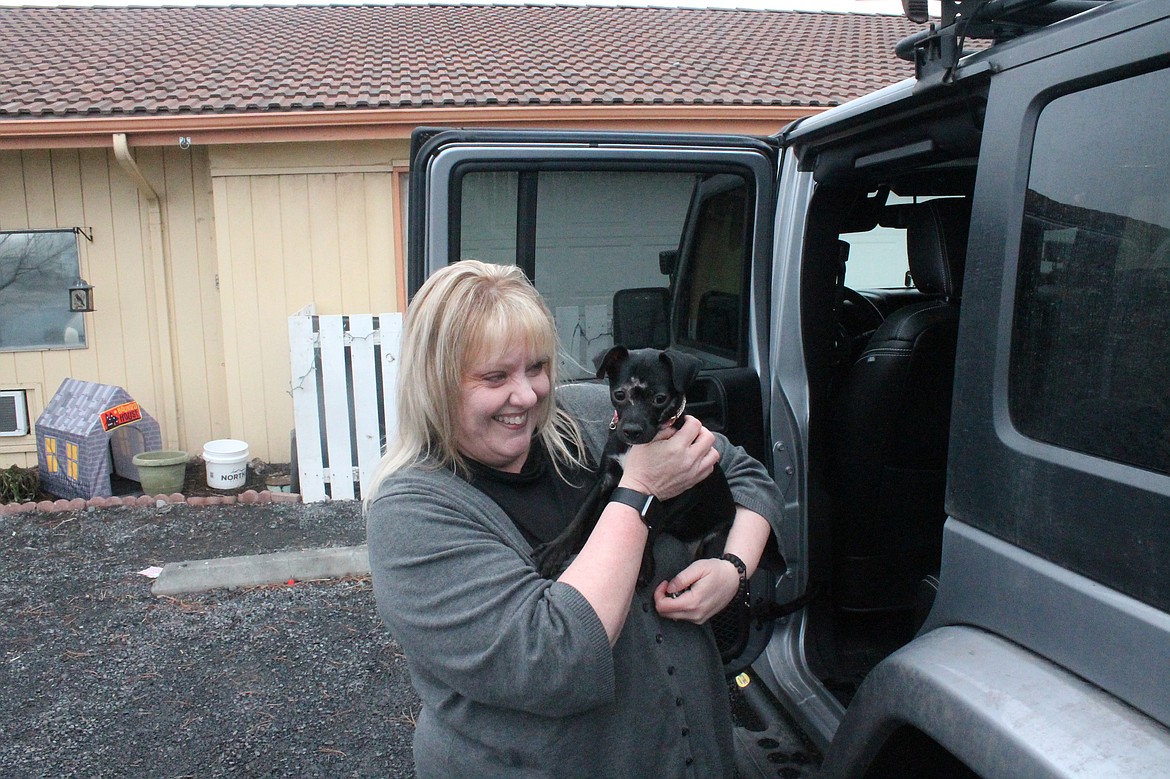
Kar Vanerstrom, vice president of the Grant County Animal Outreach board of directors, holds Puppet, the deer head Chihuahua she’s currently fostering. Puppet was brought into the shelter near death after being thrown out of a car, but she’s on the mend now, Vanerstrom said.
JOEL MARTIN/COLUMBIA BASIN HERALD
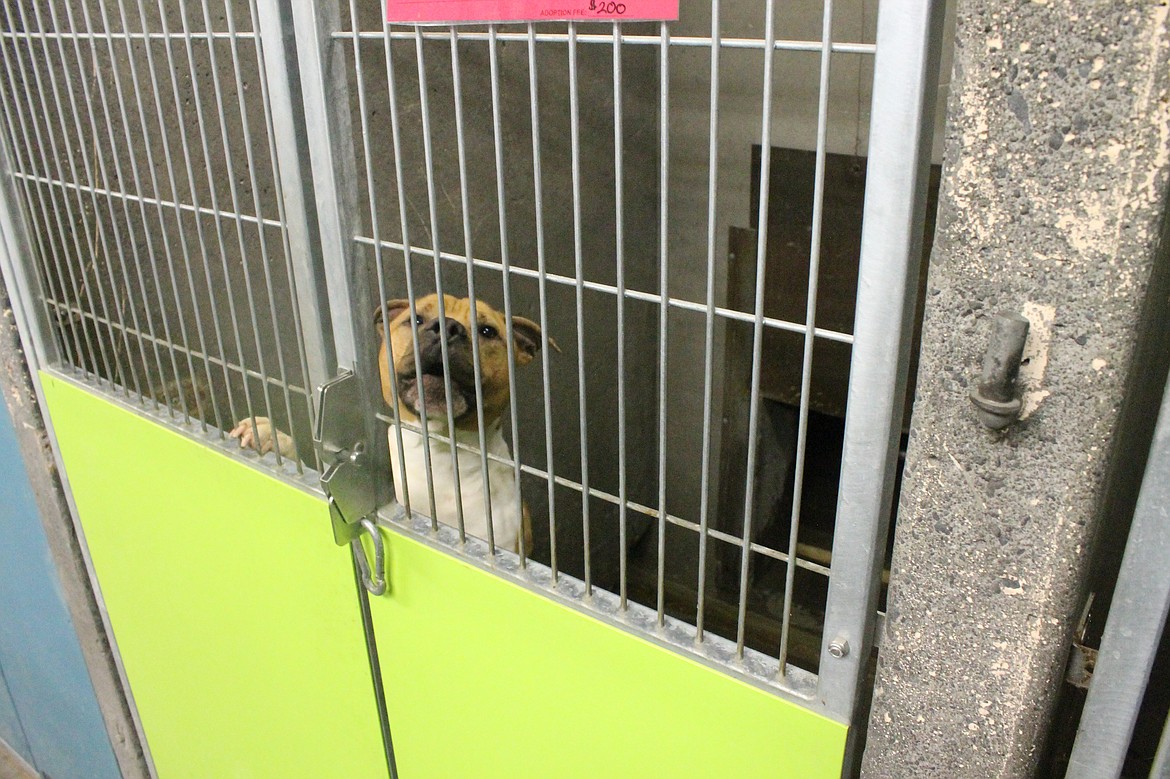
Buddy, a 5 1/2-year-old pit bull, looks up from his kennel at Grant County Animal Outreach. Buddy has been at the shelter since April and because GCAO is a no-kill facility, he’ll stay there until he finds a forever home.
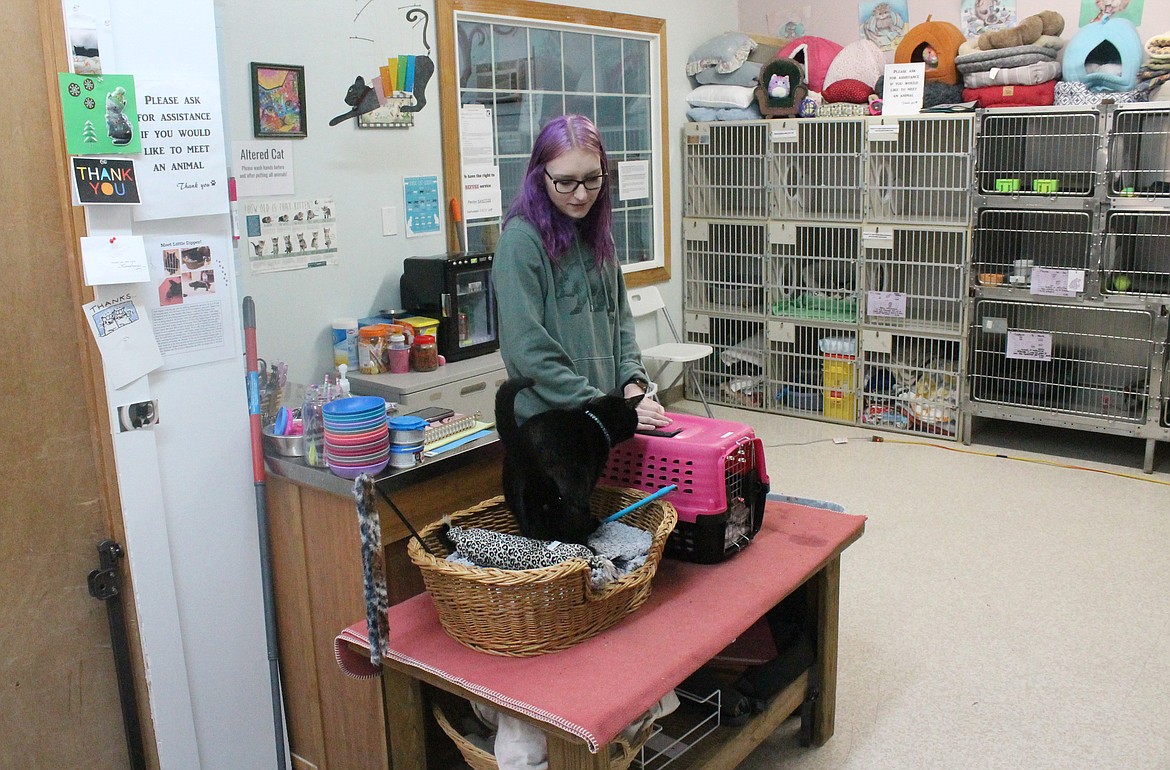
Grant County Animal Outreach staffer McKennah Solders spends a little quality time in the cat room with the shelter’s permanent cat Little Dipper. The window behind Solders opens into an isolation room for mama cats with kittens or sick cats. Its current occupant is a kitty with feline immunodeficiency virus, Solders said.
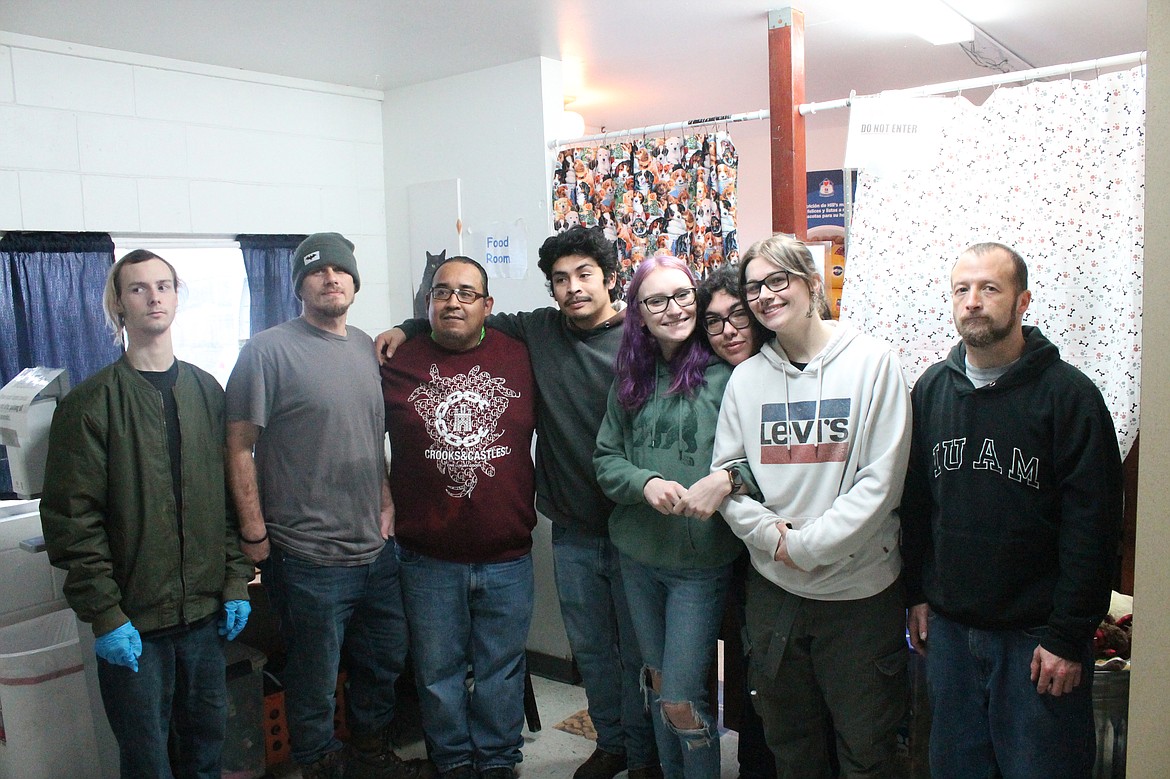
Some of the staff at Grant County Animal Outreach. From left: Jason Taylor, Jonathan Hutler, Jose Luis Degante, Bulmaro Hernandez Alvarado, McKennah Solders, Guadalupe Chavarria, Serena Jewell and Adam Sutter. Three other staff members are not pictured, one because she was at the veterinarian comforting a dog with a broken leg.
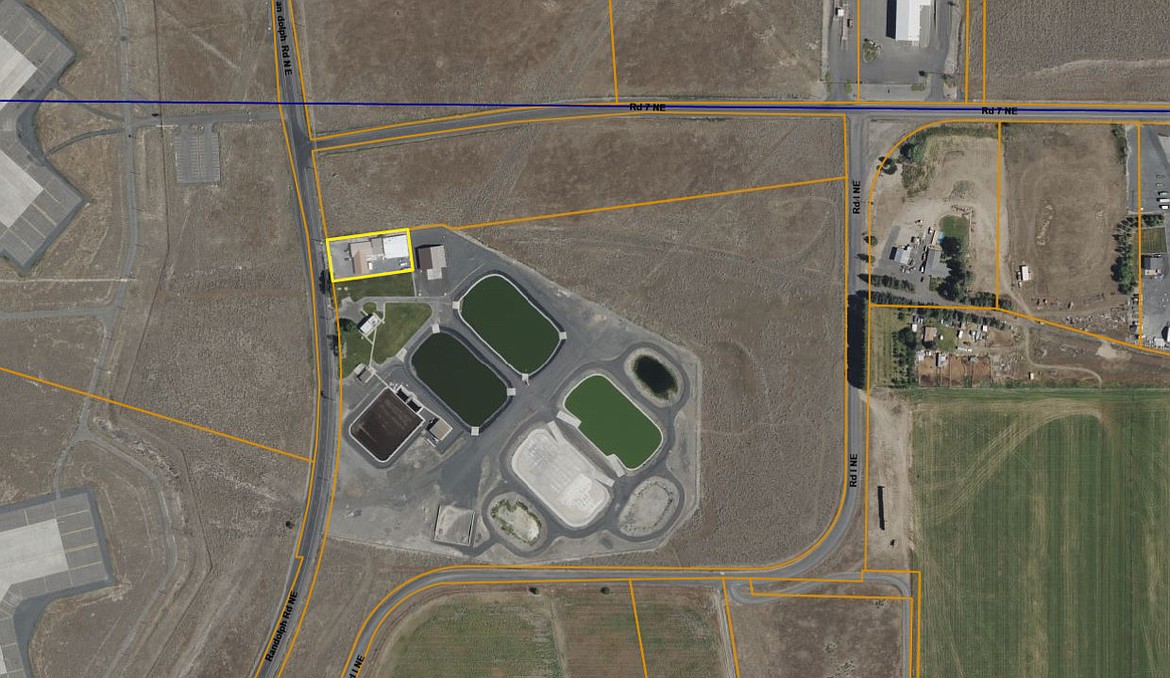
A satellite view of the Grant County Animal Outreach facility, with the shelter’s lot outlined in yellow. GCAO has its own land about a quarter-mile away that it can’t use for expansion, for environmental reasons.
Joel Martin has been with the Columbia Basin Herald for more than 25 years in a variety of roles and is the most-tenured employee in the building. Martin is a married father of eight and enjoys spending time with his children and his wife, Christina. He is passionate about the paper’s mission of informing the people of the Columbia Basin because he knows it is important to record the history of the communities the publication serves. | February 1, 2023 1:30 AM
MOSES LAKE — Grant County Animal Outreach has run out of room.
“The facility was built in World War II,” said Kar Vanerstrom, GCAO’s vice president. “And there haven't been any updates on it, so it's kind of in dire straits.”
The 4,886-square-foot shelter sits on a 0.61-acre tract of land owned by the City of Moses Lake, off in a corner of the Larson Wastewater Treatment Plant. The shelter actually owns another patch of land, about 2.83 acres, about a quarter-mile up the road but can’t expand onto it, ironically because of animals.
“That was donated to us, and come to find out, we have some endangered ground squirrels living on it,” Vanerstrom said. “So we can't build on it. No one, of course, is going to want to buy it, because you can't build on it. That makes it hard because a lot of people can see that and be like, ‘Hey, why aren't you guys building here?’ But we have two little ground squirrel nests in there. And we were told by one of the assessors that they have a radius that goes around them where you cannot touch anything.”
A small building combined with a growing population of animals makes for some very cramped quarters.
“We are supposed to be at 45, I think, is our max,” Vanerstrom said. “And we are way, way, way over that.”
Vanerstrom added that she wasn’t sure how many animals the shelter currently has, as it fluctuates from day to day. But the Grant County Sheriff’s Office and the police departments continue to drop off animals they’ve picked up, and some pet owners do the same.
“When COVID hit, everybody and their mom went and got a dog, which is fabulous,” she said. “But I don't think any of those animals were ever spayed or neutered. And when COVID kind of ended somewhat, everybody got rid of said animals and left them with us. We can drive up to the shelter and have animals be tossed over the fence. We've had animals tied up to the front gate.”
One dog had been left outside tied to what appeared to be an engine block with an extension cord around its neck, Vanerstrom said. When shelter staff arrived, the dog was lying across the road where it had been hit by a car.
“The dog that I have in my Jeep right now is a foster dog,” Vanerstrom said. “(The sheriff’s office) stopped on the road to pick little Puppet up, and she was still alive. So they rushed her immediately to us, (and) we rushed her immediately to the vet. She was under two pounds, was basically knocking on the Rainbow Bridge, but she's healing from her wounds. She was thrown out of the car, her face was all mangled, and her side and her front leg, and she was a hot mess, but she's doing better.”
Many of the staff do the same thing, fostering animals who have been too badly hurt or traumatized to leave at the shelter, Vanerstrom said.
Grant County Animal Outreach may not have enough room, but it does have a couple of things going for it. One is its working relationship with the veterinary college at WSU, which does the spaying and neutering for the shelter.
“Partnering with Washington State University has really been an awesome blessing because the spaying and neutering of animals is so expensive. In Grant County, if you, Joe Blow customer, try and call up (a veterinarian) and just say, ‘I need to get my animal spayed or neutered,’ you're looking at $200, $400. And then they're booked way out. By the time they're even able to get those animals in to be spayed and neutered, ‘Are we pregnant now? Have we impregnated someone else now?’”
The other asset GCAO has is its people. Besides volunteers who come in and pet the animals, the shelter has 11 paid staff members who clean kennels and feed, water and exercise. Laundry is a never-ending job, Vanerstrom said, because the facility isn’t wired for an industrial-sized washer and dryer and has to use residential-size machines.
“We replace those quite a bit,” she said.
Being an animal shelter worker isn’t for everybody, Vanerstrom said. Dealing with animals who have been abused or neglected can be heartbreaking.
“When I hire here at the shelter, I always tell them, ‘You always hear the shelter is a hard place. But I really need you to understand it's not only a physical job; it's a very emotional job. It just pulls at you.’ I've had grown men . . . last one day, and call me the next day crying. I get it, I do. I understand.”
While dogs take up the most space, GCAO also has plenty of cats for adoption and has had other critters brought in.
“We've had guinea pigs come through here. This last summer we had chickens. So any kind of animal that comes in here, we're finding a home or finding a resource or a rescue that can take it.”
“There’s lots of good animals here that need homes,” staffer Adam Sutter said.
Grant County Animal Outreach is a no-kill shelter, which means animals stay until they’re adopted rather than being put down after a certain amount of time. In cases where an animal is too badly hurt to survive, a veterinarian will make the decision and perform the euthanasia. One local veterinary clinic, Pioneer Veterinary, helped GCAO make an arrangement to buy Science Diet pet food at a discounted rate, Vanerstrom said, so that the animals can have a consistent diet and not be eating one brand one day and another the next. This cuts down on tummy problems for animals that are already frightened and unsettled.
The space issue doesn’t look like it will be resolved any time soon, Vanerstrom said.
“We can have a good day of having dogs adopted, like three move out, come in the next day and have the sheriff's department or the Moses Lake Police Department have five more in the back kennels, so it's kind of like we're just chasing our tail,” she said. “It is what it is. Until we get a facility that's going to be able to hold us, I think this is our new norm. I don't think we're ever going to get pre-COVID again. I think this is our new norm.”
Joel Martin may be reached at [email protected].


ARTICLES BY JOEL MARTIN

Endless battle
Noxious Weed Control Board works to keep invasive plants under control
MOSES LAKE — Some of the nastiest plants in Grant County were the topic of a class led by Jay Johnson, a consultant with the Grant County Noxious Weed Control Board, Tuesday. The Noxious Weed Control Board, as its name would suggest, is tasked with keeping weeds under control in Grant County. That’s not a small job; the board’s website lists 129 species of noxious weeds that are found around Grant County. A noxious weed is defined as an invasive, non-native plant that threatens agricultural crops, local ecosystems or fish and wildlife habitat, according to the Noxious Weed Control Board. Washington state law requires that these weeds be identified and their spread kept to a minimum, if not completely eradicated. “We’re one of those agencies a lot of people don’t really understand,” Johnson said. “We’re a county office and … our funding is tax-based assessment. When you get your tax bill and you look down at all the expenses that you pay for, there we are.”

BASIN EVENTS: Oct. 16-24
COLUMBIA BASIN — Whether you feel like shopping, crafting, learning or seeing a show, there’s something happening for you this week in the Basin. Oct. 16 ‘My Family (Mi Familia)’ screening Spanning three generations, “My Family (Mi Familia)” is a heartfelt drama that follows the Sánchez family as they build their lives in East Los Angeles. Through love, hardship, triumph, and sacrifice, the film explores the immigrant experience, the strength of family bonds, and the traditions that connect one generation to the next. Lowrider show and taco truck before the screening. Sponsored by Columbia Basin Allied Arts, EDUBS C/S and the Moses Lake Creative District. $12 per person. Doors open at 6 p.m., film begins at 7 p.m. at the Moses Lake Civic Center Auditorium, 401 S. Balsam St. Tickets and info: www.cba-arts.org.

Moses Lake author encourages women to look beyond church culture norms
MOSES LAKE — A Moses Lake author’s book, “A Christian Woman Striving to Live Her Faith in a Man-Controlled World,” takes aim at the role to which many churches relegate the female half of their congregations. “It’s to encourage women in the faith,” Linda Curran said. “A lot of churches say, ‘Teach Sunday school, do this, do that, but don’t (evangelize.)’" In her book, Curran recounts a time when she moved to a new community and joined a church there. She was surprised to learn that, as a new female member, she had been automatically assigned church cleaning duties. When she questioned it, she wrote, she was met with condescension and her objections were brushed aside. In other churches, she said, women who were capable of teaching were relegated to “women’s ministry.”