
Thinking small
JOEL MARTIN | Hagadone News Network | UPDATED 3 years, 8 months AGO
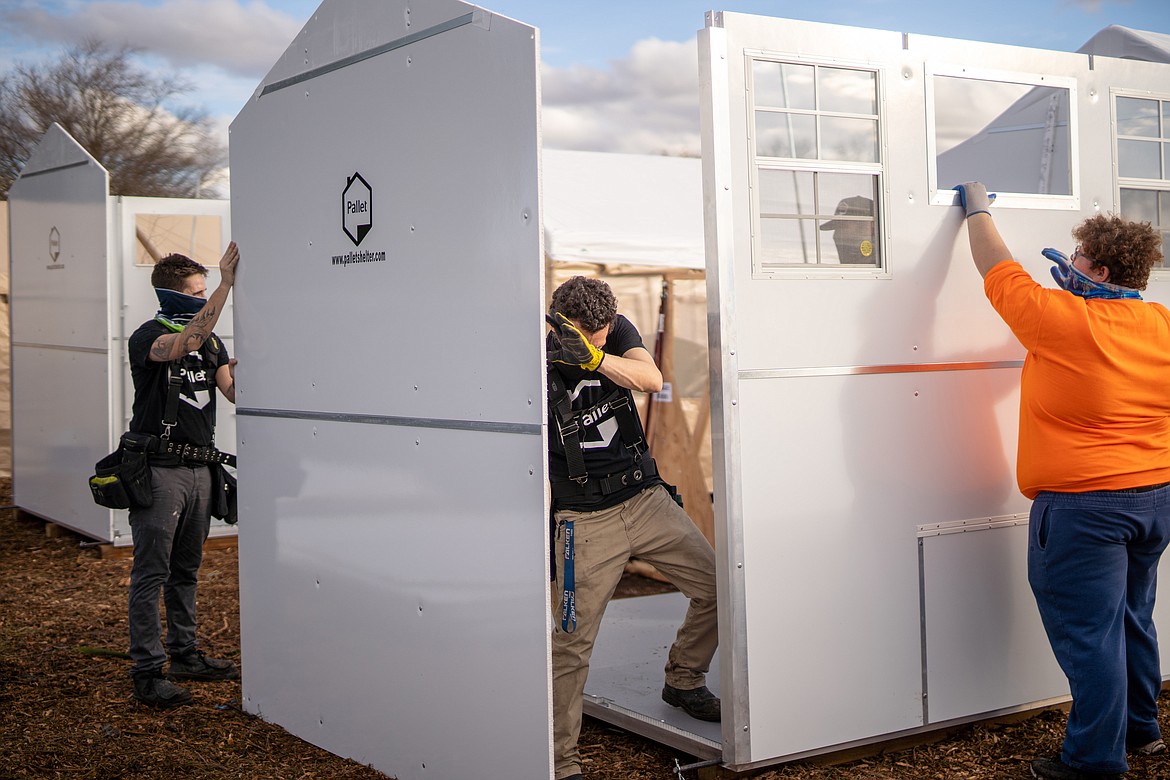
Workers assemble temporary dwellings at a Pallet Shelter village. The 64-square-foot structures cost around $7,500 and can be assembled in less than an hour.
Courtesy photo/Pallet Shelter
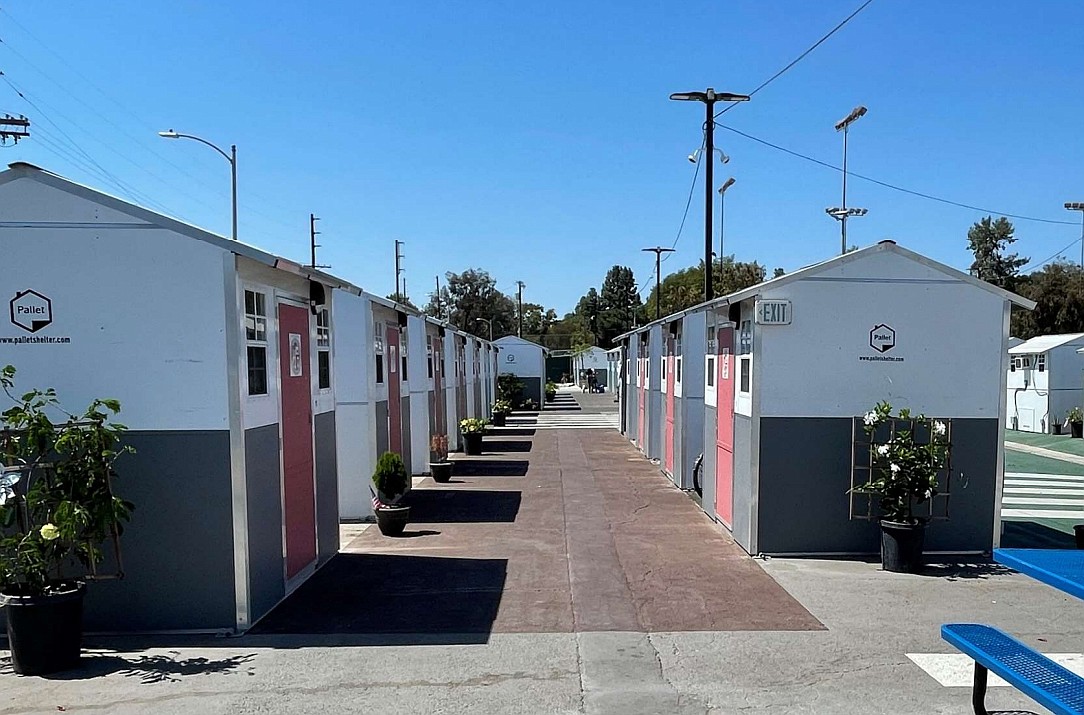
Hope Village in Longview is one of nine communities using Pallet Shelter temporary dwellings to address homelessness.
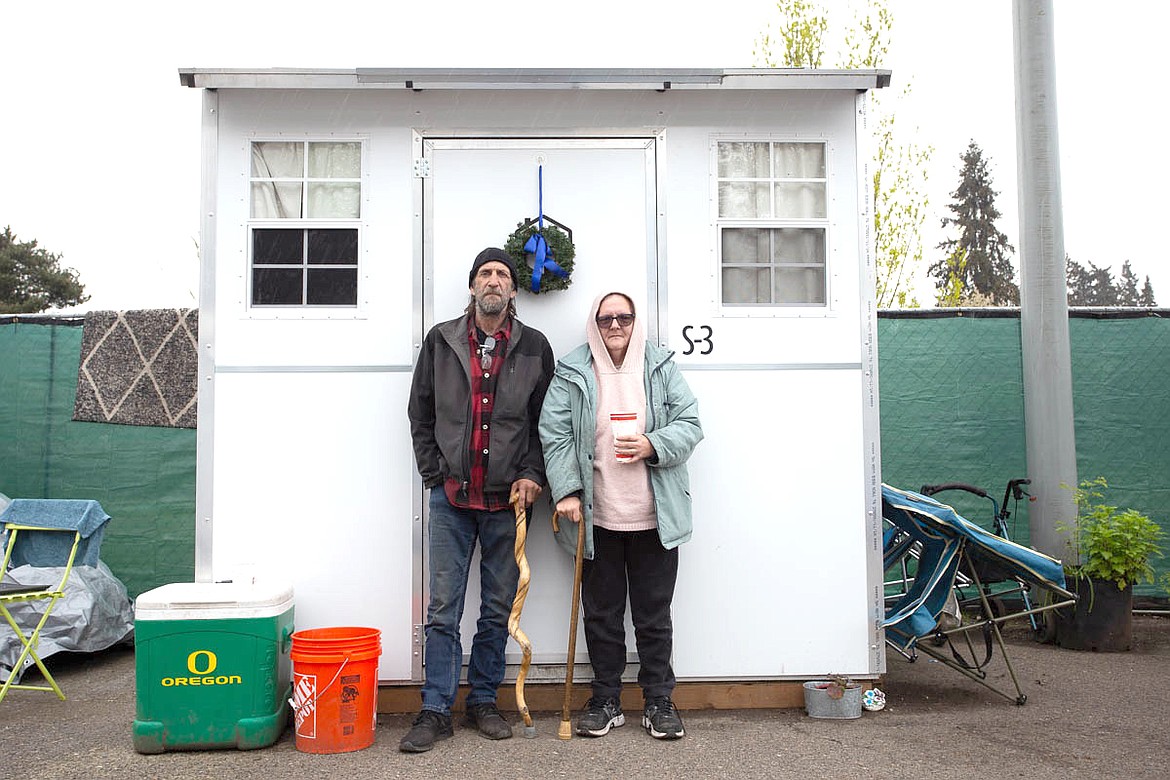
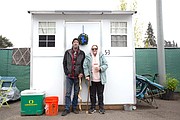
Residents stand outside a Pallet Homes structure at Vancouver’s Stay Safe Community. The temporary residences include heating and air conditioning and lockable doors and storage for comfort and safety.
Joel Martin has been with the Columbia Basin Herald for more than 25 years in a variety of roles and is the most-tenured employee in the building. Martin is a married father of eight and enjoys spending time with his children and his wife, Christina. He is passionate about the paper’s mission of informing the people of the Columbia Basin because he knows it is important to record the history of the communities the publication serves. | February 17, 2023 1:00 AM
OLYMPIA — Everybody knows there’s a housing shortage, especially for very low-income people and solutions are hard to come by. State Sen. Jeff Wilson, R-Longview, thinks he may have the start of one, however.
“A hundred years ago, people bought houses from the Sears catalog – they came in a boxcar, you found a local crew to build them or you did it yourself,” Wilson wrote in a press release announcing the introduction of Senate Bill 5657. “We see prewar kit bungalows standing proudly today in every community of the state. As prices of starter homes skyrocket, we ought to take another look at kit homes as a solution for today.”
A kit home, Wilson explained to the Herald, is purchased as a complete package of materials – lumber, fixtures, the whole works – delivered to the home site and assembled there by either the homeowner or a contractor. SB 5657 would ease permitting and zoning restrictions on kit homes in Washington, specifically for residences under 800 square feet, like the structures sometimes referred to as accessory dwelling units or mother-in-law cottages. Currently, there aren’t very many dealers in Washington for really small, inexpensive kit homes, but Wilson pointed out that the legislation could smooth the way for another advance in affordable housing – transitional shelter for the unhoused, who sometimes aren’t ready to make the move to a home of their own.
“If you've been living on the streets for six years, in a community of people all who were suffering the same thing as you and you feel supported and cared for," said Katya Hill, spokesperson for Everett-based Pallet Shelter, "you feel very unsafe that first night in your new apartment, where it's quiet, where there's no one to talk to."
That discomfort can be alleviated by transitional housing options such as kit homes, she said. The pallet homes can provide a place to store property and be safe while remaining connected with friends in the community with whom the new resident has a connection.
Hill was quick to stress that Pallet Shelter never refers to its structures as “homes,” because they’re not meant to be permanent residences. Rather, she said, they provide a safe, clean, quiet place for a person to call their own while they’re dealing with the other issues that drive homelessness. Currently, there are nine sites in Washington where Pallet Shelter has put up communities, Hill said, all of them on the west side of the state. The largest, according to Pallet Shelter’s website, is in Tacoma, where the company put up 58 shelters in partnership with Catholic Community Services. One 60-unit community was built in 10 days in Sonoma County, California, where the median home price is more than twice that of Grant County. The ideal space, Hill said, for 25 shelters is a quarter-acre, and an individual 64-square-foot unit starts at about $7,500.
“Our product in itself is rapidly deployable,” Hill said. “It comes on a pallet, hence the name. We can build a shelter village in a day, as long as the services are there such as access to sewage, access to electricity. Each of the shelters comes with storage, it comes with a (carbon monoxide) alarm, smoke alarm; it comes with a bed with a mattress. It comes with heating or air conditioning depending on where you are. It comes with a lockable door.”
Unlike traditional shelters that house people in a communal space, Hill added, a pallet home village allows residents to keep their pets with them and store their possessions safely. Cooking and bathroom facilities are shared, Hill explained, so the individual units don’t need plumbing, which would slow down the building process considerably.
“We need homes yesterday,” Wilson said. “And this is probably one of the fastest ways out of the gate to say the home is in the mail, the home is on its way. And it's very quick. This is one way to put water on the housing crisis fire.”
Joel Martin may be reached via email at [email protected].
Editor's note: The original version of this story misstated Wilson's party affiliation. It has been corrected above.
ARTICLES BY JOEL MARTIN

Endless battle
Noxious Weed Control Board works to keep invasive plants under control
MOSES LAKE — Some of the nastiest plants in Grant County were the topic of a class led by Jay Johnson, a consultant with the Grant County Noxious Weed Control Board, Tuesday. The Noxious Weed Control Board, as its name would suggest, is tasked with keeping weeds under control in Grant County. That’s not a small job; the board’s website lists 129 species of noxious weeds that are found around Grant County. A noxious weed is defined as an invasive, non-native plant that threatens agricultural crops, local ecosystems or fish and wildlife habitat, according to the Noxious Weed Control Board. Washington state law requires that these weeds be identified and their spread kept to a minimum, if not completely eradicated. “We’re one of those agencies a lot of people don’t really understand,” Johnson said. “We’re a county office and … our funding is tax-based assessment. When you get your tax bill and you look down at all the expenses that you pay for, there we are.”

BASIN EVENTS: Oct. 16-24
COLUMBIA BASIN — Whether you feel like shopping, crafting, learning or seeing a show, there’s something happening for you this week in the Basin. Oct. 16 ‘My Family (Mi Familia)’ screening Spanning three generations, “My Family (Mi Familia)” is a heartfelt drama that follows the Sánchez family as they build their lives in East Los Angeles. Through love, hardship, triumph, and sacrifice, the film explores the immigrant experience, the strength of family bonds, and the traditions that connect one generation to the next. Lowrider show and taco truck before the screening. Sponsored by Columbia Basin Allied Arts, EDUBS C/S and the Moses Lake Creative District. $12 per person. Doors open at 6 p.m., film begins at 7 p.m. at the Moses Lake Civic Center Auditorium, 401 S. Balsam St. Tickets and info: www.cba-arts.org.

Moses Lake author encourages women to look beyond church culture norms
MOSES LAKE — A Moses Lake author’s book, “A Christian Woman Striving to Live Her Faith in a Man-Controlled World,” takes aim at the role to which many churches relegate the female half of their congregations. “It’s to encourage women in the faith,” Linda Curran said. “A lot of churches say, ‘Teach Sunday school, do this, do that, but don’t (evangelize.)’" In her book, Curran recounts a time when she moved to a new community and joined a church there. She was surprised to learn that, as a new female member, she had been automatically assigned church cleaning duties. When she questioned it, she wrote, she was met with condescension and her objections were brushed aside. In other churches, she said, women who were capable of teaching were relegated to “women’s ministry.”