
Let there be light
BILL BULEY | Hagadone News Network | UPDATED 2 years, 10 months AGO

Bill Buley covers the city of Coeur d'Alene for the Coeur d’Alene Press. He has worked here since January 2020, after spending seven years on Kauai as editor-in-chief of The Garden Island newspaper. He enjoys running. | February 19, 2023 1:09 AM
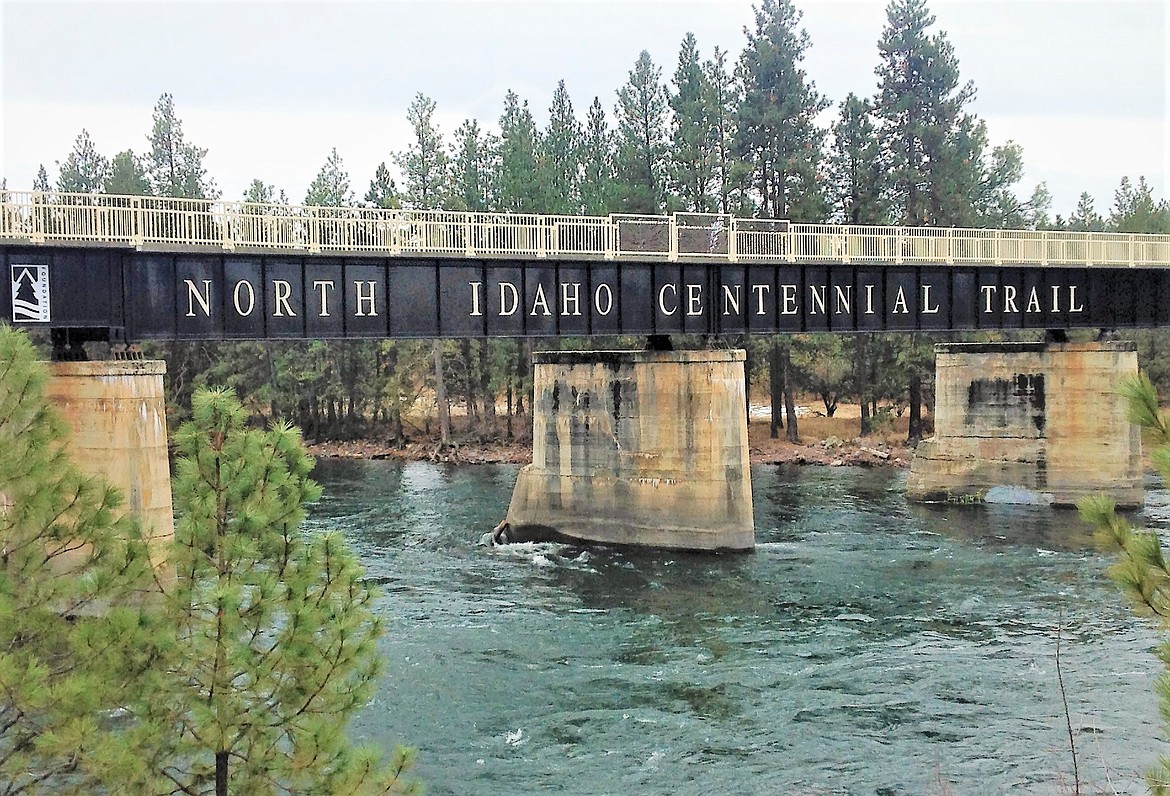
COEUR d’ALENE — Doug Eastwood watched and waited for “North Idaho Centennial Trail” to shine in the darkness over the Spokane River.
When it did, at 6 a.m. Feb. 9, he beamed with delight.
“Breathtaking,” he said. “It was that beautiful.”
Eastwood, a board member on the North Idaho Centennial Trail Foundation, was a driving force behind a longtime effort to have lights on the North Idaho Centennial Bridge, which is crossed by thousands of cyclists, runners and walkers each year.
It took money, of course, plenty of planning and dogged determination.
It was worth it.
“That is one of the most beautiful bridges that I can recall seeing under lights,” Eastwood said. “It is really nice.”
The project cost about $130,000, which included efforts to get power — the nearest source was some 3,000 feet away — to what is often called “The Gateway Bridge” between Idaho and Washington.
Eastwood said the foundation raised $60,000 including a $5,000 donation from Hanson Properties, the landowner immediately east of the bridge and south of the trail.
The North Idaho Centennial Trail Foundation, and the Joint Powers Board, comprised of Kootenai County, Coeur d’Alene and Post Falls, funded the rest and continue to maintain the bridge.
Tabitha Kraack-Bonner, trail foundation executive director, said the lights will turn on and off at dawn and dusk daily.
“The next time you are driving on Interstate 90 at night where it crosses the Spokane River, take a look at the Centennial Trail bridge to the south, it is truly a sight to see,” she said.
With long, dark winters, the bridge went unnoticed at night. A few years ago, someone suggested, “Maybe we should light it up.”
That kickstarted fundraising talks and meetings with key players. All were onboard.
COVID set things back, but last year the project regained momentum.
The Joint Powers Board, Avista, Conifer Electric in Spokane and Kasco Electric in Rathdrum also played key roles to light up the historic bridge.
“It’s an incredible asset,” said Eastwood, a cyclist.
The bridge was built in 1910 by Milwaukee Railroad, which sold it to Burlington Northern in the 1960s.
Eastwood, who served as Coeur d'Alene parks director for 35 years, said the bridge and the Spokane River were lifelines of the area's timber and mining industries, economic engines for decades.
Burlington Northern abandoned the bridge in 1974, and in 1987, the foundation began efforts to acquire what it saw as essential for the trail, which would open in 1990.
"We started knocking on the door,” Eastwood said. “Nobody would answer, but we kept knocking.”
Acquiring the bridge was one of the biggest hurdles of the entire trail project, Eastwood said.
At one point, the foundation believed it had purchased the bridge from Burlington Northern and moved ahead with bridge improvements, including repaving, restoring and adding guardrails.
But, Eastwood said, due to the foundation's mistake, it failed to close the deal and did not own the bridge.
Burlington Northern, however, still donated the bridge and 5 acres on both sides of the bridge to the foundation in 1993 — for $10. About a year later, ownership was later conveyed to Kootenai County.
Eastwood credited then-Congressman Larry Craig with playing a pivotal role in the deal.
The foundation continued to improve the bridge and, in 2018, the words North Idaho Centennial Trail, with letters about 8 feet tall, were added. Come night, they sat in darkness.
No more. With LED lights from above, they're shining bright.
“It’s unbelievable,” Eastwood said.
Eastwood said the lights do two things: Deter graffiti and highlight the trail, which stretches 23 miles from Higgens Point east of Coeur d’Alene to the Idaho-Washington state line.
It’s estimated that more than 400,000 people use the North Idaho Centennial Trail each year. It continues on the Spokane side.
Kraack-Bonner said when driving in from the east, the bridge is the first thing drivers see.
"It's like a welcoming sign to our beautiful state," she said.
The lights also spotlight the foundation's work, with trail improvements and expansions planned in Post Falls and connections to the Prairie Trail.
"We'll be doing some amazing things in the coming years," she said.
Kraack-Bonner said the lighting project was on the table when she stepped in as the foundation's director four years ago.
"To see it completed was a priceless moment for us," she said.
ARTICLES BY BILL BULEY

Day of Remembrance highlights being homeless in North Idaho, people encouraged to help
Day of Remembrance highlights being homeless in North Idaho, people encouraged to help
According to the 2025 Point in Time Homeless Count in January, Idaho has 2,697 homeless people, down slightly from the previous year. Most, 56%, were adults males between the ages of 18 and 54. In Idaho's Region One, which includes Kootenai, Bonner, Boundary, Shoshone and Benewah counties, there were 246 homeless in the PIT 2025 count.
Mayor Woody McEvers lauded for service to Coeur d'Alene
Mayor Woody McEvers lauded for service to Coeur d'Alene
Woody McEvers praised for selfless service

Tech Hub app could bring job training center to Post Falls
Tech Hub app could bring job training center to Post Falls
The AAMMC Tech Hub members have focused on a clear objective: bring the world's largest composites press and advanced composites equipment to the Inland Northwest to accelerate prototyping of advanced material aerospace parts and train a pipeline of engineers and suppliers so that next-generation of aerospace parts remain in the INW for decades to come.