
Renew hopes to resume housing assistance program soon
GABRIEL DAVIS | Hagadone News Network | UPDATED 2 years, 8 months AGO

Renew Case Manager Carry Robey poses outside of the organization’s main office at 840 East Plum Street in Moses Lake. Renew is currently training a new employee to take over Robey’s previous position as a supportive housing specialist.
Gabriel Davis/Columbia Basin Herald
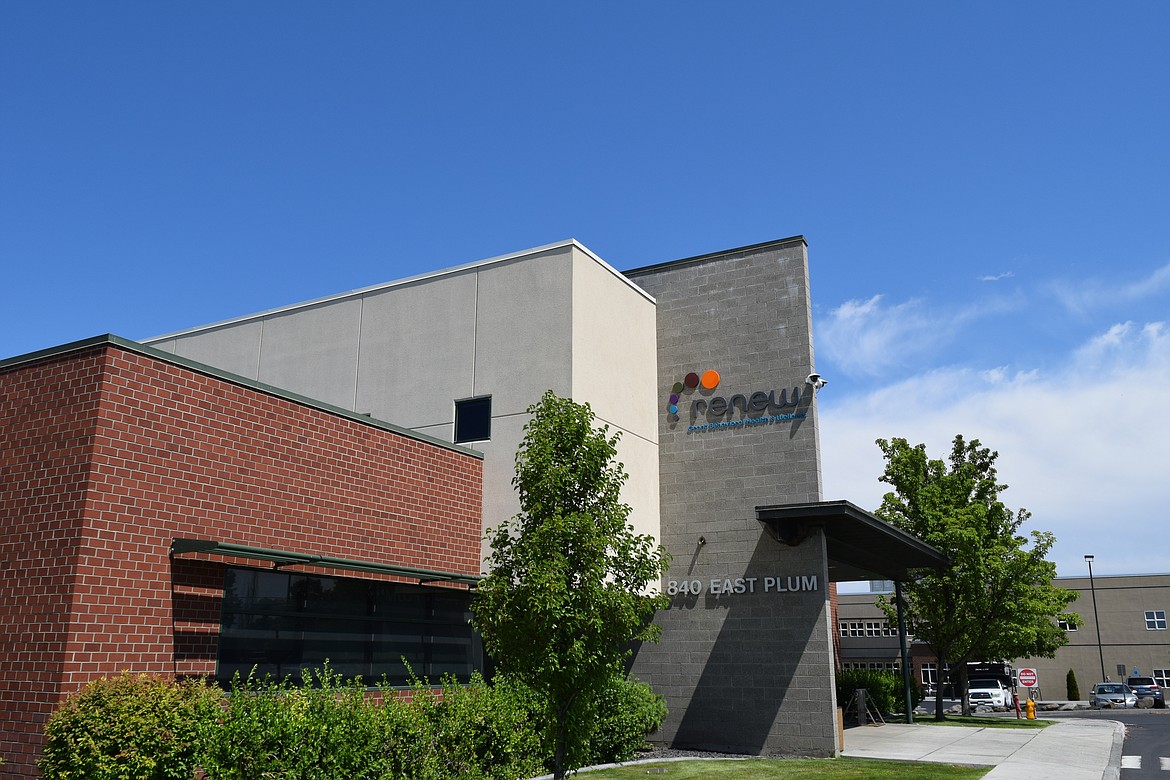
Renew, formerly Grant Integrated Services, provides behavioral health treatment across Grant County and is hoping to soon resume taking referrals for their Foundational Community Supports housing assistance program.
Gabriel Davis is a resident of Othello who enjoys the connections with his sources. Davis is a graduate of Northwest Nazarene University where he studied English and creative writing. During his free time, he enjoys reading, TV, movies and games – anything with a good story, though he has a preference for science fiction and crime. He covers the communities on the south end of Grant County and in Adams County. | July 18, 2023 6:08 PM
GRANT COUNTY — Grant County behavioral health provider Renew is hoping to take referrals again in the near future for its housing assistance program, after having to limit its new cases since January due to an overload of clients, according to LaVyonne Barnes, who supervises the program.
Barnes stated that the program, which is an arm of Amerigroup’s state-wide Foundational Community Supports program, is vital to Renew’s behavioral health treatment efforts and to servicing the large number of clients struggling with a lack of housing.
“We love the FCS program being part of Renew because we believe in Maslow’s Hierarchy of Needs, meaning it’s hard for a client to address their mental health if they don’t even have their basic needs met.”
According to Amerigroup, the FCS system requires that potential clients meet specific criteria before being provided with housing assistance. These criteria include being eligible for Medicaid, having a specific health need outlined by the program and having at least one risk factor, such as an extended period or frequent stretches of homelessness.
According to Barnes, Renew is currently in the process of training a new supportive housing specialist to take over for Carry Robey, who transitioned from that role to become a case manager. The length of the training and accreditation of their new employee means that Barnes could not provide a particular date or estimate of when they plan to begin taking referrals again for the FCS program.
Robey spoke about the basics of what Renew does to assist clients with housing.
“We find listings, make contact with landlords and rental agencies, and go and look at properties and fill out applications together,” she said.
According to Robey, Renew does not actually provide monetary assistance to clients, but instead provides support with financial planning, locating housing, working with landlords and other case management support functions. Robey stated that Renew doesn’t have the funding to help clients make rent payments, and instead helps clients obtain funding from larger programs
“We nudge them to stay eligible, to stay engaged, to keep their funding,” said Robey. “They will need to have a very strong financial plan for when they assume paying for rent on their own when those supports run out.”
Most of Renew’s housing assistance clients are referred to the program from other departments within the organization, according to Robey. Amerigroup’s criteria require specific needs and risk factors that other departments at Renew encounter and treat on a regular basis.
“It is better for the teamwork, for the whole-person-centered care idea, that they have other team members with them as well that have mutual goals,” said Robey.
Robey discusses several other barriers to providing housing assistance, not least of which is a current lack of low-income or affordable housing in Grant County.
“One of the major problems I’ve noticed is the rent gouge,” said Robey. “The properties did not increase in value, they only went up in price, and they are out of the price range of the assistance programs.”
According to Robey, low-income housing is also at capacity, and despite significant tax breaks and discounts for landowners who develop low-income housing, there are more clients than places to put them. Additionally, both Robey and Barnes explained, there is a significant lack of landlords willing to accept vouchers — Renew’s clients — or work with the organization.
“People hear the term ‘voucher’ and they think ‘I’m going to have a lot of bureaucracy. I’m going to have people wanting to inspect all my places and tell me how to manage,’ and that’s not the case,” said Robey. “A voucher is a qualified applicant that has, usually, at least some guarantee that rent will be paid. Landlords who work with us have just as many rights as any other landlord. If someone is creating a lease violation, they can still be evicted…plus the client comes in with a lot of support.”
Barnes explained that once the FCS program opens up again, Renew will try to keep the number of clients to a manageable level so that they don’t have to stop taking referrals again. According to Robey, even if Renew can’t take on a client, they do their best to find another FCS program or similar service to help them.
“The partnerships are phenomenal with those warm handoffs and those referrals,” said Robey.
In light of the barriers in place to providing housing assistance to clients in Grant County, Robey made sure to express why the program, which helps clients not just find housing but maintain that housing and better their financial situation, is so important.
“When people are able to meet the basic needs then they’re able to see that hope again, and want more for themselves,” she said.
Renew has offices in Moses Lake, Ephrata, Mattawa, Quincy, Royal City and Grand Coulee. For more information on Renew’s services and contact information, visit www.grantcountywa.gov/761/Renew.
Gabriel Davis may be reached at [email protected]. Download the Columbia Basin Herald app on iOS and Android today.
ARTICLES BY GABRIEL DAVIS

Work-based learning lets students build their own futures
MOSES LAKE — Work-based learning provides education opportunities for the workforce to receive hands-on training and technical education and prepare themselves to enter various industries. Educators and workforce development professionals from Eastern Washington discussed some the training they offer and the benefits of their programs. Next Generation Zone, an affiliate of WorkSource based in Spokane, provides job training opportunities for youth and young adults ages 16 to 24. Program Coordinator Kate Martin said there are multiple benefits to the program. “One of them is a paid work experience, and that’s where we reach out to area employers who are willing to take a young person and train them,” she said. “This is a short-term learning experience, so it’s typically about 240 hours; sometimes it could be longer or shorter. We’re the actual employer; we cover all of their wages, taxes, the L&I, and the employer just agrees to give them the experience and train them in whatever field it is that they’re wanting to go into.”

Serving schools: ESD superintendents reflect on operations, priorities
MOSES LAKE — Educational service districts are government-mandated agencies put in place to provide services to school districts across the state. ESD Superintendents discussed what they do and their priorities in operating their districts. ESD 105, led by Superintendent Kevin Chase, serves four counties, including Kittitas, Yakima and portions of Klickitat and Grant counties and provides support for 25 school districts – including Royal School District and Wahluke School District – and more than 66,000 students. “We help them collaborate with each other as well or collaborate with other partners,” Chase said. “(It’s) a lot of advocacy work, either regionally or across the state, or even federally, working on different issues that impact our education. And we provide very specialized services in certain situations in order to meet the needs of our students in our region and of our school districts.”

Columbia Basin Project making headway through Odessa Groundwater program
CASHMERE — The Columbia Basin Project is making gradual progress toward completion with particularly significant accomplishments for the Odessa Groundwater Replacement Program in the last six months or so, according to Columbia Basin Development League Executive Director Sara Higgins. “When we’re dealing with a project of this size, advancement is kind of like watching paint dry, but yes, there have been (developments),” she said. “There are a lot of exciting things happening right now.” There are more than 300 miles of main canals, about 2,000 miles of lateral canals and 3,500 miles of drains and wasteways in the irrigation project, according to the U.S. Bureau of Reclamation website. The CBDL advocates for the operation of those waterways and for the project to continue “build-out.”