
Science and myth
JOEL MARTIN | Hagadone News Network | UPDATED 3 years, 2 months AGO

“The Apeling” author Tony Dean Yetter in his apartment at home. Behind him are boxes of rare comics that he buys and sells online, he said, and the wheelchair is necessary because he’s recovering from a broken kneecap.
Joel Martin/Columbia Basin Herald
Joel Martin has been with the Columbia Basin Herald for more than 25 years in a variety of roles and is the most-tenured employee in the building. Martin is a married father of eight and enjoys spending time with his children and his wife, Christina. He is passionate about the paper’s mission of informing the people of the Columbia Basin because he knows it is important to record the history of the communities the publication serves. | July 21, 2023 1:00 AM
MOSES LAKE — They’re all real.
That’s the premise of a series of novels by Moses Lake writer Tony Dean Yetter, whose works serve a dual purpose: to tell a good story and to promote discussion of Sasquatch.
“I listened to 400 hours of testimonies from police officers to game wardens to this and that,” Yetter said of his research into the subject. “A lot of it you take with a grain of salt, you know, but when there's someone that is a 25-year veteran of the state police, you listen to him.”
Yetter’s first book, “The Apeling,” tells the story of a 5-year-old boy who survives a plane crash in a remote part of the Rocky Mountains and is taken in and raised by a clan of Sasquatch. The subsequent books recount the boy’s assimilation with his adopted species. Yetter, a fan of J.R.R. Tolkien’s world-building, has constructed a Sasquatch culture and language that he believes might not be far from the reality.
“I reasoned that they live in a 'now' environment,” Yetter said. “Everything is right now. There is no yesterday, tomorrow. So the language that I developed is based on that. For example, if they want to say ‘Let's go hunting,’ they’re going to say ‘I need eat. You, we hungry.’”
The Sasquatch language Yetter envisions includes facial expressions, gestures, clicks, hoots and whistles, many of which can also be found in human languages.
The concept of the orphan raised by a different species is hardly a new one. Edgar Rice Burroughs did it famously with his Tarzan stories, as did Rudyard Kipling in “The Jungle Book.” But the apes and wolves of those novels are animals whose existence is established, while Yetter’s stories draw on cryptozoology, which is a study that straddles scientific research and folk myth, and for that reason its enthusiasts are often viewed skeptically. Yetter is careful about the sources he uses for his inspiration, he said. His editor is Jennifer Bolm, the wife of David Hatcher Childress, a well-known researcher into cryptozoology, UFOs and similar topics. Another source is Jeff Meldrum, an anthropology professor and zoologist at Idaho State University who has published a number of papers on evolutionary morphology, and also published a book entitled “Sasquatch: Legend Meets Science.”
“With the news people, any time one of the Sasquatch community (speaks) it's automatically a hoax, and it's automatically laughable. It doesn't matter which news company’s putting it out. You can tell by the way they're acting, you know? It's a big joke,” Yetter said.
Stories of ape-like hominids (or human-like simians) can be found around the world, mostly centered on places that are remote and hostile to human population. The Cascade and Rocky Mountains have Bigfoot, the southeastern U.S. has the skunk ape, the Himalayas have the yeti, the Caucasus Mountains have the almasty and the Australian Outback has the yowie.
Yetter said he believes the accounts of sightings and even close encounters lend some weight to the stories. The authenticity of the famous 1967 Patterson-Gimlin film, which showed a tall, ape-like creature walking in the woods of Northern California, has never been proved or disproved, Yetter pointed out.
And according to Meldrum, some of the footprints attributed to Sasquatch show a midtarsal break, a pair of joints present in ape feet but not human ones. Yetter said that also was possible evidence pointing to the existence of Sasquatch.
Yetter has interests that extend beyond Sasquatch research. He buys and sells collectible comics online, and reads fantasy and science fiction. He also writes 12-16 hours a day, a habit that began when he suffered a hemorrhagic stroke 20 years ago.
“I think it became a stroke of genius,” Yetter said. “One night I got up at 3:15 in the morning and started to write, and I never stopped.”
Besides the “Apeling” books, of which three have been published, a fourth is due out next month and two more are in the works, Yetter has also written his next set of stories for publication, the “Pirates of the Inland Sea.” This six-book series is aimed at younger readers and, without giving away too much, involves an 18th-century pirate crew, a time shift into the distant future and a species of intelligent whales.
“I never run out of ideas,” Yetter said. “I published ‘The Apeling’ first, because it had a goal. And the goal is to recognize Sasquatch as an endangered species.”
Joel Martin may be reached via email at [email protected].
ARTICLES BY JOEL MARTIN
Endless battle
Noxious Weed Control Board works to keep invasive plants under control
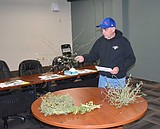
MOSES LAKE — Some of the nastiest plants in Grant County were the topic of a class led by Jay Johnson, a consultant with the Grant County Noxious Weed Control Board, Tuesday. The Noxious Weed Control Board, as its name would suggest, is tasked with keeping weeds under control in Grant County. That’s not a small job; the board’s website lists 129 species of noxious weeds that are found around Grant County. A noxious weed is defined as an invasive, non-native plant that threatens agricultural crops, local ecosystems or fish and wildlife habitat, according to the Noxious Weed Control Board. Washington state law requires that these weeds be identified and their spread kept to a minimum, if not completely eradicated. “We’re one of those agencies a lot of people don’t really understand,” Johnson said. “We’re a county office and … our funding is tax-based assessment. When you get your tax bill and you look down at all the expenses that you pay for, there we are.”

BASIN EVENTS: Oct. 16-24
COLUMBIA BASIN — Whether you feel like shopping, crafting, learning or seeing a show, there’s something happening for you this week in the Basin. Oct. 16 ‘My Family (Mi Familia)’ screening Spanning three generations, “My Family (Mi Familia)” is a heartfelt drama that follows the Sánchez family as they build their lives in East Los Angeles. Through love, hardship, triumph, and sacrifice, the film explores the immigrant experience, the strength of family bonds, and the traditions that connect one generation to the next. Lowrider show and taco truck before the screening. Sponsored by Columbia Basin Allied Arts, EDUBS C/S and the Moses Lake Creative District. $12 per person. Doors open at 6 p.m., film begins at 7 p.m. at the Moses Lake Civic Center Auditorium, 401 S. Balsam St. Tickets and info: www.cba-arts.org.
Moses Lake author encourages women to look beyond church culture norms
MOSES LAKE — A Moses Lake author’s book, “A Christian Woman Striving to Live Her Faith in a Man-Controlled World,” takes aim at the role to which many churches relegate the female half of their congregations. “It’s to encourage women in the faith,” Linda Curran said. “A lot of churches say, ‘Teach Sunday school, do this, do that, but don’t (evangelize.)’" In her book, Curran recounts a time when she moved to a new community and joined a church there. She was surprised to learn that, as a new female member, she had been automatically assigned church cleaning duties. When she questioned it, she wrote, she was met with condescension and her objections were brushed aside. In other churches, she said, women who were capable of teaching were relegated to “women’s ministry.”