
Soaring interest rates: What North Idaho needs to know
JOE TAYLOR/Staff Writer | Coeur d'Alene Press | UPDATED 2 years, 10 months AGO
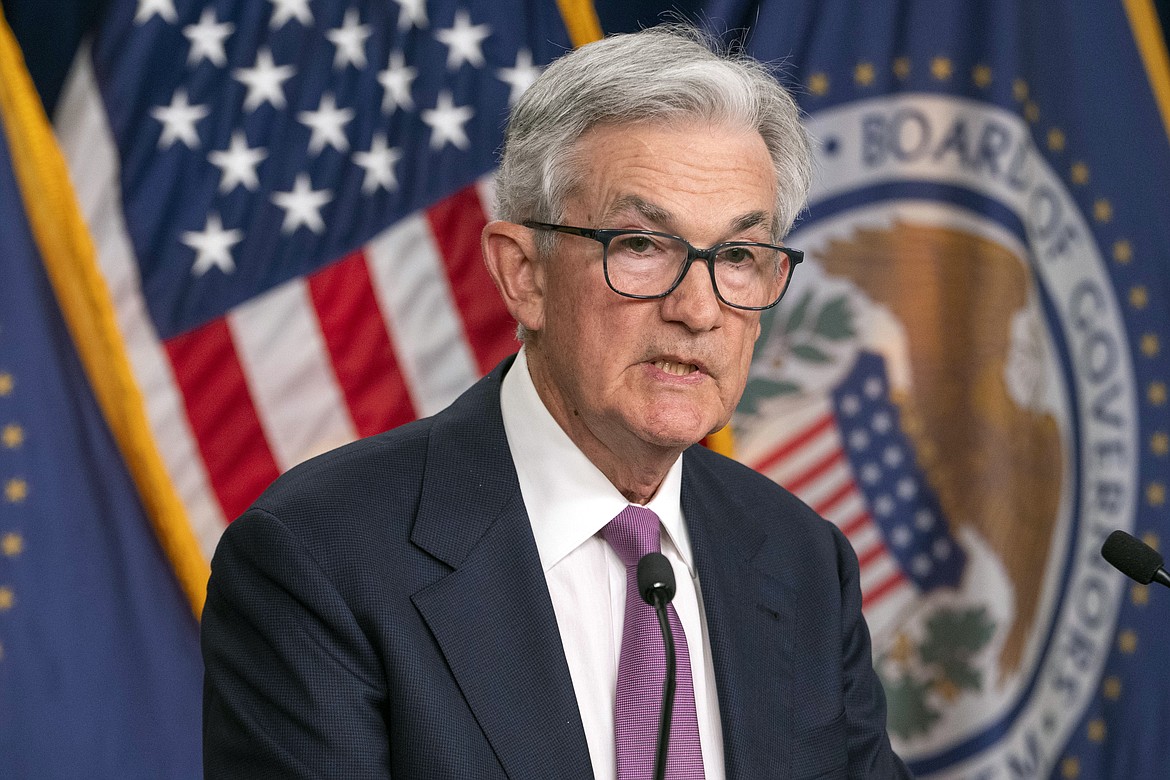
Federal Reserve Chair Jerome Powell speaks during a news conference following a Federal Open Market Committee meeting, Wednesday, June 14, 2023, at the Federal Reserve Board Building in Washington. (AP Photo/Jacquelyn Martin, File)
Sixteen-year high interest rates, declining inflation levels and more rate hikes are on the horizon. Is a recession imminent?
Since March 2022, the Federal Open Market Committee has increased its target interest rate 10 times. The target interest rate is currently between 5 and 5.25%, a level not seen since 2007.
When you hear that the interest rate is rising, you may think of soaring mortgage rates or maybe increased yield on savings accounts, but what is the interest rate and what does it really mean for it to increase?
What we commonly refer to as the interest rate is something called the Federal Funds Rate (FFR). The FFR is the rate at which banks lend money to each other overnight. If it is 5%, then a bank will be able to lend another bank at a 5% yearly rate. Since this is the overnight market, a bank will pay about 0.0139% (5%/360) interest per day on a loan.
Because banks can make a guaranteed 5% by loaning to other banks, other methods of lending like mortgages, personal loans, student loans and small business loans all become more expensive to compensate. On the other hand, the yield on certificates of deposit, saving accounts and other investments increase to attract more customers.
Ultimately, increasing the FFR is a signal from the Federal Reserve for market participants to stop borrowing and start saving. In theory, and practice, this decreased level of spending drives down inflation.
Rising interest rates are a boon to some and a detriment to others, but what about the banks themselves? Just like their customers, rising interest rates could hurt a bank as much as it may help it.
"If you have an asset-sensitive balance sheet, rising rates are good. If you are liability-sensitive, rising rates are bad," explained Wes Veach, CEO of bankcda, a local bank with branches in Coeur d’Alene, Hayden, Post Falls and Kellogg.
The dilemma that banks face with rising rates mirrors that of their customers. Banks that lend can benefit from higher interest rates, but when they borrow, they are disadvantaged by these higher rates.
Banks that are asset-sensitive can take advantage of rising rates by making loans and adjusting previous loans. On the other hand, liability-sensitive banks, which need to borrow or have taken on adjustable rate debt, are hindered by rising interest rates. However, even asset-sensitive banks may experience some turbulence due to rising rates.
With interest rates rising at breakneck speeds, Idaho banks and depositors alike are scrambling to keep up.
"The interest rate hikes happened so quickly that it was difficult to keep pace on the deposit side of the balance sheet, causing customers to seek higher yields and thus decreasing deposits/liquidity," Veach said. "For years, customers did not care about yield because all 'like products' were paying close to zero. So, once rates began to rise, customers began aggressively seeking yield."
With credit unions in Idaho offering over 4% on high-yield savings accounts, traditional banks in Idaho are seeing a minor exodus of depositors.
Even with some customers choosing to switch to a credit union or brokerage account, this level of customer loss is something that Idaho banks are equipped to handle, so bank runs are unlikely to occur. Veach says bankcda maintains a strong cash flow to keep up with the rising interest rates and raise net interest income for the bank.
Even with all of these complications, the first quarter of 2023 saw record-breaking net income for the banking sector as a whole.
While banks are skirting along just fine with the current interest rate, what about the inflation rate that increasing interest is meant to combat?
According to Jerome Powell, the chair of the Federal Reserve, the economy has experienced "stronger-than-expected growth, a tighter-than-expected labor market, and higher-than-expected inflation."
These factors indicate, Powell further said, that current policy measures are restrictive, possibly not restrictive enough, and have not been in effect for a sufficient duration. He emphasizes that "more rate hikes are likely to be appropriate." These statements were made by Powell in early June, Before monthly inflation data was available.
As of June 2023, core inflation is at 4.8%, down 0.5% from May 2023. The most recent peak in inflation was in September 2022 at 6.6%. Before this data was published, Powell said inflation was moving slower than expected and that it would likely take until 2025 to reach the Federal Reserve's target inflation. The Federal Reserve has a target of 2% inflation. Research from the Federal Reserve shows this level of inflation to be the optimal level of consistent inflation for a healthy economy.
All these factors may leave North Idaho residents wondering if a recession will happen soon. Reflecting on the current situation, Veach said, "The Pacific Northwest appears to still be strong, especially here in Kootenai County."
However, he also acknowledged a historical trend, "We don't currently see a recession in the near term, but it is worth noting that every time the yield curve has inverted, a recession has occurred."
An inverted yield curve means long-term interest rates are lower than short-term interest rates. This suggests the market is generally pessimistic about the future of the economy. But do fluctuating interest rates mean the yield curve will invert?
According to Sam Wolkenhauer, an economist for the Idaho Department of Labor, this is not necessarily the case.
“The yield curve has historically inverted only a handful of times, so we can’t say that the normal monetary policy actions of raising and lowering interest rates automatically lead to an inversion,” Wolkenhauer said. “It really depends on the broader economic climate.”
Regarding indications a recession may be somewhere in our future, Wolkenhauer said there are a lot of mixed messages and signs in the economy.
“For example, Germany, the fourth largest economy in the world, is already technically in a recession, earlier in the year we saw a string of bank failures, and so on,” Wolkenhauer said.
However, there are important signs, he said, that the economy is strong, particularly in the labor market.
“We continue to see very strong jobs reports and low unemployment, and here in Idaho the labor market is very strong," Wolkenhauer said. "Unemployment claims in Idaho, for example, are tracking at similar levels to last year, so we are not seeing signs that the labor market is in distress.”