
Exploring macro worlds
JOEL MARTIN | Hagadone News Network | UPDATED 3 years, 4 months AGO
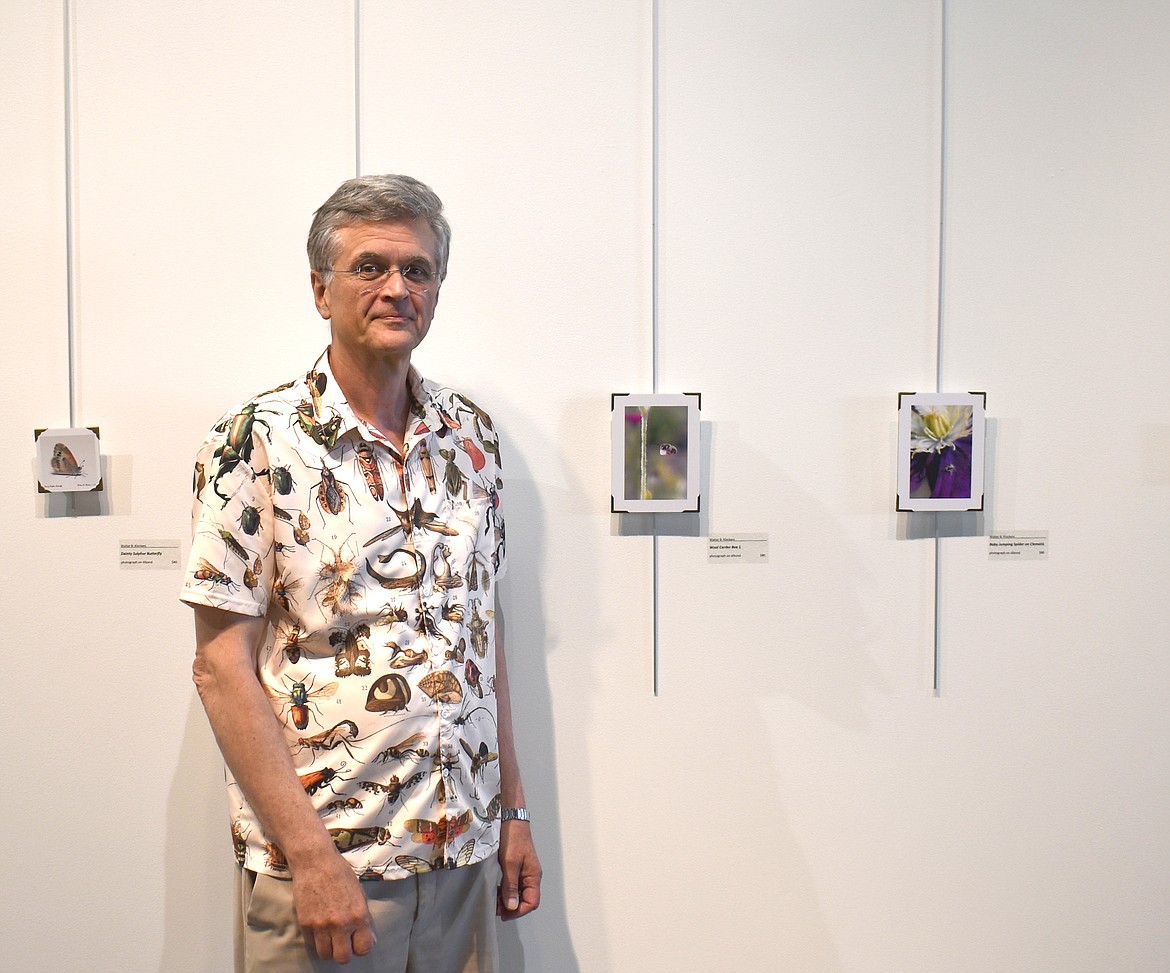
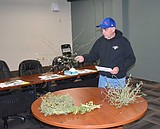
Moses Lake pastor and photographer Walter Klockers stands among his macro photos, currently on exhibit at the Moses Lake Museum & Art Center. Klockers’ insect-festooned shirt was a gift from his wife Jeannie, he said, who tolerates but does not share his passion for creepy-crawly creatures.
JOEL MARTIN/COLUMBIA BASIN HERALD
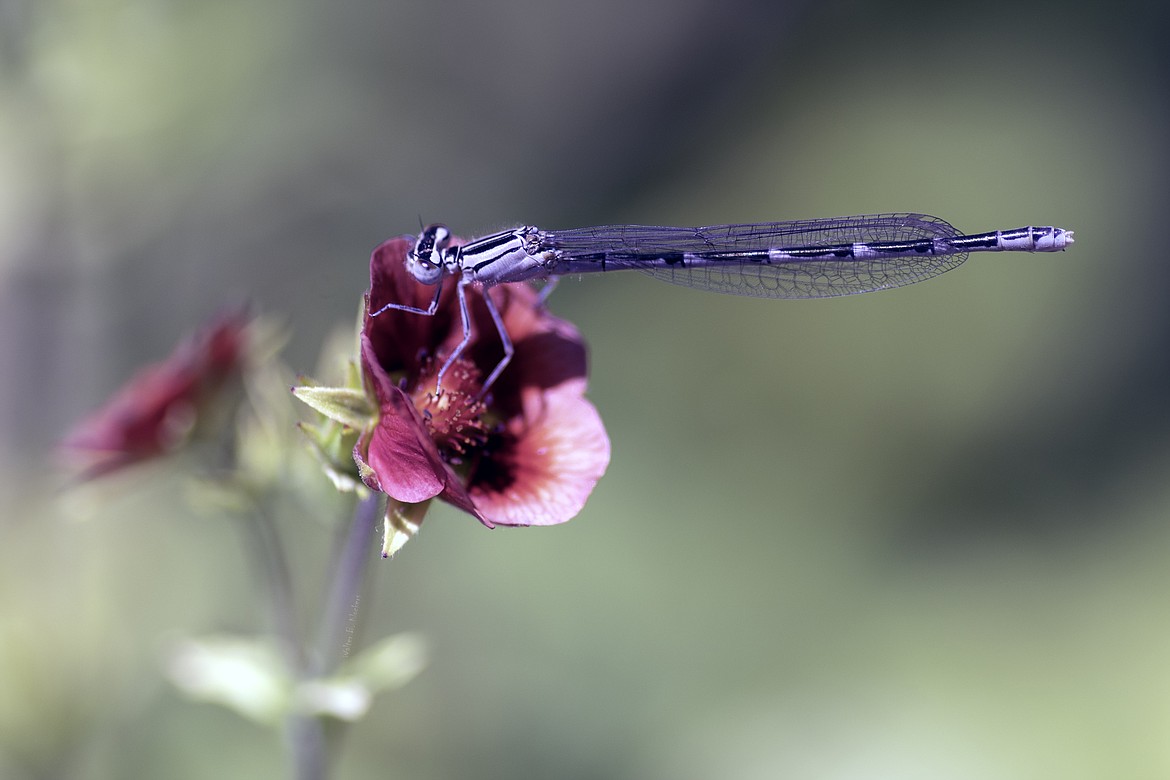
This photo of a damselfly on a flower is one of the 113 specimens of macro photography by Walter Klockers exhibited at the Moses Lake Museum & Art Center.
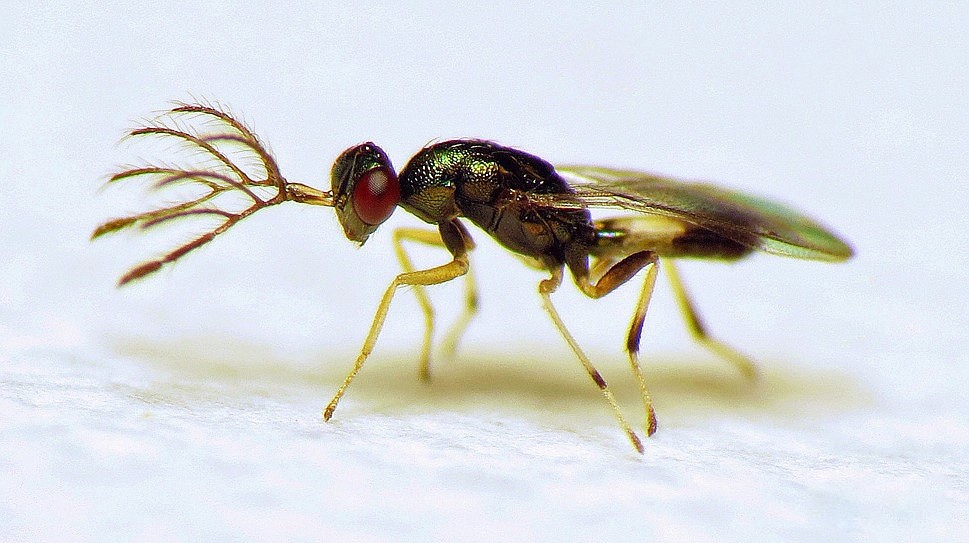
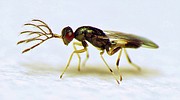
The “waspalope” looks like something out of an urban myth, but it’s a real insect called a chalcidoid wasp, Walter Klockers said. A note on the photo on display at the Moses Lake Museum & Art Center says that the wasp is only about 2 millimeters long.
Joel Martin has been with the Columbia Basin Herald for more than 25 years in a variety of roles and is the most-tenured employee in the building. Martin is a married father of eight and enjoys spending time with his children and his wife, Christina. He is passionate about the paper’s mission of informing the people of the Columbia Basin because he knows it is important to record the history of the communities the publication serves. | June 14, 2023 1:30 AM
MOSES LAKE — It all started with some boozy bugs.
“I went out in the front yard, and I went up to a tree in which there were always tens of butterflies, and I couldn't figure out why,” said Walter Klockers, whose macro photography is currently on exhibit at the Moses Lake Museum & Art Center.
It turned out that the tree had something called bacterial wet wood disease, he said, which caused it to produce a fermented froth, which attracted insects.
“It's like meeting at the bar,” Klockers said. “So you'd have this butterfly and a wasp who were mortal enemies, more or less drinking beer next to each other. I dared myself to walk into the swarm of it ... and they were so inebriated, they really didn't care about my presence.”
Thus began a passion for photographing bees and wasps and other tiny creatures that would set many people shuddering. Klockers, who serves as the pastor at Immanuel Lutheran Church, opened his first exhibit, “Butterfly Landscapes,” at the museum earlier this month with 113 photographs. Some came from his last parish in Texas, he said, but the majority he took in the yard of the parsonage in Moses Lake.
It would seem like the best way to photograph insects, especially ones that carry around stingers, would be from a distance, but Klockers prefers to get within a few inches of his subjects. One key, he said, is to move like a mantis, which he demonstrated.
“Have you ever seen a mantis move?” he said. “It's sort of like a little branch that's moving with a wind. And if you move slowly enough, you can approach something fairly easily. I'm so limber that I can get down like this and photograph the things. The other thing is to know where you are and be aware of your environment so that there's no shadow cast on the insect. And if you know those things, you can approach the insect and it usually won't even know you're there.”
One insect Klockers is especially proud of photographing is the island marble butterfly, captured at San Juan Island National Historical Park, he said. The butterfly is rare – there are only about 300 of them in existence, Klockers said – and according to the National Park Service, was thought to be extinct until 1998. The island marble butterfly is found only on San Juan Island, according to the NPS. A park biologist showed Klockers where to find them and then left, saying she’d be back in three hours.
“She said ‘You’re probably not gonna get a macro photograph of one of these things; they probably won't even light,” Klockers said. “So over three hours, there must have been at least 30- 50 butterflies that went overhead. Three of them lit, they were the rare butterfly and I couldn't get to them (before) they flew off. This one was the last one, and it went just literally 10, 15 yards from me. And I got down with my equipment and I took some pictures. Then it flew off when I quickly picked up my camera. Looking through it, I saw that that image of the butterfly and I screamed to the heavens, ‘Yes!’”
Klockers brings his entomological expertise to schools as well, he said.
“I give bug presentations for school for grade school kids,” he said. “I want them to become educated so they won't squish everything.”
One of Klockers’ favorite subjects is the European wool carder bee. Female wool carder bees take fiber off of plants, roll it up into a ball and use it as fresh bedding in their nests every day, Klockers said.
“I hung out at a particular gathering of these plants for three days, off and on, in order to get three photographs,” he said, pointing to each photo in turn. “(In this photo) it was still on the stem. This one it is taking it away from the stem. And in the third one it’s flying away.”
Klockers initially photographed his insects on a plain white background, he said, but over time he found that putting the creatures in their natural setting, on a flower or a tree, gave the photo more depth.
“There's composition to it,” Klockers said. “There's a story behind it. It's like a painting. That was my goal, to make it (not) just a bug picture, but a piece of art.”
“I'm not much of a ‘like an insect person’,” said museum Customer Service Attendant Natalia Zuyeva. “But these definitely gave me a different perspective. His composition is just so good. The bright colors definitely, I think, find the beauty in them.”
“Butterfly Landscapes” will be at the Moses Lake Museum & Art Center, 401 S. Balsam St., through July 7.
ARTICLES BY JOEL MARTIN
Endless battle
Noxious Weed Control Board works to keep invasive plants under control
MOSES LAKE — Some of the nastiest plants in Grant County were the topic of a class led by Jay Johnson, a consultant with the Grant County Noxious Weed Control Board, Tuesday. The Noxious Weed Control Board, as its name would suggest, is tasked with keeping weeds under control in Grant County. That’s not a small job; the board’s website lists 129 species of noxious weeds that are found around Grant County. A noxious weed is defined as an invasive, non-native plant that threatens agricultural crops, local ecosystems or fish and wildlife habitat, according to the Noxious Weed Control Board. Washington state law requires that these weeds be identified and their spread kept to a minimum, if not completely eradicated. “We’re one of those agencies a lot of people don’t really understand,” Johnson said. “We’re a county office and … our funding is tax-based assessment. When you get your tax bill and you look down at all the expenses that you pay for, there we are.”
BASIN EVENTS: Oct. 16-24
COLUMBIA BASIN — Whether you feel like shopping, crafting, learning or seeing a show, there’s something happening for you this week in the Basin. Oct. 16 ‘My Family (Mi Familia)’ screening Spanning three generations, “My Family (Mi Familia)” is a heartfelt drama that follows the Sánchez family as they build their lives in East Los Angeles. Through love, hardship, triumph, and sacrifice, the film explores the immigrant experience, the strength of family bonds, and the traditions that connect one generation to the next. Lowrider show and taco truck before the screening. Sponsored by Columbia Basin Allied Arts, EDUBS C/S and the Moses Lake Creative District. $12 per person. Doors open at 6 p.m., film begins at 7 p.m. at the Moses Lake Civic Center Auditorium, 401 S. Balsam St. Tickets and info: www.cba-arts.org.
Moses Lake author encourages women to look beyond church culture norms
MOSES LAKE — A Moses Lake author’s book, “A Christian Woman Striving to Live Her Faith in a Man-Controlled World,” takes aim at the role to which many churches relegate the female half of their congregations. “It’s to encourage women in the faith,” Linda Curran said. “A lot of churches say, ‘Teach Sunday school, do this, do that, but don’t (evangelize.)’" In her book, Curran recounts a time when she moved to a new community and joined a church there. She was surprised to learn that, as a new female member, she had been automatically assigned church cleaning duties. When she questioned it, she wrote, she was met with condescension and her objections were brushed aside. In other churches, she said, women who were capable of teaching were relegated to “women’s ministry.”