
Royal parents learn to identify drug risk factors
JOEL MARTIN | Hagadone News Network | UPDATED 3 years, 4 months AGO
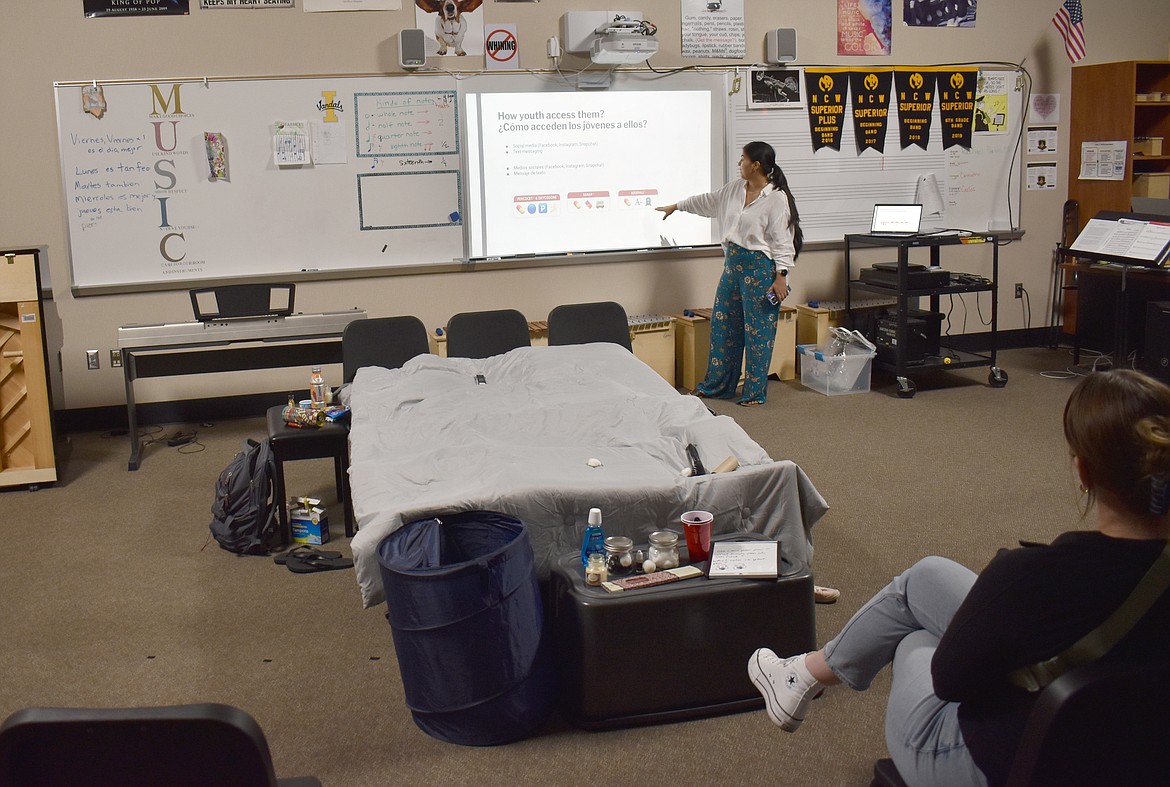
Community Prevention Specialist Brisa Sanchez tells a group of parents how to identify signs of drug use in their children at Healthy Youth, Healthy Families at Royal Intermediate School June 8. A recreation of a teenager’s bedroom serves to illustrate the possible ways kids might hide or disguise drug use at home.
JOEL MARTIN/COLUMBIA BASIN HERALD
Joel Martin has been with the Columbia Basin Herald for more than 25 years in a variety of roles and is the most-tenured employee in the building. Martin is a married father of eight and enjoys spending time with his children and his wife, Christina. He is passionate about the paper’s mission of informing the people of the Columbia Basin because he knows it is important to record the history of the communities the publication serves. | June 14, 2023 1:30 AM
ROYAL CITY — Between 20 and 30 people gathered at Royal Intermediate School June 8 for Healthy Youth, Healthy Families. The bilingual event, sponsored by Educational Service District 105, among other organizations, was designed to help families identify signs of substance abuse in youth.
“My demographic right now is particularly 10- to 13-year-olds,” said Ariana Martinez, a student assistance professional for ESD 105 attached to the Royal School District. “They're the ones kind of keeping up with the Tik Tok trends, whether that's using tampons to get drunk, putting them in alcohol, or challenges (to see) who can show up the highest at school and not get caught.”
Part of the training involved a replica of a teenager’s bedroom, to illustrate the ingenious ways kids might hide or disguise drugs or paraphernalia, and to help parents see through the subterfuge.
“We're training parents to recognize different devices, different risk factors, different signs of danger when it comes to a teenage bedroom,” said Brisa Sanchez, a community prevention specialist for ESD 105, also based in Royal City. “So if they're seeing aluminum (foil), and cotton buds in random places, balloons, wires, coils, things that aren’t usually things you need for school. There's vaping devices that could look like a like a spray deodorant, they could look like a bottle of perfume. The whole idea is we're training parents so that it will be easier for them to recognize vaping devices.”
Along with the identification training, attendees were given information about fentanyl, a dangerously powerful opioid that’s become prevalent recently, and learned how to recognize the signs of an opioid overdose and administer naloxone, or Narcan, a nasal spray that can reverse an overdose.
“There's instances where kids are seeing someone who's looking like they're having signs of overdose, and instead of helping, they're leaving. So we're hoping to empower them so that they have the knowledge they need to help.
Attendees were invited to take a free Narcan kit, offered by the Recovery Navigator Program, which had a table at the event. The Recovery Navigator Program works with law enforcement to help people who run afoul of the law because of substance abuse, but also assists anybody struggling with addiction, said Nick Baker, one of the RNP staff manning the table. That assistance can be anything from getting into a rehab program to simply getting an ID, which Baker said is often a first stepping stone to recovery.
“We are addicts in long-term recovery,” Baker said. “So we have the lived experience that people might still be going through. We've been through all that. We're able to walk with them.”
Sanchez agreed and said it’s a matter of standing beside those in recovery and being situationally aware.
“(We have to) practice and practice and practice having these hard conversations: talking about feelings, talking about expectations, talking about if this happens, what are you going to do then?” Sanchez said. “Insist that they not (ever take) any pills that have not been prescribed by the doctor, coming out of the prescription package. Pills purchased on social media are not safe. That's a fact. We need to tell them; we need to have a conversation with them multiple times. It needs to be repeated.”
Joel Martin can be reached via email at [email protected].
ARTICLES BY JOEL MARTIN

Endless battle
Noxious Weed Control Board works to keep invasive plants under control
MOSES LAKE — Some of the nastiest plants in Grant County were the topic of a class led by Jay Johnson, a consultant with the Grant County Noxious Weed Control Board, Tuesday. The Noxious Weed Control Board, as its name would suggest, is tasked with keeping weeds under control in Grant County. That’s not a small job; the board’s website lists 129 species of noxious weeds that are found around Grant County. A noxious weed is defined as an invasive, non-native plant that threatens agricultural crops, local ecosystems or fish and wildlife habitat, according to the Noxious Weed Control Board. Washington state law requires that these weeds be identified and their spread kept to a minimum, if not completely eradicated. “We’re one of those agencies a lot of people don’t really understand,” Johnson said. “We’re a county office and … our funding is tax-based assessment. When you get your tax bill and you look down at all the expenses that you pay for, there we are.”

BASIN EVENTS: Oct. 16-24
COLUMBIA BASIN — Whether you feel like shopping, crafting, learning or seeing a show, there’s something happening for you this week in the Basin. Oct. 16 ‘My Family (Mi Familia)’ screening Spanning three generations, “My Family (Mi Familia)” is a heartfelt drama that follows the Sánchez family as they build their lives in East Los Angeles. Through love, hardship, triumph, and sacrifice, the film explores the immigrant experience, the strength of family bonds, and the traditions that connect one generation to the next. Lowrider show and taco truck before the screening. Sponsored by Columbia Basin Allied Arts, EDUBS C/S and the Moses Lake Creative District. $12 per person. Doors open at 6 p.m., film begins at 7 p.m. at the Moses Lake Civic Center Auditorium, 401 S. Balsam St. Tickets and info: www.cba-arts.org.

Moses Lake author encourages women to look beyond church culture norms
MOSES LAKE — A Moses Lake author’s book, “A Christian Woman Striving to Live Her Faith in a Man-Controlled World,” takes aim at the role to which many churches relegate the female half of their congregations. “It’s to encourage women in the faith,” Linda Curran said. “A lot of churches say, ‘Teach Sunday school, do this, do that, but don’t (evangelize.)’" In her book, Curran recounts a time when she moved to a new community and joined a church there. She was surprised to learn that, as a new female member, she had been automatically assigned church cleaning duties. When she questioned it, she wrote, she was met with condescension and her objections were brushed aside. In other churches, she said, women who were capable of teaching were relegated to “women’s ministry.”