
‘The very concerned zone’
CHARLES H. FEATHERSTONE | Hagadone News Network | UPDATED 2 years, 9 months AGO
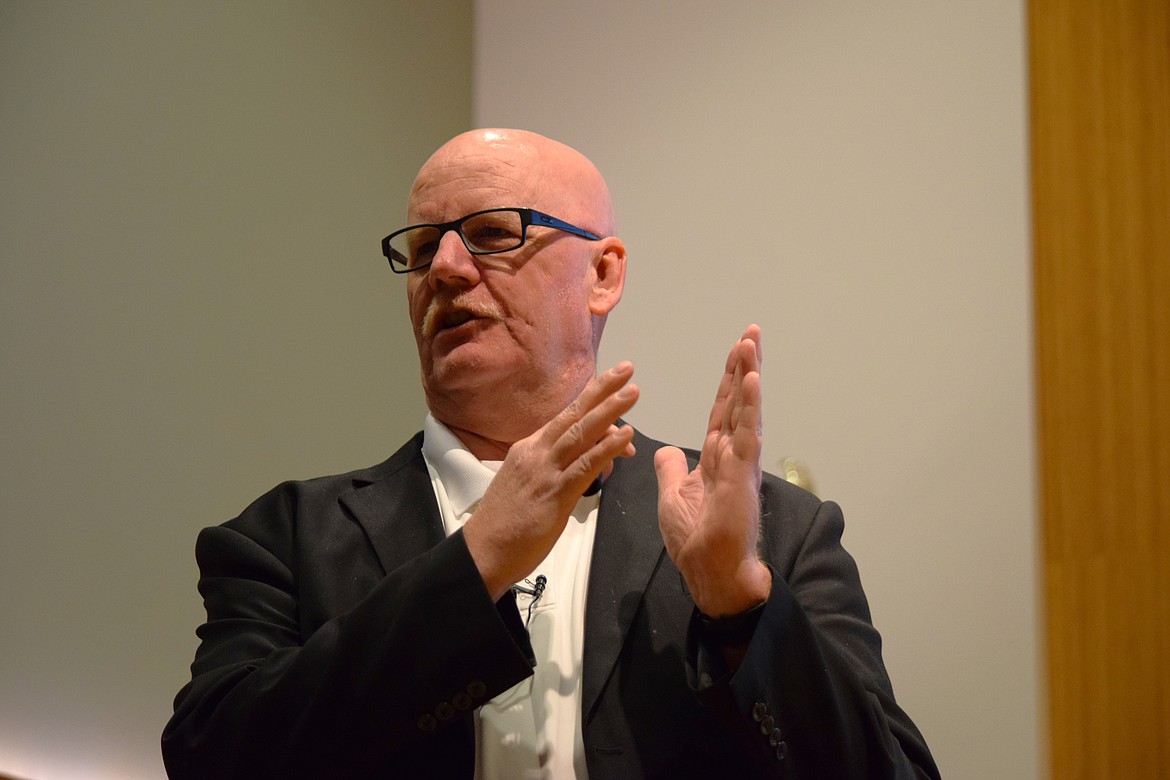
Kirk Holmes, municipal services director for the city of Moses Lake, speaking during the “Save Water, Save Moses Lake” speaker series last Thursday sponsored and organized by the Moses Lake Museum & Art Center.
CHARLES H. FEATHERSTONE/COLUMBIA BASIN HERALD
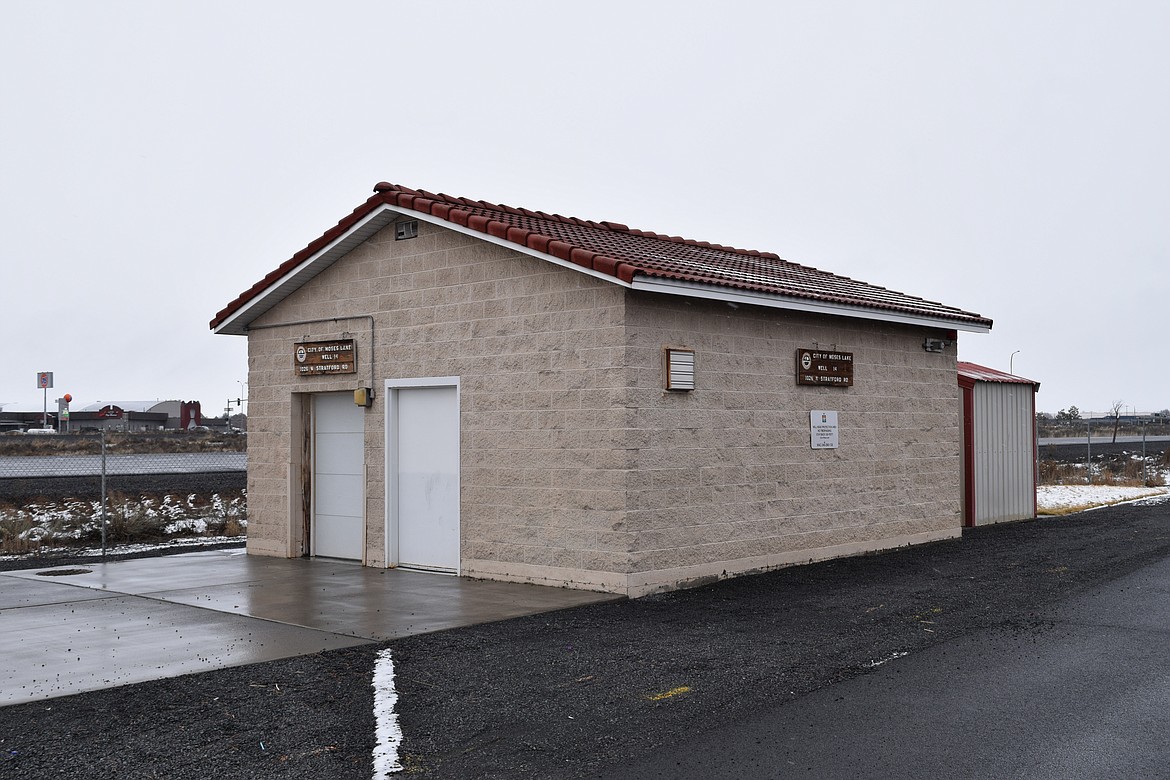
The city of Moses Lake’s Well 14, located at the north side of the parking lot of the Sportsmans Warehouse at 1020 N. Stratford Dr. in Moses Lake.
MOSES LAKE — It’s Moses Lake Municipal Services Director Kirk Holmes’ job to make sure that everyone in Moses Lake has enough water to drink.
Making sure that goal is maintained over the next few years, especially as the city grows and the deep aquifers that provide much of its water slowly decline will take a lot of work.
“I’m not sure that we’ve entered crisis zone quite yet with your water supply,” Holmes said during a presentation in the Moses Lake Civic Center Auditorium last week. “I would say that we are in the concerned zone – in the significantly concerned zone.”
Holmes, who came to Moses Lake roughly a year ago, spoke on Thursday as part of the Moses Lake Museum & Art Center’s “Save Water, Save Moses Lake” speaker series, and gave an overview of the water dilemmas facing the city and his belief that the situation can be dealt with, even that will require time, work and money.
“What I really want to make sure that you understand is that there are solutions,” he said. “You might be sitting there thinking, what’s the problem? We’re surrounded by water. Yeah, we are. But a wise person that works for the city of Moses Lake always reminds me that legal access to water is not uncomplicated.”
“It’s very difficult. It’s very challenging. And that’s where we’re at,” he said.
Depletion of the deep aquifer under the Columbia Basin is not unique to Eastern Washington, Holmes said. Rather, the overuse of groundwater is a problem across the West, from the great plains that sit above the giant Ogallala Aquifer to California’s Central Valley — all of which have been declining as human use, for drinking and for farmland irrigation, has increased since the middle decades of the 20th century.
However, Holmes said the problem underneath the Basin has its own unique features given the way the Columbia Basin Project was sold to prospective settlers looking for irrigated land to farm.
“The whole Grant County area was marketed as a land of milk and honey. Come here, great farmland, lots of water,” he said.
The failure to build the East High Canal and finish the Columbia Basin Project prompted the state of Washington to issue, beginning in the 1960s, what it believed were temporary groundwater permits for irrigation. As more people drilled wells and pumped, Holmes said the level of the deep aquifer dropped, forcing irrigators and cities reliant upon that aquifer, to drill deeper, sometimes down 2,000 feet, where the water gets hot, the quality declines significantly and the amount of energy needed to pump water and maintain adequate pressure increases significantly.
“The deeper we go, the more challenges we have,” he said.
The deepwater aquifers — 1,000 feet down or deeper — are 10,000-12,000 years old, and do not recharge easily or quickly, Holmes said. Currently, the city of Moses Lake has 18 wells drilled into those aquifers. However, pumping rates on six of them are throttled back to ensure they continue pumping water as opposed to air.
Holmes said the city is looking at shallower wells — water pumped from wells less than 300 feet deep — but in the northern part of town, groundwater contamination leftover from the former Larson Air Force Base means that water may not be easily usable. Currently, the U.S. Environmental Protection Agency monitors wells around the former base and is engaged in cleaning up chemicals widely used in the 1950s to clean aircraft that filtered down to the water table.
In other places, that shallow water is fine but needs to have some metals like manganese, nitrates and phosphorus filtered out in order to be acceptable for use as drinking water.
“We have some pesky compounding problems,” he said.
Among the solutions the city is looking at is using water from Moses Lake, as well as treated wastewater, to irrigate lawns and parks, Holmes said. The city is also examining changes to zoning codes that would encourage the planting of less water-intensive lawns and landscaping plants. Holmes said city staff has identified 33 sites — mostly city parks — that could either be irrigated with lake water or relandscaped with more drought-resistant plants.
“The areas we’re looking at, maybe a new landscape type,” he said. “We’re really close to sort of moving forward on a project right now to eliminate all turn grass and go to more of a heritage-type gardening area and use it as a showcase for people to come and see it.”
“I mean, we can make things look nice without having a bunch of turf grass,” Holmes added.
Holmes said he talks about the water situation frequently to civic groups, noting that his goal is not to scare people, but rather make them aware of a situation that needs to be addressed and prompt them to support city officials as they seek to solve the problem.
“This is a real deal. It’s a real issue that we need to address,” he said. “There’s no reason we can’t solve this problem. It’s a little scary, we’ve got some issues identified, we’re moving forward.”
Charles H. Featherstone can be reached at [email protected].
ARTICLES BY CHARLES H. FEATHERSTONE

Potato prices up, sales down for first quarter 2023
DENVER — The value of grocery store potato sales rose 16% during the first three months of 2023 as the total volume of sales fell by 4.4%, according to a press release from PotatoesUSA, the national marketing board representing U.S. potato growers. The dollar value of all categories of U.S. potato products for the first quarter of 2023 was $4.2 billion, up from $3.6 billion for the first three months of 2022. However, the total volume of potato sales fell to 1.77 billion pounds in the first quarter of 2023 compared with 1.85 billion pounds during the same period of 2022, the press release noted. However, total grocery store potato sales for the first quarter of 2023 are still above the 1.74 billion pounds sold during the first three months of 2019 – a year before the outbreak of the COVID-19 pandemic, the press release said.

WSU Lind Dryland Research Station welcomes new director
LIND — Washington State University soil scientist and wheat breeder Mike Pumphrey was a bit dejected as he stood in front of some thin test squares of stunted, somewhat scraggly spring wheat at the university’s Lind Dryland Research Station. “As you can see, the spring wheat is having a pretty tough go of it this year,” he said. “It’s a little discouraging to stand in front of plots that are going to yield maybe about seven bushels per acre. Or something like that.” Barely two inches of rain have fallen at the station since the beginning of March, according to station records. Pumphrey, speaking to a crowd of wheat farmers, researchers, seed company representatives and students during the Lind Dryland Research Station’s annual field day on Thursday, June 15, said years like 2023 are a reminder that dryland farming is a gamble.

Wilson Creek hosts bluegrass gathering
WILSON CREEK — Bluegrass in the Park is set to start today at Wilson Creek City Park. The inaugural event is set to bring music and visitors to one of Grant County’s smallest towns. “I've been listening to bluegrass my whole life,” said the event’s organizer Shirley Billings, whose family band plays on their porch every year for the crowd at the Little Big Show. “My whole family plays bluegrass. And I just wanted to kind of get something for the community going. So I just invited all the people that I know and they’ll come and camp and jam.” ...