
A call answered
JOEL MARTIN | Hagadone News Network | UPDATED 3 years, 6 months AGO

Pastor Floyd Wilks and his wife Sharon Wilks stand in the sanctuary of the Moses Lake First Church of the Nazarene Sunday. The two are retiring after 50 years in ministry.
JOEL MARTIN/COLUMBIA BASIN HERALD
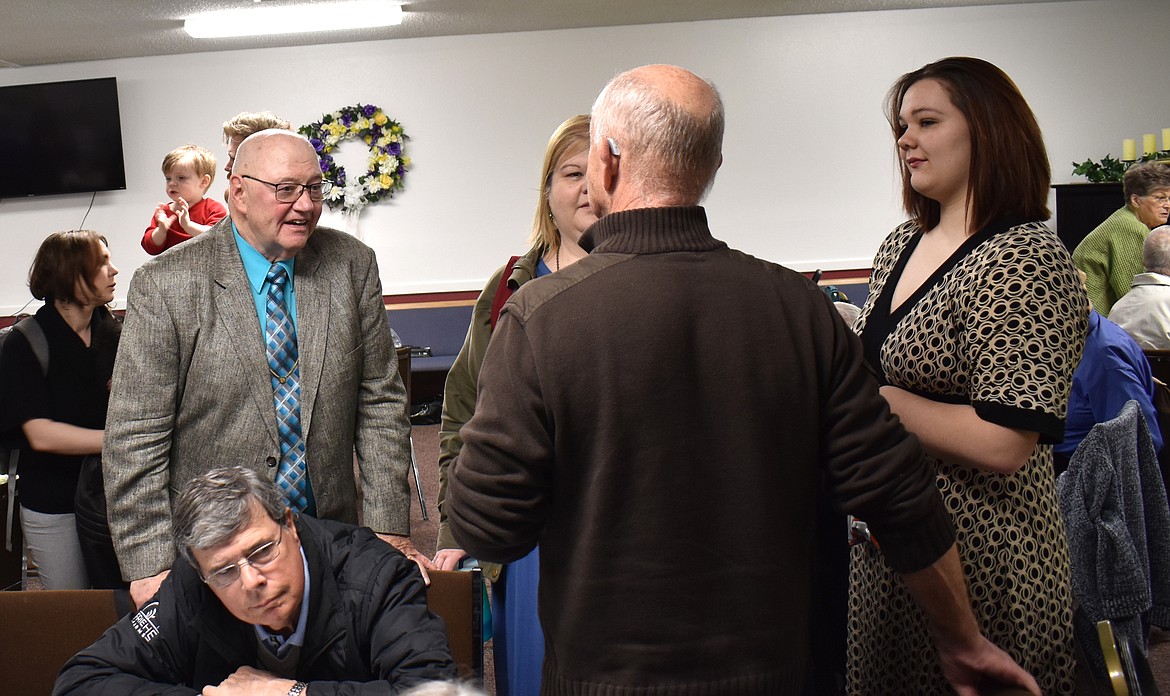
Pastor Floyd Wilks, left, visits with some well-wishers at his retirement celebration Sunday at Moses Lake First Church of the Nazarene.

The Wilkses at their wedding in 1971. The two were called to ministry two years later and have served full-time ever since.
Joel Martin has been with the Columbia Basin Herald for more than 25 years in a variety of roles and is the most-tenured employee in the building. Martin is a married father of eight and enjoys spending time with his children and his wife, Christina. He is passionate about the paper’s mission of informing the people of the Columbia Basin because he knows it is important to record the history of the communities the publication serves. | March 31, 2023 1:30 AM
MOSES LAKE — There’s been a lot of change in American churches in the last 50 years. The Sexual Revolution, the Jesus Movement, megachurches, the end of the Cold War, the Internet, the pandemic – all these things have left their mark. And through it all, Pastor Floyd Wilks has been right there, in his pulpit, ministering.
Wilks, who has been the pastor at Moses Lake First Church of the Nazarene since 1986, officially retired Saturday. The church fellowship hall was packed with church members past and present and other well-wishers in the community to thank Wilks and his wife Sharon Wilks for their many years of service.
“It’s a huge change for us,” Sharon said. “We've not been down this road before.”
“Yeah, this what we've done all of our lives will be different,” Floyd said.
Ministry, both Wilkses said, is very much a team effort between the pastor and his wife.
“If it's not it usually fails,” Sharon said.
“She was called as much as I was to do this,” Floyd said. “I couldn't have done it without her. She has done all the music and office administration, all, my typing.”
Answering the call
The Wilkses met and fell in love as teenagers, at the church both their families attended. They married in 1971, thinking they knew what the rest of their lives would look like. But God had other plans.
“I grew up on a dairy farm,” Floyd said. “My wife and I were going to take over the farm. We were married two years, and then we felt the call to ministry and left all that. It was very hard. But everything that we left was okay. We were blessed, you know? We made the right decision.”
Floyd studied for the ministry by correspondence course through Northwest Nazarene College, the denomination’s college in Nampa, Idaho.
“There was a time when we wanted to move there,” he said. “But it never worked out for us financially. So we just did the best we could. We were married two years on the farm, and then we moved to the city, which was different for me. But the Lord helped us. I give him the credit.”
Shepherding youth
With Floyd freshly ordained, the Wilkses went back to their home church in Spokane to serve in youth ministry.
1973 was an interesting time for young Christians. The strict mores of the 1950s and 1960s were being challenged and new trends were emerging, in the Church of the Nazarene as in many other denominations.
“The dress, the long hair, some of those things were issues with the church, you know,” Floyd said. “We tried to help the kids through that. Outward appearance isn't always what we need to look at.”
The Wilks home was a center of youth activity in their Spokane years, they said.
“We had a lot of retreats,” Floyd said. “In fact, we had a house in Spokane that had a big living room, and those kids would come by after school and camp out there.”
“We went through the popcorn in those days,” Sharon said. “It was cheap filler.”
The impact the Wilkses had on those youth has lasted through the decades, as the Wilkses found out a week before their retirement when a group of their former youth students, now in their 60s, came to services in Moses Lake.
“We didn't even know some of them because we hadn't seen them for 50 years,” she said. “It's amazing.”
“When we were youth pastors, some of those kids were only five or six years younger,” Floyd said.
“We had a traveling choir then of 50 kids, and a lot of them showed up,” Sharon said. “So it was really emotional … They shared that because we helped them they were able to raise Christian children, which was really neat to hear because some of those kids were from unchurched families.”
The Wilkses next spent six years ministering in Heppner, a town of about 1,400 in northeastern Oregon, before coming to Moses Lake in 1986. That calling would keep them here for the next 36 years and beyond.
‘What the Lord’s done’
Full-time ministry is not a vocation for wimps. Only 20% of pastors last a decade in ministry, according to a 2016 study. The hours are long – 55-75 hours a week, according to the same study – and the pay is usually low and sometimes uncertain. It takes a lot of faith and a lot of dedication to stick with it. But God has always come through for them, the Wilkses said.
“I've wished I would have kept some journals and things, “Floyd said. “Kept track of some of the miracles, some of the good things we went through.”
“In the early days in Oregon, I remember one time we gave away all our food to a family that was hurting, in need. And then we didn't have anything,” Sharon said.
“And then we were blessed,” Floyd added.
“Somebody showed up at our door with a turkey and a ham, and our kids started crying,” Sharon said. “But those are long past days.”
The Wilkses raised three daughters in Moses Lake, all of whom have now gone into social work, in areas like hospice and child protection. That’s a kind of ministry too, Floyd said.
He also took on some other roles briefly on top of leading a congregation, he said.
“In the early days I was a police chaplain for a while, and hospital chaplain and hospice chaplain,” he said. “And it got just too much, with the church.”
“He got beat up one night on the police thing, too, and ended up in (the emergency room),” added Sharon.
Floyd did retain one secondary ministry, however. He’s a licensed funeral director and works part-time for Kayser’s Chapel of Memories.
“Two years ago I did 26 funerals,” he said. “That's been part of the ministry, and I feel like I've helped a lot of people. That one year I did 26, and then last year was 22 … We've been here long enough that there are family connections. I've had one family that I've done four, five (funerals) in the family.”
“Floyd is just the nicest man,” said Denise Flinn, who works with him at the funeral home. “Super kind, caring, compassionate. All the families that he's worked with here have nothing but good things to say about him. He’s really amazing.”
Floyd won’t be retiring from funeral work any time soon, he said. But that’s one of the few things not changing. The Wilkses raised their kids in a 900-square-foot parsonage, and then a family willed a 3,000-square-foot house to the church, so they were able to spread out a bit. Now they’re downsizing again. They’ll be staying in town, though. The church hasn’t called a new pastor yet, but an interim pastor is coming to fill in during that often-long process.
“This has been a wonderful church. Great people,” Floyd said.
“We counted, and in the 36 ½ years, we only have five people left that were here when we came.” Some have moved away and others have gone on to heaven, she added.
“What we are, is because of what the Lord's done in our lives,” Floyd said. “And that's who we are … There's been times when things are rough. You think, are we really making a difference? Does it matter what we're doing? And then you hear (that you’ve helped someone) and you know that you made the right choice.”
Joel Martin can be reached via email at [email protected].

ARTICLES BY JOEL MARTIN

Endless battle
Noxious Weed Control Board works to keep invasive plants under control
MOSES LAKE — Some of the nastiest plants in Grant County were the topic of a class led by Jay Johnson, a consultant with the Grant County Noxious Weed Control Board, Tuesday. The Noxious Weed Control Board, as its name would suggest, is tasked with keeping weeds under control in Grant County. That’s not a small job; the board’s website lists 129 species of noxious weeds that are found around Grant County. A noxious weed is defined as an invasive, non-native plant that threatens agricultural crops, local ecosystems or fish and wildlife habitat, according to the Noxious Weed Control Board. Washington state law requires that these weeds be identified and their spread kept to a minimum, if not completely eradicated. “We’re one of those agencies a lot of people don’t really understand,” Johnson said. “We’re a county office and … our funding is tax-based assessment. When you get your tax bill and you look down at all the expenses that you pay for, there we are.”

BASIN EVENTS: Oct. 16-24
COLUMBIA BASIN — Whether you feel like shopping, crafting, learning or seeing a show, there’s something happening for you this week in the Basin. Oct. 16 ‘My Family (Mi Familia)’ screening Spanning three generations, “My Family (Mi Familia)” is a heartfelt drama that follows the Sánchez family as they build their lives in East Los Angeles. Through love, hardship, triumph, and sacrifice, the film explores the immigrant experience, the strength of family bonds, and the traditions that connect one generation to the next. Lowrider show and taco truck before the screening. Sponsored by Columbia Basin Allied Arts, EDUBS C/S and the Moses Lake Creative District. $12 per person. Doors open at 6 p.m., film begins at 7 p.m. at the Moses Lake Civic Center Auditorium, 401 S. Balsam St. Tickets and info: www.cba-arts.org.

Moses Lake author encourages women to look beyond church culture norms
MOSES LAKE — A Moses Lake author’s book, “A Christian Woman Striving to Live Her Faith in a Man-Controlled World,” takes aim at the role to which many churches relegate the female half of their congregations. “It’s to encourage women in the faith,” Linda Curran said. “A lot of churches say, ‘Teach Sunday school, do this, do that, but don’t (evangelize.)’" In her book, Curran recounts a time when she moved to a new community and joined a church there. She was surprised to learn that, as a new female member, she had been automatically assigned church cleaning duties. When she questioned it, she wrote, she was met with condescension and her objections were brushed aside. In other churches, she said, women who were capable of teaching were relegated to “women’s ministry.”