
Royal City talks insurance at council meeting
JOEL MARTIN | Hagadone News Network | UPDATED 3 years, 5 months AGO
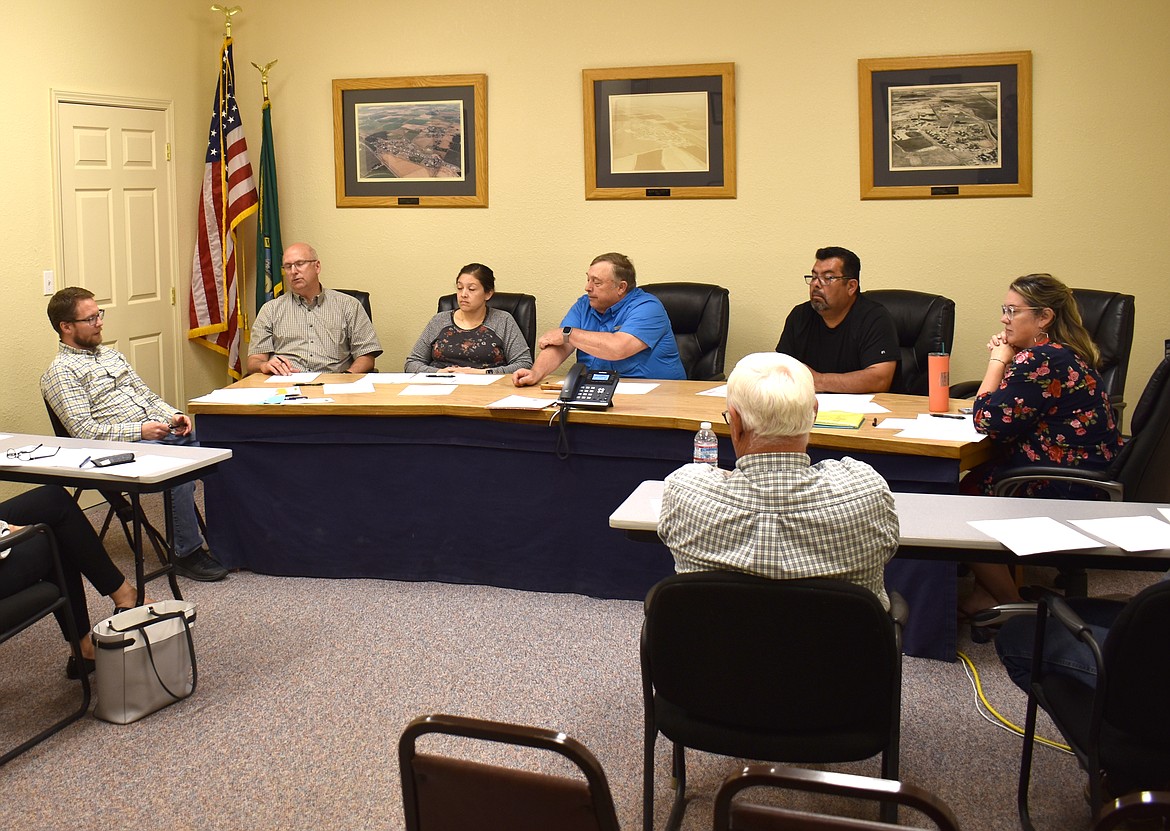
City Finance Director Shilo Christensen discusses insurance options with the Royal City City Council. From left: Shilo Christensen, Council Member Michael Christensen, Council Member Perla Garcia, Mayor Kent Anderson, Council Member Hector Rodriguez and Council Member Tiffany Workinger.
Joel Martin
Joel Martin has been with the Columbia Basin Herald for more than 25 years in a variety of roles and is the most-tenured employee in the building. Martin is a married father of eight and enjoys spending time with his children and his wife, Christina. He is passionate about the paper’s mission of informing the people of the Columbia Basin because he knows it is important to record the history of the communities the publication serves. | May 10, 2023 1:20 AM
ROYAL CITY — Insurance was a significant topic at the Royal City City Council meeting May 2.
The first order of business involved the city’s co-sponsorship agreement with Summerfest. The draft agreement called for Summerfest to indemnify the city in case someone gets hurt at the town’s community celebration, which takes place July 7-8. Summerfest, which operates as a nonprofit corporation, does not currently carry liability insurance because of the cost, council members said.
“The liability piece for the city is, it's an event that you're co-sponsoring, but you're not the ones in charge of the event,” explained City Attorney Katherine Kenison. “Your staff isn't involved in setting up the event, putting the event on, being on site during the event and managing it. So to the extent there was an accident, somebody got injured, you don't have a lot of control over that … if the city is sponsoring the event, then your choices are either have each party remain responsible for its own negligence, in which case, yes, you would want Summerfest to have insurance to back up that indemnity. Or you can agree that the city, in co-sponsoring it, assumes the liability and not require insurance. So obviously (there is) a lot more risk for the city if you don't require anything from Summerfest.”
If the city is willing to increase its exposure in the event of an injury, said Finance Director Shilo Christensen, the council could just strike out the indemnification clause.
“I wouldn't have a problem doing that,” said Council Member Tiffany Workinger. “I know that the bounce houses and that type of stuff, they all carry their own insurance. So if somebody were to hurt themselves on those, those people carry insurance.”
“Well, they do carry insurance,” Kenison said. “But the way that Washington liability laws work … because it's your property, and because you're sponsoring the event, even though the bounce house owner and operator is supposed to have L&I licenses and insurance to cover liability, you're never going to not be named in the lawsuit. Because it's your property, your event.”
“So you're saying the bounce house insurance company is going to go after the city?” asked Workinger. “So in the same conversation, the city's mitigating their liability by holding Summerfest responsible. But wouldn't then whoever is suing still go to the biggest pocket, which is the city? The same way that they're going to override the bounce house insurance, they're going to override Summerfest insurance and put that on the city?”
“Washington (has) joint several liability,” Kenison explained. “If both the city and the bounce house owner are sued, then the plaintiff can collect against either party. So if we were 10% liable, and the bounce house owner was 90% liable, the client can collect 100% from us. And then it's up to us to go after the bounce house owner to the 90%. And if they're under-insured, you're not going to recover that.”
“So really, there's probably no negative from just carrying it ourselves anyway and taking that out,” Mayor Kent Anderson said. “Because we're going to be liable anyway, if something happens.”
“As property owner and co-sponsor, you're going to be named in (a lawsuit),” Kennison replied. “It's just a matter of whose pocket the money is coming out of first.”
The council voted unanimously to remove the indemnification clause.
The question of the city’s insurance pool was raised next. Christensen said the city currently buys its insurance through Cities Insurance Association of Washington, but CIAW’s annual rate has increased significantly, from $132,233.30 in 2022 to $175,485.26 in 2023. Christensen said he had also spoken with representatives from Risk Management Service Agency, which is part of the Association of Washington Cities, and from Washington Cities Insurance Authority. RMSA quoted $122,692 for the year, while WCIA quoted $101,623. WCIA’s coverage also appeared to be better, Christensen added.
“It seemed like (WCIA’s) coverage was even beefier,” he said. “CIAW’s was, I think, $10 million per occurrence, and then WCA was $20 million. They had a lot more ammo.”
“I've worked with all three pools with my different cities over the years and my opinion is that WCIA has provided superior service for their clients consistently over the years,” Kenison said. She explained that CIAW had gone from just insuring cities to insuring other entities like school districts, tribes and homeowners associations.
“They've expanded their pool of clients and so there's a lot more risk,” she said. “I think it's more difficult to manage that risk across that broad spectrum. Because school districts have their own set of statutes, port districts have their own set of statutes, cities have their own set of statutes. So you have to be really good at a lot of things to provide services.”
A final decision won’t have to be made until September, Christensen said.
Joel Martin can be reached via email at [email protected].
ARTICLES BY JOEL MARTIN

Endless battle
Noxious Weed Control Board works to keep invasive plants under control
MOSES LAKE — Some of the nastiest plants in Grant County were the topic of a class led by Jay Johnson, a consultant with the Grant County Noxious Weed Control Board, Tuesday. The Noxious Weed Control Board, as its name would suggest, is tasked with keeping weeds under control in Grant County. That’s not a small job; the board’s website lists 129 species of noxious weeds that are found around Grant County. A noxious weed is defined as an invasive, non-native plant that threatens agricultural crops, local ecosystems or fish and wildlife habitat, according to the Noxious Weed Control Board. Washington state law requires that these weeds be identified and their spread kept to a minimum, if not completely eradicated. “We’re one of those agencies a lot of people don’t really understand,” Johnson said. “We’re a county office and … our funding is tax-based assessment. When you get your tax bill and you look down at all the expenses that you pay for, there we are.”

BASIN EVENTS: Oct. 16-24
COLUMBIA BASIN — Whether you feel like shopping, crafting, learning or seeing a show, there’s something happening for you this week in the Basin. Oct. 16 ‘My Family (Mi Familia)’ screening Spanning three generations, “My Family (Mi Familia)” is a heartfelt drama that follows the Sánchez family as they build their lives in East Los Angeles. Through love, hardship, triumph, and sacrifice, the film explores the immigrant experience, the strength of family bonds, and the traditions that connect one generation to the next. Lowrider show and taco truck before the screening. Sponsored by Columbia Basin Allied Arts, EDUBS C/S and the Moses Lake Creative District. $12 per person. Doors open at 6 p.m., film begins at 7 p.m. at the Moses Lake Civic Center Auditorium, 401 S. Balsam St. Tickets and info: www.cba-arts.org.

Moses Lake author encourages women to look beyond church culture norms
MOSES LAKE — A Moses Lake author’s book, “A Christian Woman Striving to Live Her Faith in a Man-Controlled World,” takes aim at the role to which many churches relegate the female half of their congregations. “It’s to encourage women in the faith,” Linda Curran said. “A lot of churches say, ‘Teach Sunday school, do this, do that, but don’t (evangelize.)’" In her book, Curran recounts a time when she moved to a new community and joined a church there. She was surprised to learn that, as a new female member, she had been automatically assigned church cleaning duties. When she questioned it, she wrote, she was met with condescension and her objections were brushed aside. In other churches, she said, women who were capable of teaching were relegated to “women’s ministry.”