
Built to spec
JOEL MARTIN | Hagadone News Network | UPDATED 3 years, 5 months AGO
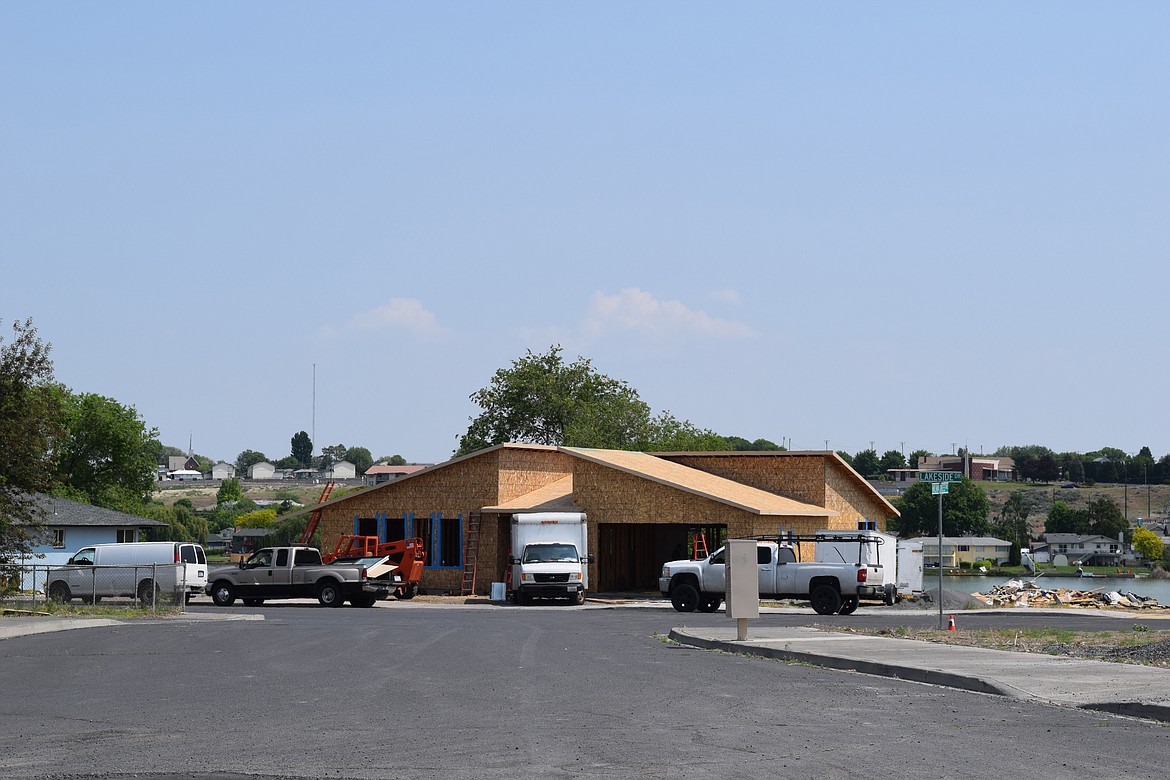
Building a home from scratch, like this one in Moses Lake, is an especially good option during this housing crunch.
R. Hans Miller/Columbia Basin Herald
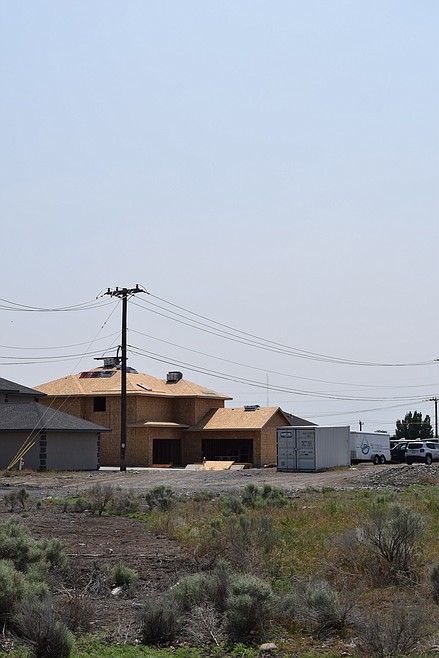
A house under construction in Moses Lake. Home construction loans are a little bit more involved than ordinary mortgages, but they offer flexibility.
Joel Martin has been with the Columbia Basin Herald for more than 25 years in a variety of roles and is the most-tenured employee in the building. Martin is a married father of eight and enjoys spending time with his children and his wife, Christina. He is passionate about the paper’s mission of informing the people of the Columbia Basin because he knows it is important to record the history of the communities the publication serves. | May 19, 2023 1:00 AM
MOSES LAKE — One of the peculiarities of the Columbia Basin is that, even in a housing crunch, we’ve got tons of land waiting to be built on. There’s space for housing, just not the homes themselves.
One solution to that is for would-be homeowners to look into a home construction loan.
“Because of the limited inventory that we're seeing in the existing home market, a construction loan gives (home buyers) the option to build a new home on a lot,” said Terran Brown, a sales manager with Churchill Mortgage, which recently held an online informational seminar in Moses Lake on home construction loans. “Specifically in the Moses Lake area, you have plenty of land, plenty of lots available for a good price where you don't have a ton of existing resale inventory.”
A construction loan is especially appealing to first-time buyers, Brown said, because they may be limited in their ability to come up with the conventional 10% down payment. A construction loan can give them the flexibility to go through a USDA, VA or FHA program that can reduce the necessary money up front.
“And for the folks that are just wanting to upgrade their home – we call those move up buyers – current homeowners who have experienced really good equity growth over the last three years, and they are looking to move up to a new home with a pool and a shop or bigger acreage, whatever the case may be, if they've got access to that equity, we can roll the equity directly into the construction load and help them build a home of their dreams.”
A home construction loan is a little more complex than the typical mortgage, Brown said. Home construction loans typically involve a three-part approval process. First, as with any mortgage, the client has to be approved for the loan, allowing them a given amount of money to shop with. Then the builder needs to be approved as well.
“We, the lender, review the builder’s financials and ensure that they're a reputable builder and that they have a history of performing well in these construction loan transactions,” he explained.
Once the client and the builder are lined up, there’s still the project itself to be approved. The lender will check over the plan specs, the permits and a detailed budget for the home to make sure it’s within feasible parameters. Once that’s done, Brown said, the loan closes and the project can begin.
“At closing, there's typically an initial draw that is issued to the builder to get the construction started or to get permits or whatever's needed,” Brown said. “And then every month, the builder requests another draw to advance to the next phase of construction.”
The lender keeps the builder supplied with the necessary funds to get the home built, Brown said, and the borrower makes monthly payments on the interest – not the principal – until the home is ready.
“But you can actually finance those interest-only payments during construction into the loan amount,” he said. “So you're not making those interest-only payments out of your pocket throughout the transaction. You don't actually make a payment until construction is complete, and you start making your full principal and interest payment after the construction completion.”
“We do the draws, we do all the documents,” said Terrilynn Martin, who runs Churchill’s Moses Lake office. “(The buyers) are involved all the way through and we just kind of the streamline. It's not as complicated because I'll be there to hold your hand throughout.”
Not all construction loans are for brand-new homes, either, Martin explained. Construction loans also can apply to existing homes, for upgrades or to buy and rehabilitate a fixer-upper.
“Let's say you find a house out Stratford and the kitchen is super outdated, (or) it has lots of land and you have an idea that you want a shop,” Martin said. “So you have purchased the home itself. Then you would seek a builder, and you would find out what it would cost to redo the kitchen, add a shop, put in a pool. Then you combine that loan together. But you have to have a bid, just like it was construction, what that would cost to make this home ideal.”
In this scenario, the home would have to be the buyer’s primary residence, Martin added, not something they were buying to flip.
No process is without its pitfalls, however. Home construction loans are by nature document-heavy, Brown said, and buyers sometimes assume that they need to supply less documentation than is actually necessary.
“Another thing to look out for is when looking for a builder, find somebody reputable,” he said. “Don't just Google somebody. You really want to find a reputable builder to ensure that you have a delightful experience and you're getting the home that you're paying for.”
Buyers should also do some research beforehand to make sure the project isn’t going to run into unanticipated snags, Martin said.
“What's the land that you're looking at?” she said. “Is it near wetlands? And I just know that from experience. We did a yurt, where we found out based on the city plans that (the property) was classified (as) wetlands … It could happen that you're too close to the lake because you want a lake view. Now you have (to have) flood insurance, and that's going to change your cost.”
“(It’s important to have) a loan officer and a builder and a realtor on your side, that are there to help you build your dream home,” Brown said. “Because without a great team to support you, it can become very, very overwhelming. It's quite an arduous process. So it's really important to have a good team of experts around you.”
Joel Martin can be reached via email at [email protected].
ARTICLES BY JOEL MARTIN

Endless battle
Noxious Weed Control Board works to keep invasive plants under control
MOSES LAKE — Some of the nastiest plants in Grant County were the topic of a class led by Jay Johnson, a consultant with the Grant County Noxious Weed Control Board, Tuesday. The Noxious Weed Control Board, as its name would suggest, is tasked with keeping weeds under control in Grant County. That’s not a small job; the board’s website lists 129 species of noxious weeds that are found around Grant County. A noxious weed is defined as an invasive, non-native plant that threatens agricultural crops, local ecosystems or fish and wildlife habitat, according to the Noxious Weed Control Board. Washington state law requires that these weeds be identified and their spread kept to a minimum, if not completely eradicated. “We’re one of those agencies a lot of people don’t really understand,” Johnson said. “We’re a county office and … our funding is tax-based assessment. When you get your tax bill and you look down at all the expenses that you pay for, there we are.”

BASIN EVENTS: Oct. 16-24
COLUMBIA BASIN — Whether you feel like shopping, crafting, learning or seeing a show, there’s something happening for you this week in the Basin. Oct. 16 ‘My Family (Mi Familia)’ screening Spanning three generations, “My Family (Mi Familia)” is a heartfelt drama that follows the Sánchez family as they build their lives in East Los Angeles. Through love, hardship, triumph, and sacrifice, the film explores the immigrant experience, the strength of family bonds, and the traditions that connect one generation to the next. Lowrider show and taco truck before the screening. Sponsored by Columbia Basin Allied Arts, EDUBS C/S and the Moses Lake Creative District. $12 per person. Doors open at 6 p.m., film begins at 7 p.m. at the Moses Lake Civic Center Auditorium, 401 S. Balsam St. Tickets and info: www.cba-arts.org.

Moses Lake author encourages women to look beyond church culture norms
MOSES LAKE — A Moses Lake author’s book, “A Christian Woman Striving to Live Her Faith in a Man-Controlled World,” takes aim at the role to which many churches relegate the female half of their congregations. “It’s to encourage women in the faith,” Linda Curran said. “A lot of churches say, ‘Teach Sunday school, do this, do that, but don’t (evangelize.)’" In her book, Curran recounts a time when she moved to a new community and joined a church there. She was surprised to learn that, as a new female member, she had been automatically assigned church cleaning duties. When she questioned it, she wrote, she was met with condescension and her objections were brushed aside. In other churches, she said, women who were capable of teaching were relegated to “women’s ministry.”