
Pretend poverty, real struggles
JOSA SNOW | Hagadone News Network | UPDATED 2 years, 7 months AGO
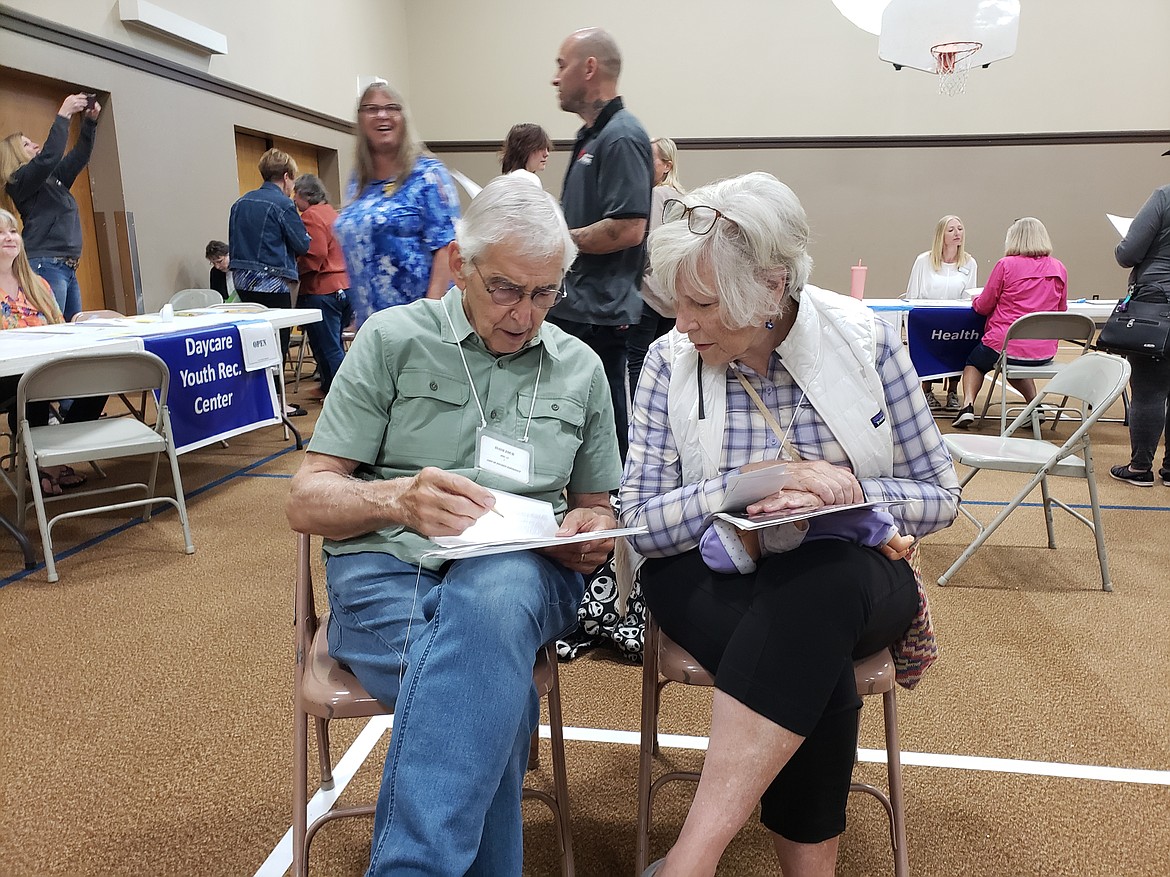
George and Kathleen Sayler struggle to map out a plan to make ends meet during a poverty simulation game by the Community Action Partnership Tuesday. The Cost of Poverty Experience is a training tool where participants learn to empathize with people living below the poverty line where daily struggles can become a stressful crisis.
JOSA SNOW/Press
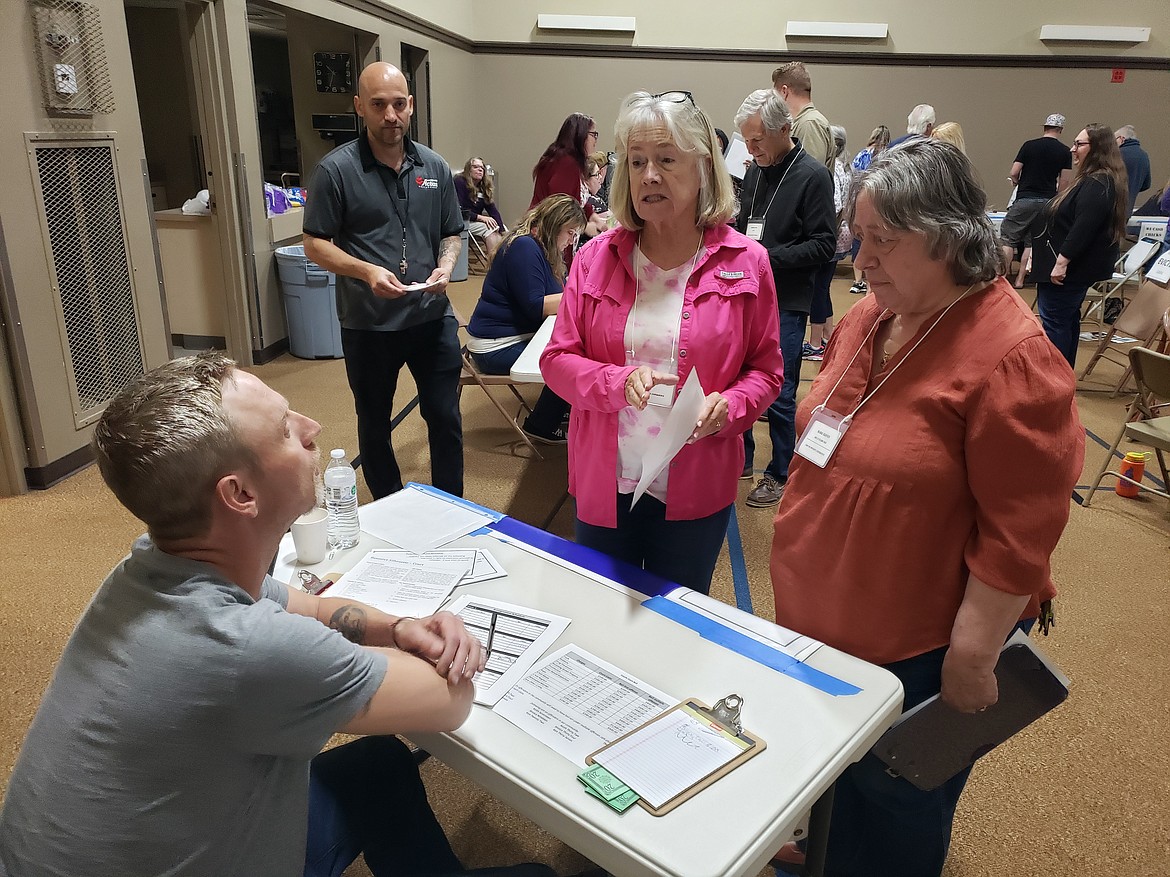
Karen Grace, center, tries to negotiate with the "judge" Tuesday in a Cost of Poverty Experience at First Presbyterian Church in Coeur d'Alene. During the simulation, Grace "went to jail" for not having enough money.
George and Kathleen Sayler were stressed out.
The couple struggled at every step Tuesday during the Cost of Poverty Experience, a simulation organized by the Community Action Partnership at the First Presbyterian Church in Coeur d’Alene.
“We have not figured out the system,” Kathleen told George after the first round of the simulation.
The Cost of Poverty experiment is a hectic game that simulates what people in poverty go through while trying to navigate the complex system of community services and life situations.
The Saylers were assigned a struggling-family scenario, including an infant, and had to work to get life back on track. They and the roughly 60 other participants had four 15-minute rounds, representing each week of the month. By the end of the "month," they had to acquire needed services, pay bills, make sure they had food, check in at work, ensure the kids went to school and otherwise try to maintain order in their lives.
The first thing the Saylers thought they should do was have Kathleen pursue a job at the “minimum wage employer” table.
“You can’t bring your baby to work,” she was told.
Kathleen spent a few minutes filling out an application at the "day care" table. She tried to drop off the faux infant, but didn’t have enough money to pay. By the time she finished the application at the community services table, the day care was closed and, soon, the round ended. Kathleen missed her first week of work and still had to figure out what to do with George and the baby.
The goal of the simulation was for people to understand the challenges of making ends meet.
Each "family" started with a set of circumstances and resources in a folder. Parameters included money, assets, prescription requirements and goals. They had to get through the month by visiting different service tables. School took a few minutes and a full-time job used six of the 15 minutes.
Everything took time, which quickly ran out.
Some family members were enrolled in community college, but most of them dropped out of school by the fourth week to save time and pay bills or buy food.
A "police officer" roamed the room, serving warrants and looking for delinquent children. Kids had to be in school. Some participants had to report to probation officers or judges.
According to the U.S. Census Bureau data, 9.5% of people in Kootenai County live below the poverty line.
“What I’ve learned is there’s all kinds of help if you know the system,” Kathleen Sayler said. “One thing that would be so helpful would be a list of what you have to do — and in what order.”
Poverty simulation participants didn’t know the system until they started going through it: No families had the same needs.
In the simulation, 15 families represented common types of families who enter poverty; single parents, veterans, people with mental health challenges, ex-offenders, people struggling with addiction, immigrants, people with elderly dependents and more.
In week three, the Saylers received a card from one of the administrators.
“You’ve had a mental breakdown,” it read.
“I’m thinking of giving up,” Kathleen said. “We might have to just give everything up.”
In real life, the couple are retired teachers and George is a former Idaho state representative. They attended the Cost of Poverty Experience simulation to understand what people are up against when they experience poverty.
In this game, the Saylers felt overwhelmed.
And the stakes were not even real.
Another participant struggled with the strict policies at each service table. She surprised herself when she got frustrated and irritable when the volunteers had to turn her away.
Volunteers running the community service tables generally tried to be helpful, but had rules to follow. They often referred families to where they could get checks cashed or apply for aid, but the information wasn’t always accurate and could kill more time.
By the end of the month, people were frantic, frustrated, stressed out and sometimes angry.
The Cost of Poverty experiment was open to anyone. Most participants were in the community services field. Many were paid to attend as a form of job training.
The goal of the simulation was to foster empathy for people in poverty and to promote more awareness among people in community services.
“How many of you paid all your bills at the end of the month?” family coach Jamie Kearney asked during the debrief at the end of the simulation.
Nearly no one raised their hands.
“How many of you were evicted for not paying rent?” Kearney asked.
Roughly a third of the participants were evicted from their chairs, their seats were folded up and a sign saying “EVICTED” was taped to their chairs.
“It’s kind of stressful,” said Mary Wolfinger, who managed the helpful homeless shelter, a service table that offered housing, but with strict rules and a curfew that could waste precious time. “It feels bad, having to turn people away.”
Even the volunteers were challenged by the exercises. The judge was lenient toward mental health victims, but still had to strictly enforce the law when people couldn’t get their "medications" on time.
“We’re working on survival right now,” Kearney said. “And people in poverty are living in crisis.”
Many participants made decisions that surprised even themselves. One family left a mother and daughter in jail while the father tried to pay rent, go to work and make bail.
They were evicted.
Many kids missed school while parents struggled to get kids to medical appointments with no access to vehicles.
“I watched how poverty affected people going to school,” said a volunteer at the day care table, where attendance dropped as the weeks went on.
Beyond the chaos of the hour, a silver lining could be seen.
Services are available, Kearney said.
Love Inc., Family Promise, St. Vincent de Paul North Idaho and other community agencies offer different types of assistance. People from those groups attended the simulation, hoping to learn how to be more effective as they help people struggling below the poverty line.
ARTICLES BY JOSA SNOW

Away in a manger in Stateline
Star of wonder leads community to Speedway's Bethlehem
The wintry weather didn’t stop a handful of volunteers from putting together the fifth annual Night in Bethlehem Saturday, a reenactment of the night Jesus was born, which will also take place from 4:30 - 6:30 p.m. Dec. 10, and Dec. 16-17.

Bench project could incorporate recycled wind turbines
Hayden's Come Together bench program may take new direction
Hayden’s coming together bench program is taking on a new shape after the arts commission heard a presentation from Canvus Wednesday.

Hayden hosts open house on HURA district
City Council could vote to expand
Hayden’s Urban Renewal Agency could expand its district in the near future, depending on feedback from an open house at Hayden City Hall Tuesday.