
Public input sought for Community Wildfire Protection Plan
KRISTI NIEMEYER | Hagadone News Network | UPDATED 2 years, 11 months AGO
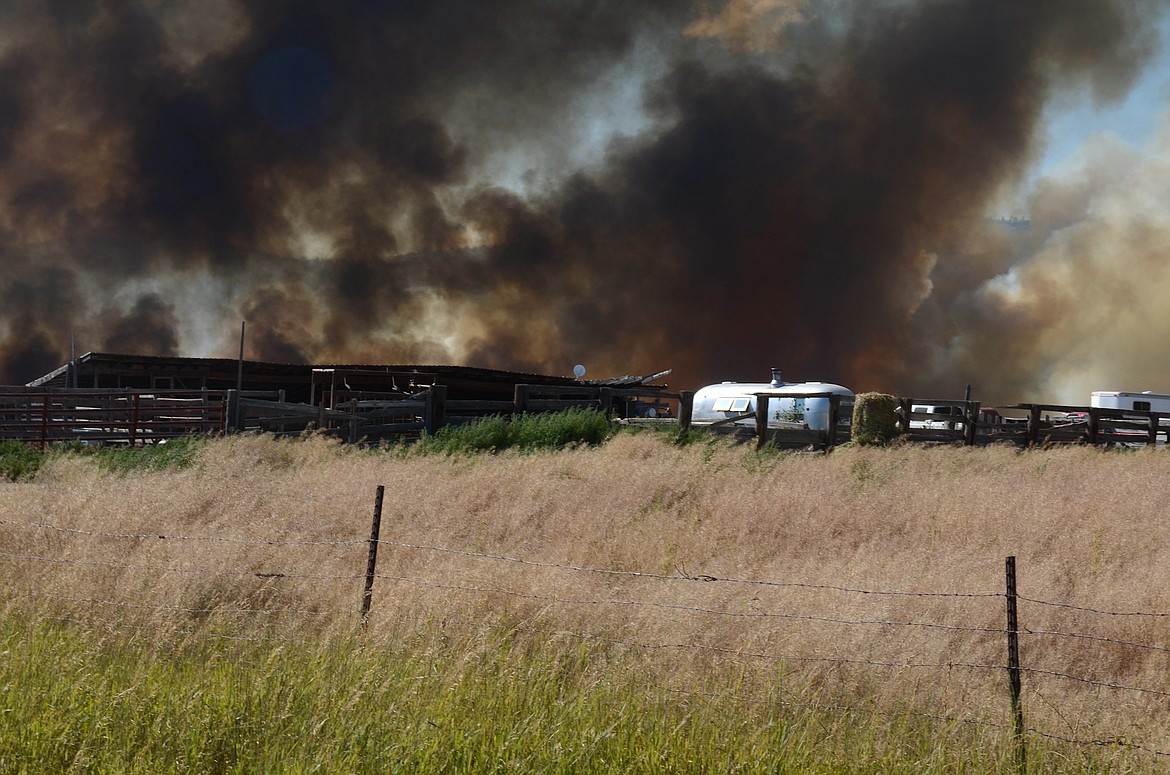
The Middle Ridge Fire jumped the Flathead River north of Sloans Bridge and boiled across a field near Round Butte Road Sunday afternoon, fueled by low humidity and gusty winds. (Kristi Niemeyer/Leader)
Kristi Niemeyer learned her newspaper licks at weekly newspapers, beginning at the Mission Valley News in 1981, then at the helm of the Ronan Pioneer and, eventually, as co-editor of the Lake County Leader until 1993. She launched and co-published Lively Times, a statewide arts and entertainment monthly, before returning to the Leader in 2022, and serving as its editor until July 2026. Reach her at [email protected] | November 2, 2023 12:00 AM
Lake County is in the process of updating its Community Wildfire Protection Plan (CWPP) – a document that helps identify and address the local threats of wildfire. After a summer when four large fires threatened homes and communities across the county, the undertaking seems more relevant than ever.
Developing these plans became a national standard of practice in 2003 under the Healthy Forests Restoration Act. Lake County’s current plan was adopted in 2005. However, the Department of Natural Resources and Conservation encourages communities to update wildfire plans every five years to account for changes such as housing developments, fuel treatments, wildfire behavior and new data.
According to a press release from Carey Cooley, Lake County Fire Mitigation Coordinator,
“In the last 18 years, many changes have occurred across the county, including the construction of new homes and infrastructure within wildfire risk areas. These changes can affect the way a community copes with fire and have prompted the need to update the CWPP.”
Most wildfires in Montana are caused by accidental human ignition, Coolidge writes, and CWPPs have proven to be helpful tools in preventing human-caused blazes.
Updating the plan is a collaborative endeavor involving Lake County, local fire departments, the Montana DNRC, and the Confederated Salish and Kootenai Tribes.
One critical step is community involvement. To that end Lake County will host a meeting and open house, 6-8 p.m. Nov. 8 at the Ronan Community Center. The meeting offers a presentation, Q&A, and information stations. Input may also be submitted online at htp://bit.ly/LakeCountyCWPP.
Although the plan isn’t legally binding, it can help elected officials make policy decisions. It’s also intended to inspire collaborative efforts between residents and homeowners’ associations, fire protection districts, and government and business entities to make their communities safer from wildfire.
One key to the success of a CWPP is addressing the Wildland Urban Interface – that area where wildland fuels meet development, such as homes, businesses and infrastructure. According to the press release, “Targeting these areas for fire risk reduction projects is likely to have the greatest effect in protecting residents’ homes, livelihoods and valued natural resources. “
The updated plan will also include maps and statistics related to wildfire risk; recommendations on how to reduce risk for individual homeowners and communities; and priority fuel reduction projects that are eligible for funding.
The draft CWPP update will be available in January for public review, with the final plan due in March. For more information, email Cooley at [email protected] or call 406-872-2335.
ARTICLES BY KRISTI NIEMEYER

Polson Farmers Market takes break after productive season
“My body’s ready for a break, but it’s been a good year,” said Eric Gedenk between sales at the Ploughshare Farm stand. The organic farm in Moiese is a regular vendor at the Polson Farmers Market, which wrapped up for the season last Friday morning.

The Ripple Effect: Poolside party raises more than $20,000 for aquatic center
The Ripple Effect, a fundraiser for Mission Valley Aquatics and Fitness in Polson, drew nearly 200 supporters to the poolside Saturday night for games, drinks, appetizers and auctions.

Incumbent Shelly Fyant faces Republican Charles Headley in HD 91 race
Incumbent Democrat Shelly Fyant is running for a second term in the House of Representatives against Charles Headley.