
About 1,000 non-native rainbow trout removed from Gunsight Lake
CHRIS PETERSON | Hagadone News Network | UPDATED 2 years, 10 months AGO
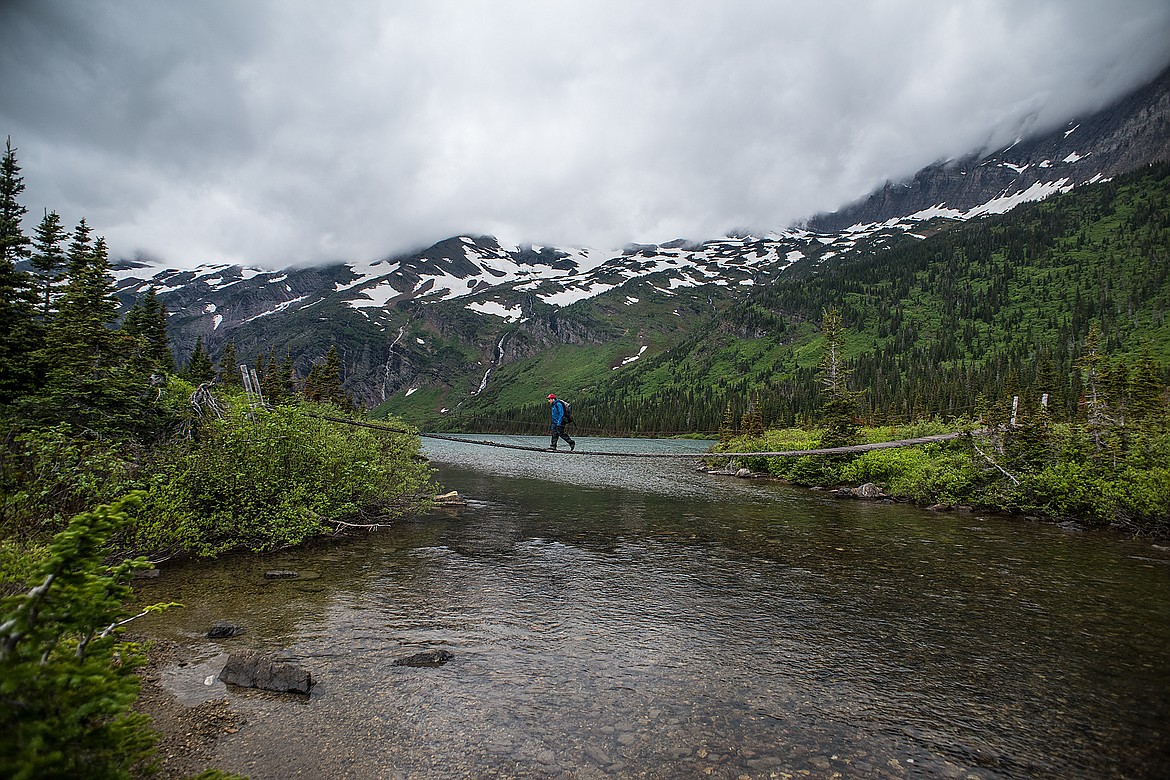
A hiker crosses the suspension bridge at Gunsight Lake.
Chris Peterson is the editor of the Hungry Horse News. He covers Columbia Falls, the Canyon, Glacier National Park and the Bob Marshall Wilderness. All told, about 4 million acres of the best parts of the planet. He can be reached at [email protected] or 406-892-2151. | November 8, 2023 1:00 AM
The effort to restore native trout in Glacier National Park’s high country lakes continued this fall after biologists removed roughly 1,000 non-native rainbow trout from Gunsight Lake, just below the Continental Divide on the east side of the park.
The lake was treated with the piscicide Rotenone which kills the fish, but does no harm to other wildlife.
Park and U.S. Geological Survey biologists will now stock the lake with lake whitefish, bull trout and westslope cutthroat trout over the coming years, raised from native stocks in other lakes and streams on the east side of the park.
It’s a continuing effort by the park to bolster and restore native fish stocks in lakes and streams inside the park.
For the past 15 years or so Glacier has been trying to expunge non-native fish from select waters. The biggest problem has been non-native lake trout on the west side. The trout migrate up from Flathead Lake where they were introduced in the early 1900s and slowly, but surely, have invaded many of Glacier’s west side lakes.
Glacier has taken to manually netting lake trout in lakes like Quartz and Logging over the past several years.
Once lake trout get established in a lake, they outcompete and just plain old eat the native bull trout. USGS biologist Vin D’Aneglo, at a recent talk at the Montana Lakes Conference noted that recent studies found that where lake and bull trout are in the same lake, bull trout can make up as much as 14% of a lake trout’s diet.
Both are predators but lake trout simply bull the bull trout over.
The process can be a slow one, but in eight lakes west of the divide, bull trout are considered functionally extinct.
The netting projects have paid off, D’Angelo noted. Biologists have been successful in targeting lake trout in Quartz and bull trout numbers have rebounded. Biologists had tracked lake trout to their spawning sites at avalanche chutes where they’re easier to net. They then kill the fish and their carcasses are sunk to the bottom.
In Logging Lake the netting is also working. Biologists haven’t been netting there as long, but this year the first redds — bull trout spawning beds, reappeared in upper Logging Creek.
Todate, biologist have removed more than 5,600 lake trout from Logging Lake.
Unlike lake trout, bull trout spawn in streams.
Another tactic that’s proven successful is simply moving bull trout. Biologists moved fish a few years ago to Grace Lake, where they are now the apex predator, munching on non-native Yellowstone cutthroat trout.
Grace Lake is protected from a lake trout invasion by a natural waterfall onLogging Creek, which drains it.
The Gunsight project is similar. That lake is also protected by a natural waterfall which keeps non native species from invading it because they can’t get past the barrier. Gunsight is drained by the St. Mary River, which has multiple waterfalls.
Sometimes biologists put in manmade barriers. Akokola Lake, which has a small population of bull trout, is protected by a waterfall biologists built from rock and timbers to keep non-native lake trout from invading it, D’Angelo noted.
ARTICLES BY CHRIS PETERSON
Grizzly sow with cub had dead whitetail cached nearby when attack occurred
Montana Fish Wildlife and Parks released more details on a bear attack in the Cedar Flats area on Aug. 31, noting it was a grizzly sow with a cub and there was a cached whitetail deer carcass about 100 yards off the trail near the incident.
Study: When a bear fights a dog, women more likely than men to step in
People walking their dogs in bear country shouldn’t rely on Fido to be an early warning system or come to their aid in an attack, a new study suggests.
Enjoy huckleberries? Thank a bumblebee
If you’ve ever savored a huckleberry, you can probably thank a bumblebee for it. Turns out hucks are one of the favorite plants to pollinate, as they provide an early spring food for bees, according to recent research by the U.S. Geological Survey.