
'Holy grail': Enhancement process could make EVs more efficient, practical
JOEL MARTIN | Hagadone News Network | UPDATED 2 years, 11 months AGO
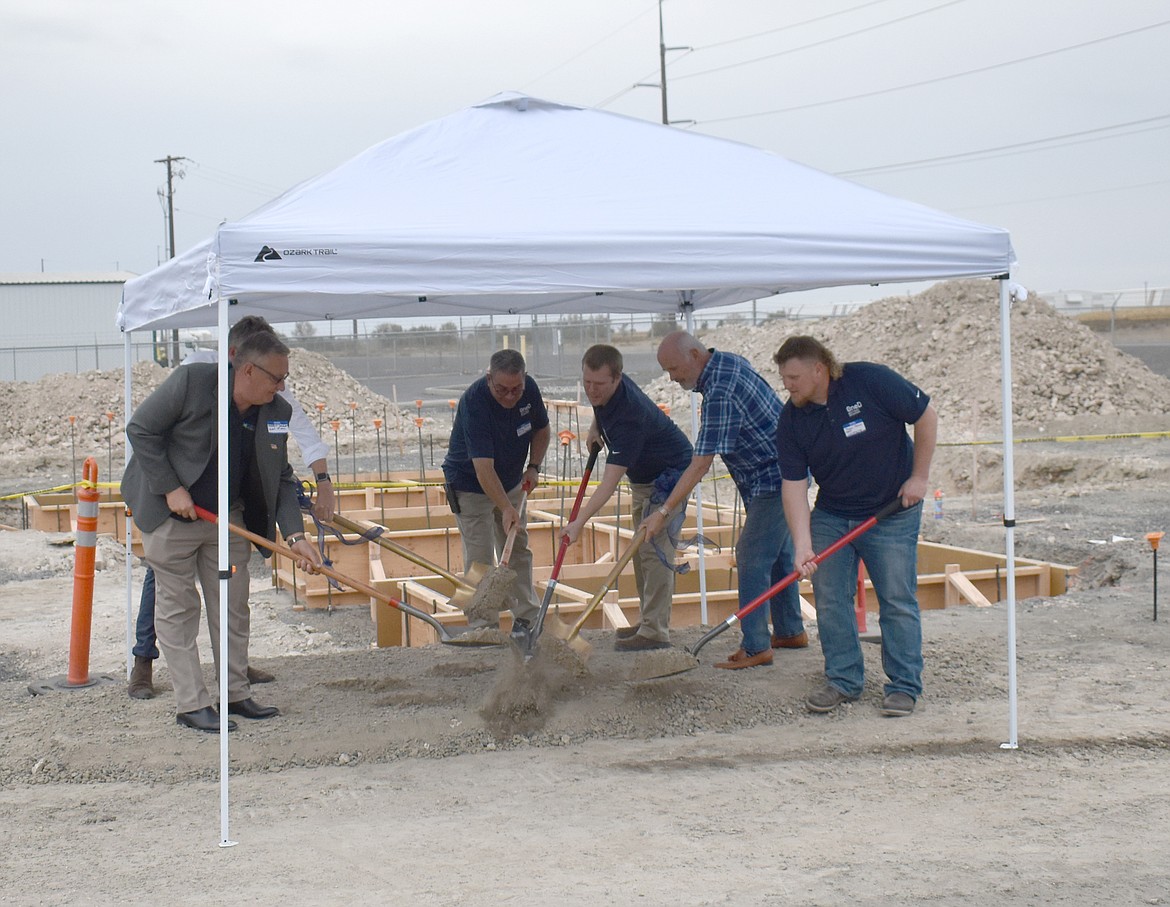
Dirt flies at the groundbreaking Oct. 9 for OneD Battery Sciences’ silane offloading station, part of the company’s new Moses Lake facility. OneD Battery Sciences uses silicon to increase battery efficiency and affordability for electric vehicles, according to company officials. From left: Port of Moses Lake Commissioner Darrin Jackson, On D Chief Operations Officer Jan Marc Luchies (partially hidden behind Jackson), OneD Operations Engineer Rufino Garza, OneD Moses Lake Site Manager Nick Kamerath, Moses Lake City Council Member David Eck and OneD Construction Manager Tyson Olson.
Joel Martin/Basin Business Journal
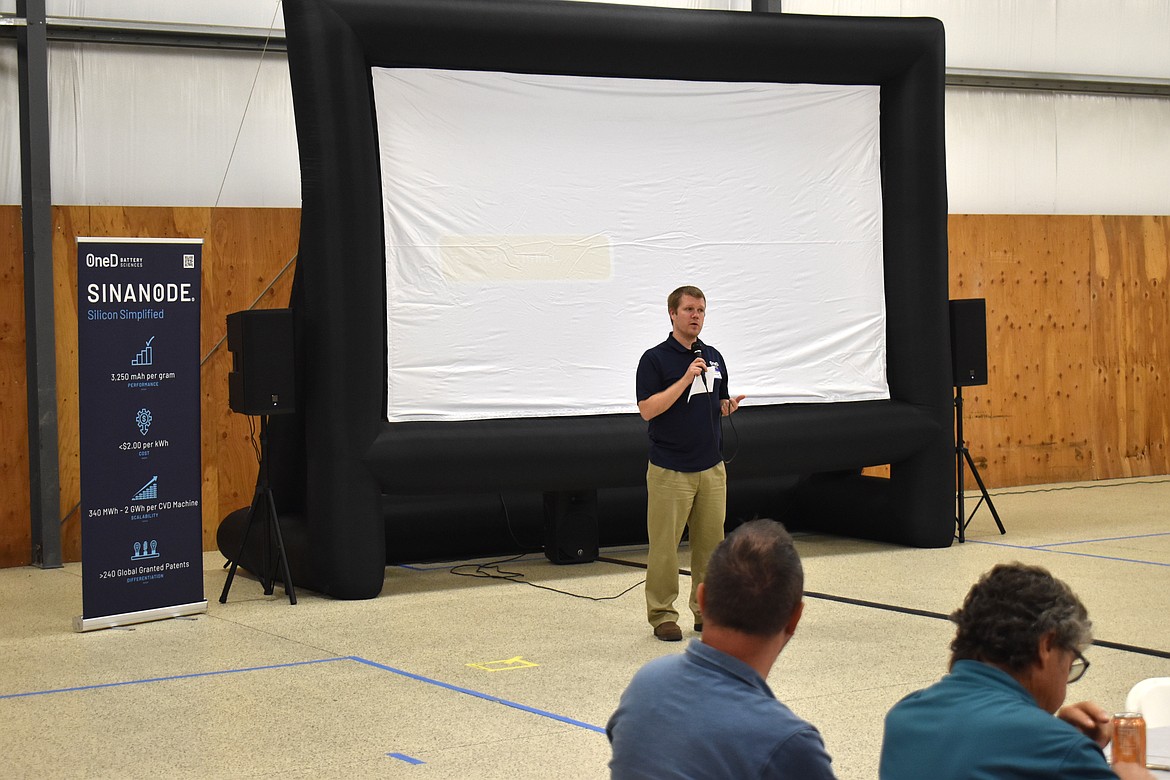
OneD Battery Sciences Moses Lake Site Manager Nick Kamerath addresses the audience at OneD’s groundbreaking Oct. 9.
Joel Martin/Basin Business Journal
Joel Martin has been with the Columbia Basin Herald for more than 25 years in a variety of roles and is the most-tenured employee in the building. Martin is a married father of eight and enjoys spending time with his children and his wife, Christina. He is passionate about the paper’s mission of informing the people of the Columbia Basin because he knows it is important to record the history of the communities the publication serves. | November 14, 2023 1:00 AM
MOSES LAKE — Americans like to drive. What Americans don’t like is the cost of filling their gas tank. In recent years, electric vehicles, powered with a rechargeable battery, have been presented as a possible solution. It would seem a match made in heaven for the Inland Northwest; Washington has the second-highest gasoline prices and the third-highest diesel prices in the country, according to the American Automobile Association, and according to the Bureau of Labor Statistics, eastern Washington enjoys some of the lowest electricity costs. Problem solved, right?
Well, no. The lithium-ion batteries that power EVs are expensive to manufacture, and thus expensive for the consumer. They can only go so long between charges, and the charging process can take hours in between drives. What’s needed, then, is a battery that lasts longer and charges faster.
“Our goal is very simple,” said Vincent Pluvinage, CEO of OneD Battery Sciences, which broke ground on a plant in Moses Lake Oct. 9. “We want to enable competitive, affordable EVs … In order to compete, one must manufacture affordable EVs, that have a lower price and therefore a lower-cost battery, but also a longer range and faster charging.”
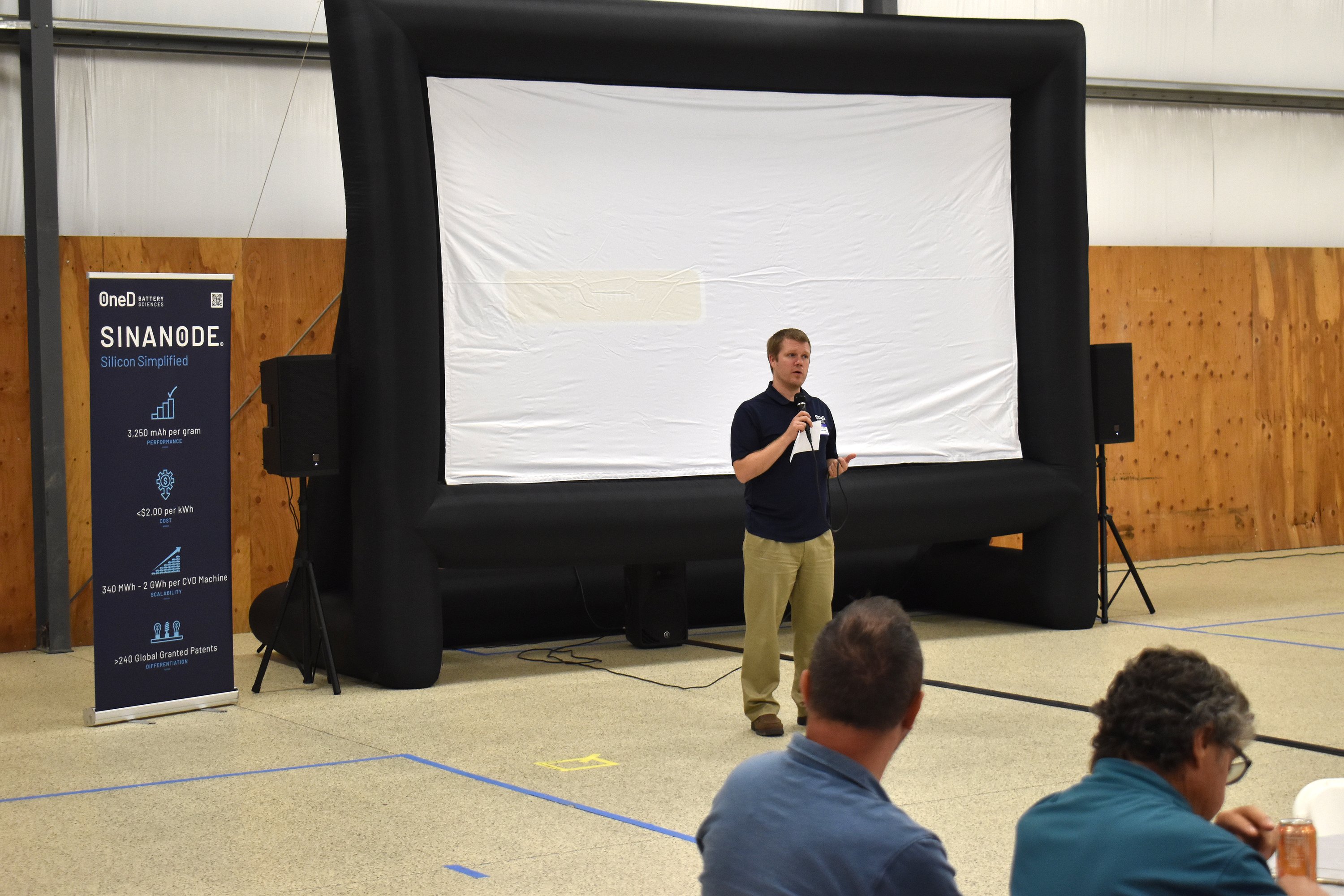 OneD Battery Sciences Moses Lake Site Manager Nick Kamerath addresses the audience at OneD’s groundbreaking Oct. 9.
Joel Martin/Basin Business Journal
The key lies in the structure of a battery. A lithium-ion battery consists of a cathode, which is the positive pole, and an anode, which is the negative, with a separator between them. The cathode is made of lithium in combination with various other metals, and the anode is usually made of graphite, a form of carbon. A charge is created by lithium ions moving from the anode to the cathode; the battery is recharged by reversing the process and moving ions back into the anode, according to an article by the U.S. Department of Energy. The battery’s capacity is thus determined by how much the graphite can store.
OneD’s solution is to enhance the graphite with silicon, which has much higher capacity, said OneD Chief Operating Officer Jan-Marc Luchies.
“That is the holy grail, because the storage capacity of silicon is 10 times better than graphite,” Luchies said. “If you add 10% of silicon to the graphite, then you double the capacity of the graphite. Suddenly, you need half the amount of graphite. And on top of that, you’re able to more easily store electricity in the cell, provided that your cathodes can support that. As a result, the batteries can be of a higher capacity.”
Some other companies are working on ways to replace the graphite with silicon altogether, Luchies said, but since batteries using graphite have been in large-scale production for 40 years, it makes economic sense to improve the existing materials rather than reinvent the wheel. It also made economic sense to locate OneD’s facility in Moses Lake, because it’s just down the road from the REC Silicon plant, which is in the process of restarting production after several years’ hiatus.
OneD calls its process Sinanode, a portmanteau word combining “silicon,” “nano” and “anode. It involves inserting nanowires – strands about 1/1000 the width of a human hair – made of silicon into the minute pores of the graphite, according to its website. The structure, a string rather than a round particle, gives the silicon better stability and lets it attach more effectively.
OneD’s plan is to enhance enough batteries to convince a vehicle manufacturer– in the U.S., OneD is working with General Motors – that OneD’s technology is both efficient and safe and can be produced on the massive scale that a major automaker requires, Luchies said. Once that’s done, OneD can either go into production itself or license the Sinanode process to other manufacturers.
“The Moses Lake branch will basically show two things, two objectives,” he said. “One is, we show these carmakers sufficient material that they can qualify the cells because they want to, of course, not have a burning car at a certain moment. So they want to have sufficient material to test not two cells or 10, or maybe 50 that you can easily do out of R&D, but thousands of cells they need, maybe even battery packs where you need 10,000 or maybe 100,000 cells.”
The Moses Lake plant is expected to begin production in the first half of 2024, according to Construction Manager Tyson Olson.
“We live in a world where efficiency is key, doing more with less,” Pluvinage said. “Efficiency means using a process that increases performance and reduces cost.”
ARTICLES BY JOEL MARTIN

Endless battle
Noxious Weed Control Board works to keep invasive plants under control
MOSES LAKE — Some of the nastiest plants in Grant County were the topic of a class led by Jay Johnson, a consultant with the Grant County Noxious Weed Control Board, Tuesday. The Noxious Weed Control Board, as its name would suggest, is tasked with keeping weeds under control in Grant County. That’s not a small job; the board’s website lists 129 species of noxious weeds that are found around Grant County. A noxious weed is defined as an invasive, non-native plant that threatens agricultural crops, local ecosystems or fish and wildlife habitat, according to the Noxious Weed Control Board. Washington state law requires that these weeds be identified and their spread kept to a minimum, if not completely eradicated. “We’re one of those agencies a lot of people don’t really understand,” Johnson said. “We’re a county office and … our funding is tax-based assessment. When you get your tax bill and you look down at all the expenses that you pay for, there we are.”

BASIN EVENTS: Oct. 16-24
COLUMBIA BASIN — Whether you feel like shopping, crafting, learning or seeing a show, there’s something happening for you this week in the Basin. Oct. 16 ‘My Family (Mi Familia)’ screening Spanning three generations, “My Family (Mi Familia)” is a heartfelt drama that follows the Sánchez family as they build their lives in East Los Angeles. Through love, hardship, triumph, and sacrifice, the film explores the immigrant experience, the strength of family bonds, and the traditions that connect one generation to the next. Lowrider show and taco truck before the screening. Sponsored by Columbia Basin Allied Arts, EDUBS C/S and the Moses Lake Creative District. $12 per person. Doors open at 6 p.m., film begins at 7 p.m. at the Moses Lake Civic Center Auditorium, 401 S. Balsam St. Tickets and info: www.cba-arts.org.

Moses Lake author encourages women to look beyond church culture norms
MOSES LAKE — A Moses Lake author’s book, “A Christian Woman Striving to Live Her Faith in a Man-Controlled World,” takes aim at the role to which many churches relegate the female half of their congregations. “It’s to encourage women in the faith,” Linda Curran said. “A lot of churches say, ‘Teach Sunday school, do this, do that, but don’t (evangelize.)’" In her book, Curran recounts a time when she moved to a new community and joined a church there. She was surprised to learn that, as a new female member, she had been automatically assigned church cleaning duties. When she questioned it, she wrote, she was met with condescension and her objections were brushed aside. In other churches, she said, women who were capable of teaching were relegated to “women’s ministry.”