
State grant to fund Stratford overpass safety study
JOEL MARTIN | Hagadone News Network | UPDATED 2 years, 11 months AGO
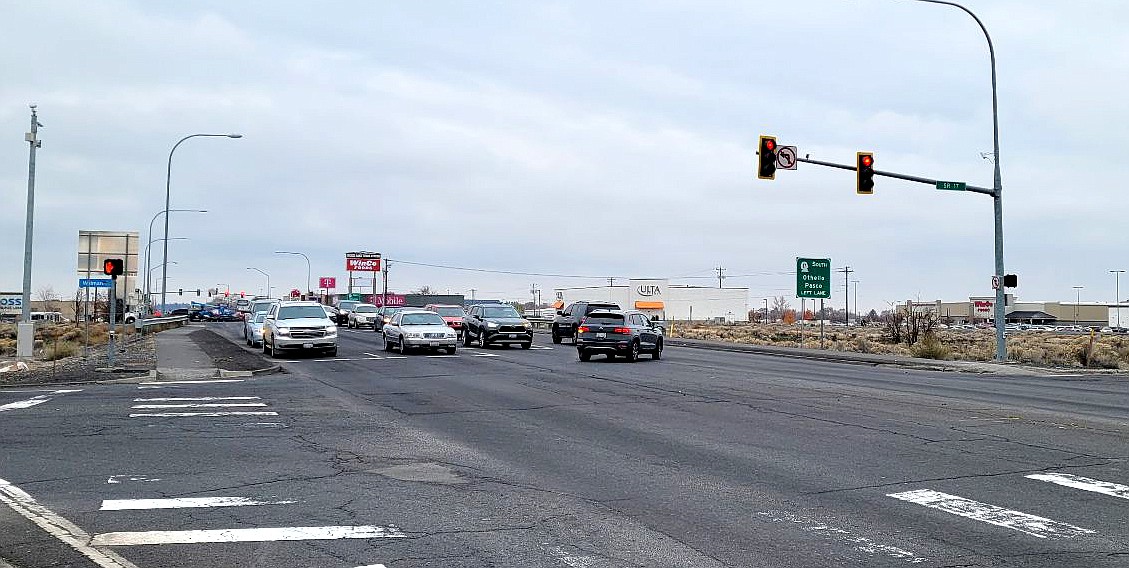
The city of Moses Lake will look for ways to make crossing SR 17 at Stratford Road safer through a grant from the Washington State Department of Transportation.
R. HANS MILLER/COLUMBIA BASIN HERALD
Joel Martin has been with the Columbia Basin Herald for more than 25 years in a variety of roles and is the most-tenured employee in the building. Martin is a married father of eight and enjoys spending time with his children and his wife, Christina. He is passionate about the paper’s mission of informing the people of the Columbia Basin because he knows it is important to record the history of the communities the publication serves. | November 15, 2023 7:28 PM
MOSES LAKE — The Moses Lake City Council voted Tuesday to accept a Washington State Department of Transportation grant to study ways to make the overpass at Stratford Road and State Route 17 safer to cross on foot.
The grant, a little over $685,000, will go to design a solution to improve bicyclist and pedestrian crossing on the bridge, according to the WSDOT’s project summary. Moses Lake City Engineer Richard Law told the council that the sidewalk, which is less than three feet wide, is dangerous for pedestrians moving back and forth between the neighborhoods north of the highway and the shopping areas to the south.
“Do we have any idea what the pedestrian traffic is across that bridge?” asked Council Member Judy Madewell.
“It's not that much,” Law said. “Because who would be crazy enough to try to do it? There was a lady that lived in the neighborhood to the north, and I haven't seen her in a while but she was in — I don't know what you'd call it — a jazzy scooter. She would drive in the outside lane to get to the store, because she couldn't get on the sidewalk, and it wasn't wide enough for her scooter anyway. And I have witnessed a mother with a stroller and a little kid in tow, trying to (hold them and walk in single file) on a sidewalk that's only (a few feet) wide right next to all of the cars. So the pedestrian traffic is probably very low. Because who would be crazy enough? You'd have to be pretty desperate to feel safe trying to get back and forth across there.”
The grant isn’t for any actual construction on the bridge, Law said; it’s just to study options and determine what’s feasible. Possible solutions using the existing structure included narrowing the driving lanes and widening the sidewalks, or building an underpass under the highway for pedestrians, or even a hanging sidewalk on the side of the bridge.
“To build a new bridge is very expensive,” Law said. “The most cost-effective thing would be to narrow the lanes and build wider sidewalks. Or, the other option is, you demo one side of the sidewalk, and you build one wide sidewalk on one side and use the existing bridge deck. So if we had to do it with the city of Moses Lake’s money and (go with) the least expensive option, that would probably be the solution.”
Getting the whole project done would be likely to run about $25 million, Law told the council. If the city can show the Department of Transportation that the need exists and can be met, state money could be made available to cover it.
“If we can leverage their money to come up with a great design that will eliminate not only pedestrian barriers but traffic barriers in an area where we know we have problems, and we can make a great pitch to the state and show need, we we can probably leverage a lot of money from the state to make this happen,” Law told the council. “We're not going to pay for it ourselves. We can't, there's just no way to afford that.”
“I've spoken with DOT quite frequently and know some of our reps in the area, and they said exactly what he's saying: those pedestrian-friendly projects they're putting extra money towards. So under that umbrella, we can get that particular area cleaned up.”
A motion to accept the grant passed unanimously.
Joel Martin may be reached via email at [email protected].
ARTICLES BY JOEL MARTIN

Endless battle
Noxious Weed Control Board works to keep invasive plants under control
MOSES LAKE — Some of the nastiest plants in Grant County were the topic of a class led by Jay Johnson, a consultant with the Grant County Noxious Weed Control Board, Tuesday. The Noxious Weed Control Board, as its name would suggest, is tasked with keeping weeds under control in Grant County. That’s not a small job; the board’s website lists 129 species of noxious weeds that are found around Grant County. A noxious weed is defined as an invasive, non-native plant that threatens agricultural crops, local ecosystems or fish and wildlife habitat, according to the Noxious Weed Control Board. Washington state law requires that these weeds be identified and their spread kept to a minimum, if not completely eradicated. “We’re one of those agencies a lot of people don’t really understand,” Johnson said. “We’re a county office and … our funding is tax-based assessment. When you get your tax bill and you look down at all the expenses that you pay for, there we are.”

BASIN EVENTS: Oct. 16-24
COLUMBIA BASIN — Whether you feel like shopping, crafting, learning or seeing a show, there’s something happening for you this week in the Basin. Oct. 16 ‘My Family (Mi Familia)’ screening Spanning three generations, “My Family (Mi Familia)” is a heartfelt drama that follows the Sánchez family as they build their lives in East Los Angeles. Through love, hardship, triumph, and sacrifice, the film explores the immigrant experience, the strength of family bonds, and the traditions that connect one generation to the next. Lowrider show and taco truck before the screening. Sponsored by Columbia Basin Allied Arts, EDUBS C/S and the Moses Lake Creative District. $12 per person. Doors open at 6 p.m., film begins at 7 p.m. at the Moses Lake Civic Center Auditorium, 401 S. Balsam St. Tickets and info: www.cba-arts.org.

Moses Lake author encourages women to look beyond church culture norms
MOSES LAKE — A Moses Lake author’s book, “A Christian Woman Striving to Live Her Faith in a Man-Controlled World,” takes aim at the role to which many churches relegate the female half of their congregations. “It’s to encourage women in the faith,” Linda Curran said. “A lot of churches say, ‘Teach Sunday school, do this, do that, but don’t (evangelize.)’" In her book, Curran recounts a time when she moved to a new community and joined a church there. She was surprised to learn that, as a new female member, she had been automatically assigned church cleaning duties. When she questioned it, she wrote, she was met with condescension and her objections were brushed aside. In other churches, she said, women who were capable of teaching were relegated to “women’s ministry.”