
Governor seeks input from local Habitat for Humanity chapter
JOEL MARTIN | Hagadone News Network | UPDATED 2 years, 10 months AGO
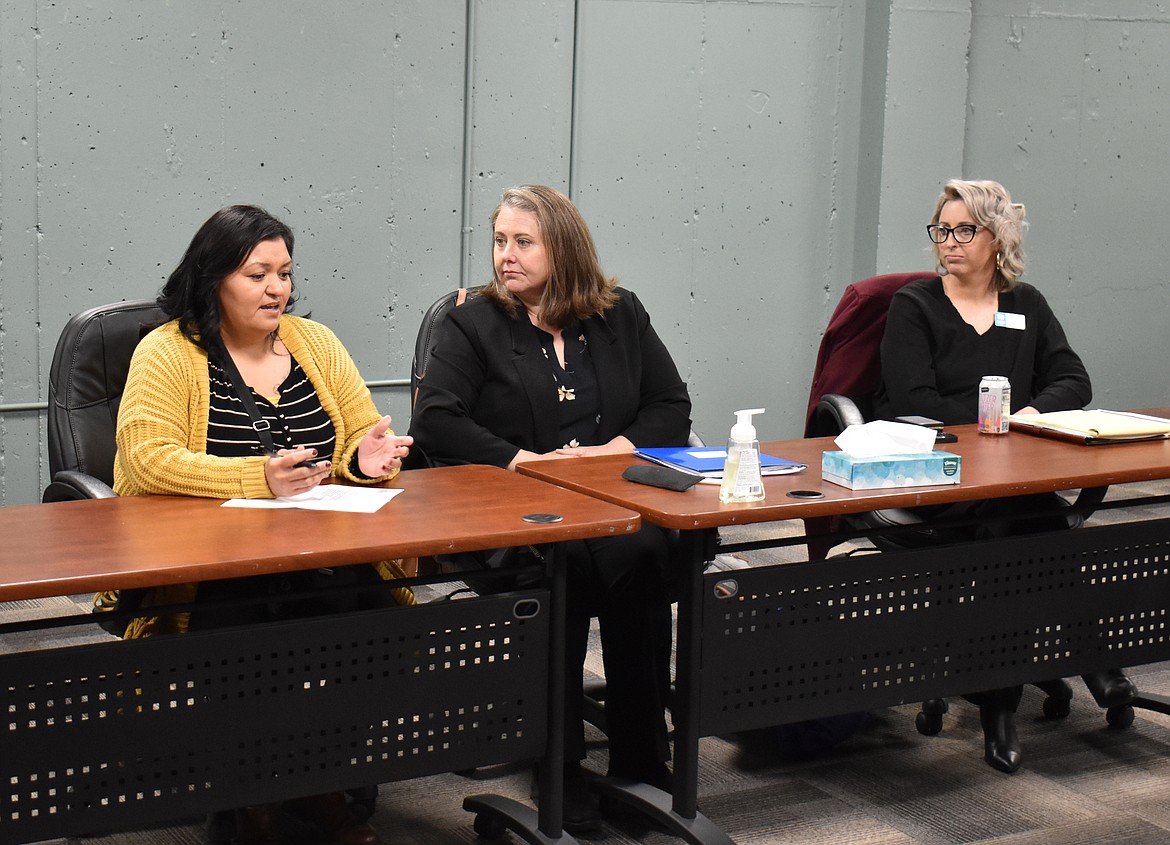
Alexandra Colin, left, of Moses Lake tells the story of her family’s move into a Habitat for Humanity home at Wednesday’s round table meeting with Gov. Jay Inslee.
JOEL MARTIN/COLUMBIA BASIN HERALD
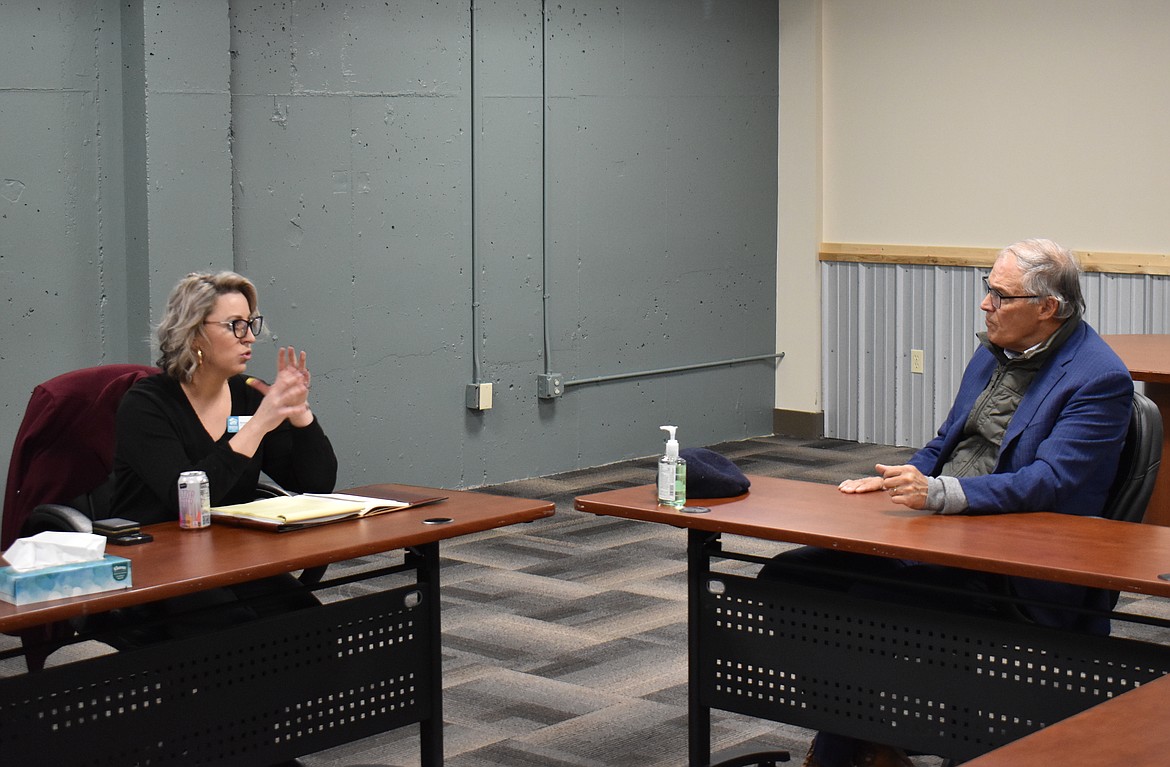
Washington Gov. Jay Inslee, right, listens as Habitat for Humanity Spokane CEO Michelle Girardot tells him about two homes Habitat recently completed made primarily from concrete.
Joel Martin has been with the Columbia Basin Herald for more than 25 years in a variety of roles and is the most-tenured employee in the building. Martin is a married father of eight and enjoys spending time with his children and his wife, Christina. He is passionate about the paper’s mission of informing the people of the Columbia Basin because he knows it is important to record the history of the communities the publication serves. | November 29, 2023 6:24 PM
MOSES LAKE — Construction costs and energy efficiency were among the topics of a round table discussion between Washington Gov. Jay Inslee and representatives of Habitat for Humanity in Moses Lake on Wednesday.
“We know we've got a housing shortage,” Inslee said. “And I want to ask your advice on the best way to build housing in the state of Washington. Fundamentally, we have a shortage of dwelling units. Habitat has been such an incredible and efficient help, leveraging volunteer hours; it's so successful the way you do it. But we need we need the public investment with dollars as well.”
Inslee made frequent reference to the Climate Commitment Act, which he signed into law in 2021 and includes provisions to encourage electric vehicle use and lower energy consumption. The law has not been universally popular; a petition was filed last week to create a ballot initiative to repeal the CCA.
Kelly Price, sales manager for Guild Mortgage who works closely with Habitat for Humanity of Greater Moses Lake, said those provisions have raised the cost of building a new home by at least $15,000. The regulations may be a benefit in some parts of the state, she said, but Grant County is not one of them.
“In some counties, I can see the pipe dream ... that these improvements will help save in the long run. For people that are with Habitat for Humanity and people that we're building homes for, they can't afford electric vehicles. We’re very fortunate; Grant County has some of the lowest energy costs in the nation. So the things that are required ... for example, the electric vehicle plug that's now required with the new construction homes. When you do that, the hard part is that upfront investment because the builders are not absorbing that. Habitat for Humanity can't absorb that. That gets passed on to the consumer.”
“That’s why the Climate Commitment Act is so important because it's created a fund to help families like that to afford these types of investments,” Inslee said. “That's why it's been so successful; we've got a billion and a half dollars in this fund that can help people get access to these new energy efficiency improvements.”
Michelle Girardot, CEO of Habitat for Humanity Spokane, said her organization had recently completed two homes built primarily from concrete, which she said improved energy efficiency, made the construction process simpler and increased safety as well.
“I guess the most fun way to describe it is like building with Legos,” Girardot said. “We take these foam forms and we stack all on top of each other. That essentially creates the exterior of the home. And then we pour the concrete into these forms. So instead of many, many weeks or possibly months to complete a home with volunteer labor, it decreases that schedule significantly. The other part of that is fire season. The world is changing, especially for our more rural communities. Many of our community members may be living in prefab units that are going to be much more susceptible to wildfires. These are non-combustible, so not only do they decrease the cost of your energy efficiency aspects, but also your asset will be more effective.”
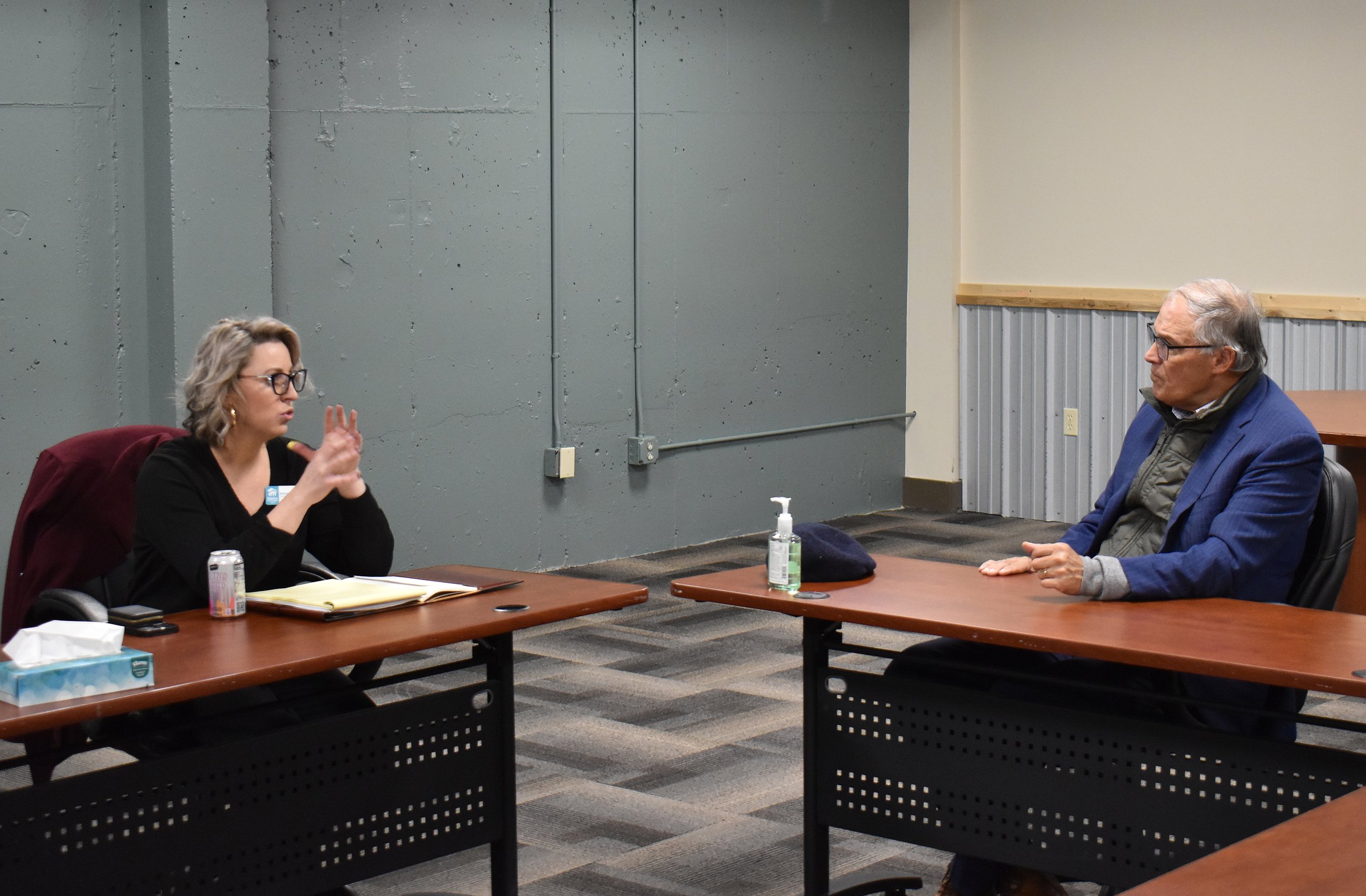 Washington Gov. Jay Inslee, right, listens as Habitat for Humanity Spokane CEO Michelle Girardot tells him about two homes Habitat recently completed made primarily from concrete.
“Are they cheaper to insure?” Price asked.
“yeah, the house is non-combustible, so you get a significant discount on your homeowner’s (insurance) for that,” replied Robin Moore, president of Habitat for Humanity of Greater Moses Lake and an agent with Basin Pacific Insurance. “The downside is, typically the cost overall is a little more expensive, so your replacement costs might be a little bit higher.”
Alexandra Colin, whose family received Habitat for Humanity’s 13th home in Moses Lake, had nothing but praise for the organization.
“Habitat was a blessing,” Colin said. “It was the perfect timing. It's God's timing. I had gotten laid off, and I didn't know how I was going to pay my mortgage. Right after I got laid off, my mom got diagnosed with (cancer). I was a single mom with three kids. So I didn't know what I was going to do.”
Colin heard about Habitat for Humanity and applied, and was approved a few months later, she said. She and her family moved in eight years ago, she added.
“It's just awesome,” she said. “It's awesome for my kids to actually have their own room, because we lived in a two-bedroom with my mom and my three kids and myself. So this program has been amazing. I thank you.”
“Thanks for sharing your story,” Inslee said. “Good, good news. We want more families to have your success.”
Joel Martin may be reached via email at [email protected].
ARTICLES BY JOEL MARTIN

Endless battle
Noxious Weed Control Board works to keep invasive plants under control
MOSES LAKE — Some of the nastiest plants in Grant County were the topic of a class led by Jay Johnson, a consultant with the Grant County Noxious Weed Control Board, Tuesday. The Noxious Weed Control Board, as its name would suggest, is tasked with keeping weeds under control in Grant County. That’s not a small job; the board’s website lists 129 species of noxious weeds that are found around Grant County. A noxious weed is defined as an invasive, non-native plant that threatens agricultural crops, local ecosystems or fish and wildlife habitat, according to the Noxious Weed Control Board. Washington state law requires that these weeds be identified and their spread kept to a minimum, if not completely eradicated. “We’re one of those agencies a lot of people don’t really understand,” Johnson said. “We’re a county office and … our funding is tax-based assessment. When you get your tax bill and you look down at all the expenses that you pay for, there we are.”

BASIN EVENTS: Oct. 16-24
COLUMBIA BASIN — Whether you feel like shopping, crafting, learning or seeing a show, there’s something happening for you this week in the Basin. Oct. 16 ‘My Family (Mi Familia)’ screening Spanning three generations, “My Family (Mi Familia)” is a heartfelt drama that follows the Sánchez family as they build their lives in East Los Angeles. Through love, hardship, triumph, and sacrifice, the film explores the immigrant experience, the strength of family bonds, and the traditions that connect one generation to the next. Lowrider show and taco truck before the screening. Sponsored by Columbia Basin Allied Arts, EDUBS C/S and the Moses Lake Creative District. $12 per person. Doors open at 6 p.m., film begins at 7 p.m. at the Moses Lake Civic Center Auditorium, 401 S. Balsam St. Tickets and info: www.cba-arts.org.

Moses Lake author encourages women to look beyond church culture norms
MOSES LAKE — A Moses Lake author’s book, “A Christian Woman Striving to Live Her Faith in a Man-Controlled World,” takes aim at the role to which many churches relegate the female half of their congregations. “It’s to encourage women in the faith,” Linda Curran said. “A lot of churches say, ‘Teach Sunday school, do this, do that, but don’t (evangelize.)’" In her book, Curran recounts a time when she moved to a new community and joined a church there. She was surprised to learn that, as a new female member, she had been automatically assigned church cleaning duties. When she questioned it, she wrote, she was met with condescension and her objections were brushed aside. In other churches, she said, women who were capable of teaching were relegated to “women’s ministry.”